Roundup
ROUNDUP
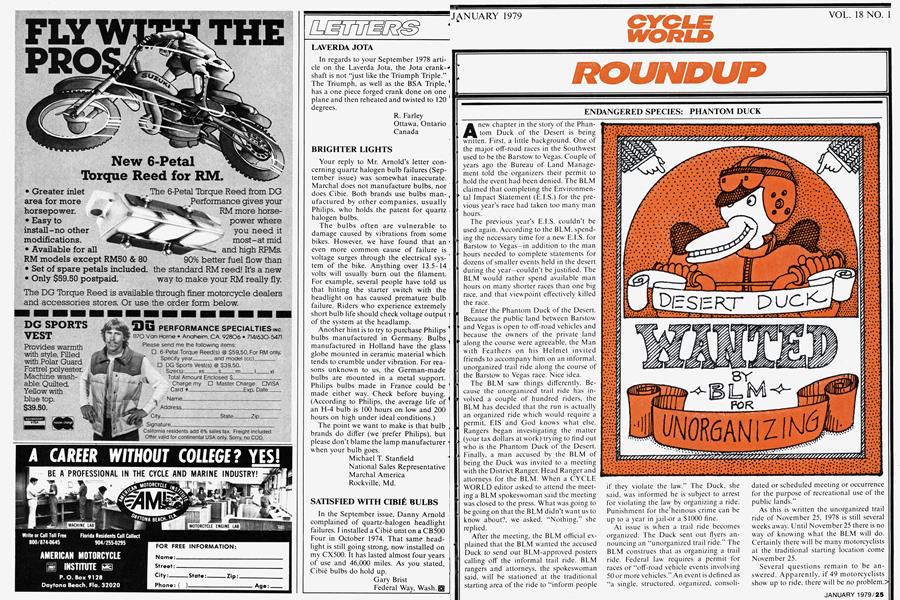
ENDANGERED SPECIES: PHANTOM DUCK
A new chapter in the story of the Phantom Duck of the Desert is being written. First, a little background. One of the major off-road races in the Southwest used to be the Barstow to Vegas. Couple of years ago the Bureau of Land Management told the organizers their permit to hold the event had been denied. The BLM claimed that completing the Environmental Impact Statement (E.I.S.) for the previous year’s race had taken too many man hours.
The previous year’s E.I.S. couldn’t be used again. According to the BLM, spending the necessary time for a new E.I.S. for Barstow to Vegas—in addition to the man hours needed to complete statements for dozens of smaller events held in the desert during the year—couldn’t be justified. The BLM would rather spend available man hours on many shorter races than one big race, and that viewpoint effectively killed the race.
Enter the Phantom Duck of the Desert. Because the public land between Barstow and Vegas is open to off-road vehicles and because the owners of the private land along the course were agreeable, the Man with Feathers on his Helmet invited friends to accompany him on an informal, unorganized trail ride along the course of the Barstow to Vegas race. Nice idea.
The BLM saw things differently. Because the unorganized trail ride has involved a couple of hundred riders, the BLM has decided that the run is actually an organized ride which would require a permit, EIS and God knows what else. Rangers began investigating the matter (your tax dollars at work) trying to find out who is the Phantom Duck of the Desert. Finally, a man accused by the BLM of being the Duck was invited to a meeting with the District Ranger, Head Ranger and attorneys for the BLM. When a CYCLE WORLD editor asked to attend the meeting a BLM spokeswoman said the meeting was closed to the press. What was going to be going on that the BLM didn’t want us to know about?, we asked. “Nothing,” she replied.
After the meeting, the BLM official explained that the BLM wanted the accused Duck to send out BLM-approved posters calling off the informal trail ride. BLM rangers and attorneys, the spokeswoman said, will be stationed at the traditional starting area of the ride to “inform people if they violate the law.” The Duck, she said, was informed he is subject to arrest for violating the law by organizing a ride. Punishment for the'heinous crime can be up to a year in jail-or a $1000 fine.
At issue is when a trail ride becomes organized. The Duck sent out flyers announcing an “unorganized trail ride.” The BLM construes that as organizing a trail ride. Federal law requires a permit for races or “off-road vehicle events involving 50 or more vehicles.” An event is defined as “a single, structured, organized, consolidated or scheduled meeting or occurrence for the purpose of recreational use of the public lands.”
As this is written the unorganized trail ride of November 25, 1978 is still several weeks away. Until November 25 there is no way of knowing what the BLM will do. Certainly there will be many motorcyclists at the traditional starting location come November 25.
Several questions remain to be answered. Apparently, if 49 motorcyclists show up to ride, there will be no problems
But if 50 show up, who is violating the law? Is the 50th person in violation or are all 50 violating the law? How can 50 or more people ride motorcycles in one area and not have an event, as defined by federal law? And what about the permits? How can a person find out what is required to get a permit issued? The rules and regula tions which require permits for events don't require the ranger to issue permits if `he doesn't want to.
GAS PAINS
While emergency gas rationing plans may not sound important, they could spell doom for motorcyclists in the future. The Energy and Economic Regulatory Administration (EERA) has proposed a gasoline rationing plan which would allocate gas to registered motor vehicles. Only motorcycles would be allocated onetenth the amount of gas automobiles would be allocated.
The thinking (or lack of it) at EERA is that a motorcycle uses one-fifth the gas a car uses and is driven half as much. There is no provision for allocating fuel to unlicensed motorcycles.
Because the plan would allocate gas to vehicles, not drivers, a person who has a motorcycle and a car would be able to use gasoline rationed to his car in his motorcycle. Also, the ration coupons could be sold legally.
The AMA has filed an official protest and included information to justify giving motorcycles one-fifth as much gasoline as automobiles would be allowed. Before the plan could be put into effect it would have to be approved by both houses of Congress and could only be implemented in a state of national emergency. Then again, the 55 mph speed limit was supposed to be temporary, too.
ROAD BOMBER
O ne of the more interesting endurance racers entered in the Suzuka eight hour endurance race was an XT500 Ya maha-based special nicknamed Road Bomber. While details on the Thumper weren't available, the bike apparently has a special frame and suspension. The single front disc brake is from a Honda 400F. Normal spoked wheels and street tires are used. Most impressive were the results. The Yamaha came in 8th, beating the first CBX by three places and three laps with riders Yamada and Ishii aboard.
ITALOPHILES TAKE NOTE
T hree new models from Moto Guzzi have been introduced recently. Newest of the three is the V50, a 490cc V-Twin shaft drive cycle designed along the same lines as the larger V-Twin Moto Guzzis but
with an all-new frame. Moto Guzzi claims a weight of 330 lb. for the V50 and horse power of 41.5 at 7500 rpm. The engine is highly oversquare at 74x57mm bore and stroke. Compression ratio is 10.8 to 1. >
Unlike Honda’s V-Twin 500, the Moto Guzzi is a 90° vee. The head is shaped to keep the engine as narrow as possible.
The other new models are the 1000 SP and V1000 G5. Both share the lOOOcc VTwin engine now used in the 1000 IConvert but with a 5-speed transmission.
The G5 comes equipped with saddlebags while the sporting SP has an integral fair ing similar to the BMW R100RS but not the same shape. All Moto Guzzis share the integrated triple disc braking system first introduced by Moto Guzzi in 1976.
TWO-STROKE FANS BEWARE
In California there’s currently a plan being considered by the state Air Resources Board which would apply the same pollution regulations now in force for street bikes to off-road bikes. That’s only one of 125 anti-pollution proposals in the plan drafted by the South Coast Air Quality Management District and the Southern California Association of Governments.
Although regulations for motorcycles in California wouldn’t necessarily affect motorcycles sold elsewhere, the size of the market in California could mean all motorcycles would meet California standards. Adopting street bike pollution rules for dirt bikes won’t in itself prohibit twostrokes. Both Yamaha and Suzuki produce two-stroke on-off road bikes which meet the regulations. But both have oil injection as does Yamaha’s RD400. The regulations would likely increase weight and decrease power on two-stroke off-road bikes if approved by the state Legislature. 13