Husqvarna Or390
HUSQVARNA OR390
CYCLE WORLD TEST
The Desert King Gets a New Frame and Longer Legs.
Last year Husqvarna introduced a new model called the OR. The OR was basically the MX with a 3-gal. tank, Curnutt shocks, 86dB(A) pipe. a less steep steering head angle and a transmission that contained wide ratio gears for first, second and third and close ratio fourth, fifth and sixth. This model was close to what desert stars Larry Roesler and Jack Johnson developed for the Nevada and California deserts, and Baja racing. The model also proved perfect for enduros and general play riding in many areas.
The OR became an instant success and ^demand exceeded availability until late in the year when a special shipment arrived from Sweden.
Historically Husqvarna has introduced its newest engineering marvels on the MX bikes. The WRs. etc., alw'ays seemed a year behind; that is, they usually used the forks ^and such from the previous year’s MX line.
Husqvarna has been developing a new frame for a couple of years and the late summer rumor mill said the 1979 CR would utilize the new' frame. Because the OR had proven so popular and noting Husqvarna’s past policy, the OR was expected to be little changed.
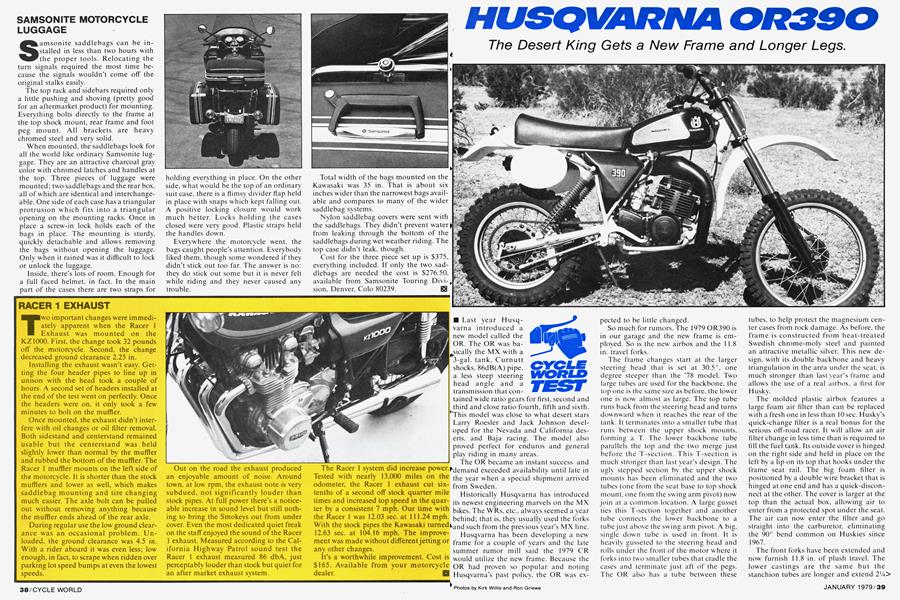
So much for rumors. The 1979 OR390 is in our garage and the new frame is employed. So is the new airbox and the 11.8 in. travel forks.
The frame changes start at the larger steering head that is set at 30.5°, one degree steeper than the '78 model. Two large tubes are used for the backbone, the top one is the same size as before, the lower one is now almost as large. The top tube runs back from the steering head and turns downward when it reaches the rear of the tank. It terminates into a smaller tube that runs between the upper shock mounts, forming a T. The lower backbone tube parallels the top and the two merge just before the T-section. This T-section is much stronger than last year’s design. The ugly stepped section by the upper shock mounts has been eliminated and the two tubes (one from the seat base to top shock mount, one from the sw ing arm pivot) now' join at a common location. A large gusset ties this T-section together and another tube connects the lower backbone to a tube just above the swing arm pivot. A big, single down tube is used in front. It is heavily gusseted to the steering head and rolls under the front of the motor w here it forks into two smaller tubes that cradle the cases and terminate just aft of the pegs. The OR also has a tube between these tubes, to help protect the magnesium center cases from rock damage. As before, the frame is constructed from heat-treated Swedish chrome-moly steel and painted an attractive metallic silver. This new design, with its double backbone and heavy triangulation in the area under the seat, is much stronger than lastvear’s frame and allows the use of a real airbox, a first for Husky.
The molded plastic airbox features a large foam air filter than can be replaced with a fresh one in less than 10 sec. Husky’s quick-change filter is a real bonus for the serious off-road racer. It will allow an air filter change in less time than is required to fill the fuel tank. Its outside cover is hinged on the right side and held in place on the left by a lip on its top that hooks under the frame seat rail. The big foam filter is positioned by a double wire bracket that is hinged at one end and has a quick-disconnect at the other. The cover is larger at the top than the actual box, allowing air to enter from a protected spot under the seat. The air can now' enter the filter and go straight into the carburetor, eliminating the 90° bend common on Huskies since 1967.
The front forks have been extended and now furnish 11.8 in. of plush travel. The lower castings are the same but the stanchion tubes are longer and extend 2‘/4> in. through the top fork clamps. Air valves are furnished and covered by nice molded rubber caps. New oil"seals are employed and nary a drop of oil escaped past them during our long test. Stanchion tube diameter remains 35mm but, with the increased travel, they now look spindly.
A large diameter chrome-moly swing arm from last year is retained but the shock mounts have been moved forward Wi in. and the arm is xh in. wider at the front. Husky is one of the few companies not using a curved arm on their latest offerings. Curved or not. it’s a strong, well made unit.
Gas-charged 17-in. Curnutt shocks al-^ low the rear wheel 11 in. of travel. Curnutt shocks were developed by a Califojrniaj desert rider and perform admirabf^flp desert and open country type terrain. They sport small cooling fins at their tops and a large oil capacity to ward off fading. They are completely rebuildable, and all of the pieces are available individually. Replacement should never be necessary unless an owner prefers a different brand.
The OR’s engine remains mostly the same as the ’78. It is a compact magnesium cased 6-speed, radial head, reed cage, twostroke. It became a production engine in 1975 and has developed into a reliable and powerful unit.
The 6-speed transmission is a combination of WR and CR gears; wide ratios for first, second, third, close ratio for fourth, fifth and sixth. This desert-developed combo makes it possible to poke along at a slow walk on goat trails in first, and still pull strongly in sixth on long sandy grades without a gearing change. This combination of ratios is perfect in many parts of America and has contributed to the instant popularity of the OR models. The OR comes with two extra front sprockets; one smaller, one larger. Woods riders w ill want to install the smaller one, Baja experts the larger, but most other users will probably find the delivered ratio perfect. If a change is desired, it is a simple chore but will require a pair of snap-ring pliers. With the pliers a gearing change can be made in a few minutes.
The drive sprocket/swing arm pivot relationship isn't as close as some of Husky’s competition, but it allows room for extremely talhgearing without a rear sprocket change. It is still much closer than some and employs a novel chain tensioner jplaced just behind the swing arm pivot. It is positioned to remove excess slop on both compression and rebound. The tensioner is a stationary type and doesn't use a spring. Two plastic rub blocks keep the 520 Renold chain from sawing through the metal bracket and a spare set is supplied in the tool kit pouch. A redesigned double roller guide hangs from the swing arm in front of the rear sprocket and keeps the chain aimed at the sprocket.
The new frame made it necessary to reshape the snake pipe and a small heat shield has been added to the rear cones to prevent scorched legs. A big, rebuildable silencer is nicely mounted to the rear frame loop. It emits only 86dB(A) and is off-road legal.
Both front and rear wheels use large spokes and aluminum rims.The rims have a center section that is deeper than a normal wheel, making tire changing easier. The hubs are the same nice conical units used last year. The rear hub was widened slightly last year allowing thé use of wider rear brake shoes. As always, Husky’s rear brake is a full-floating unit that doesn’t chatter or hop when applied hard in down hill whoops and bumps.
Shifting is positive, smooth and precise. Almost no effort is required to change into> a higher or lower gear, but the rider still has enough feel to know the gear change has taken place. Perfect. If the rider stalls the big motor, a search for neutral will be necessary before it can be re-started. Primary kick starting has never been a part of Husky’s package and still isn’t. Husqvarna’s engineering department doesn’t feel the convenience is worth the extra engine weight it would produce. Neutral is easy to find and the rider soon adapts.
The 390 engine is pure pleasure to use. Vibration is slight, powerband wide and horsepower strong. Useable power starts at idle and continues to top rpms. It isn’t fussy, thanks to the high voltage Motoplat ignition. Mikuni carburetor and six-petal reed induction. It is as happy at 3 mph in a rock pile as it is at 90 mph on a Baja road. Gas consumption is low' (for a racing engine) and a 70-80 mile range can be expected from the stock 3 gal. tank.
With a foot of fork travel and 11 inches at the rear, bumps and gullies are crossed as if they were smooth ground. Damping and spring rates are perfect for most riders. People who weigh more than 180 lb. and ride hard will probably want to add a harness-ring pre-load to the shock springs and add 5 psi air pressure to the forks, but most will find it unncessary. Both brakes are progressive and powerful.
Even the standard tires are right for their intended use; A Trelleborg 3.50-21 front, 5.00-17 Barum rear.
The seat measures almost 1 in. longer this year but the basic shape remains unchanged. It’s trim and lets the operator stand without dragging against his thighs, but an all-day, sit-down ride makes one wish for one of the wider pre-1975 seats.
Many small things have received attention. The flimsy brake height adjuster bracket has been redesigned and moved. The adjuster bolt is now located on the back side of the brake pedal and uses the swing arm bolt as a stop. It is harder to adjust initially but is much stronger and doesn’t require frequent adjustment anyway. The well finished 3 gal. gas tank has clear plastic covers on its sides to protect the paint and finish from abrasion. The fuel balance tube (unnecessary and disliked by anyone who ever had to remove the tank) has finally been eliminated on the OR. The attaching bolt for the static arm/rear brake backing plate has been turned around so only the bolt head protrudes, making it less vulnerable in rock areas.
All control cables have large housings with oiler pots and won’t require replacement.
A Gunner Gasser throttle is standard equipment and insures against snagged throttle cables.
Magura dogleg hand levers with mud covers and good grips are furnished.
The shift lever has a spring-loaded, folding end. The lever has a strong shaft and lets the folding end fold without damaging the unit structurally.
A small wire loop welded to the front downtube keeps the clutch cable from being smashed when the forks are at full lock.
Handlebars are rubber mounted and rear-set. This position makes fork maintenance simpler and the rubber mounting isolates vibration.
Rear sprocket bolt size has been increased to 8mm, 8.8 grade hardened items and should eliminate the few isolated cases of breakage.
Once the rider is aboard the tall seat, the Husky feels much like past Huskys, Seat foam is deep, bars are shaped correctly and the foot controls are the right length and placement.
The long, pretzel-shaped kick start lever gives good leverage and lets the operator’s foot clear the peg, but the added suspension makes even the tall rider stretch a little to operate it.
A couple of swift kicks usually brings it to life and warm-up is quick. Clutch pull is a light two-finger operation and the transmission drops into low gear without clanging or clunking. >
The more rigid frame can be noticed immediately. It doesn’t twist or flex on the roughest terrain. Full advantage from the new frame design (better cornering) can’t be fully utilized because of the forks. Damping and spring rates are perfect but the forks aren’t rigid enough. They are only 35mm in diameter and engagement has been shortened to increase travel. The combination allows them to flex and give a vague, unprecise feel to the steering. Larger tubes, (38mm or so) and more engagement, or thicker 35mm tubes and more engagement would give a more positive and precise feel to the bike. After riding the 390 for a few hours most people adapt to the lack of precision and an extremely fast pace can be maintained.
Like Husqvarna’s older models, the new model requires the rider to move around on the bike; on the tank for fast, tight corners, back a little for sand, and lots of body English in between.
The front wheel may be lofted in any gear, at any speed, but it no longer flies itself. Thanks to the longer wheelbase, the rider now has more control and may keep the front wheel on the ground, if so wished. Older models didn’t allow this choice when ridden aggressively.
The increased seat height is truly a nuisance when trying to dab on a sideslope. Even a six-footer will feel clumsy and have trouble touching the ground. Nothing comes free; this is the trade-off necessitated by 12-in. travel forks.
HUSQVARNA
OR390
This Husqvarna built fork has perfect damping and spring rates. Their action is unbelievably smooth. Unfortunately they have only 4~5 in. of engagement, and the stanchion tubes are small (35mm) for the amount of travel they furnish. This combination causes flex and some loss of steering precision.
$2195
The big OR has excellent brakes. They have good feedback, are progressive, and will stop the machine from any speed the engine will propel it.
We took the OR to the desert several times and also used it to pre-run the Parker 400 race course. We returned it with the original plug still in it. Nothing broke or required modification. The OR is a competitive racer or super playbike in stock form. Forget about buying accessories, you won’t need them. The popularity of the ’78 model OR made finding one difficult. We are predicting the 1979 will be even more popular. E9