Honda Cbx
HONDA CBX
CYCLE WORLD TEST
Even in an age of superbikes, nobody could believe it when Honda unveiled the CBX Six late in 1977. More cylinders, more camshafts, more horsepower, more speed, more acceleration, more more. It was the fastest, quickest, flashiest, most head-turning two-wheeled street vehicle ever seen. Just sitting on it sent a chill up a rider’s spine, and the exhaust note prompted experienced pilots to secretly doubt that they’d ever be able to fully master the immense, overwhelming machine.
From the beginning, the CBX aroused strong emotions. The first test bikes were hand-built prototypes. Skeptics said the machines the public would be able to buy would be nothing like the pre-production models delivered for testing. Purists with affection for Singles and Twins were aghast at all those parts^, all that expense and maintenance hassle and weight and overkill just to carry a man from here to there and back again. Joan Claybrook. administrator of the National Highway Traffic Safety Administration, set aside a special barb for the CBX and Honda in a doomsday speech to representatives of the motorcycle industry, denouncing horsepower as evil and completely missing the point of sporting riding.
Horsepower and sporting riding are what the CBX is all about.
When CYCLE WORLD tested a prototype in the April, 1978 issue, we declared the CBX the “fastest bike we've ever tested.” Which it was, howling down the dragstrip in 11.46 seconds with a terminal speed of 117.95 mph.
The production line CBX is finally here.
It’s still the head-turning flash bike it was last year, and it still arouses strong emotions. More significantly, the CBX is still the fastest bike we've ever tested. In fact, it’s even faster than the prototype, streaking down the quarter mile in 11.36 sec. @ 118.11 mph, a full tenth of a second quicker than our first CBX.
The performance improvement may have come from better quality control, because there haven’t been major design changes. The CBX has a 1047cc transverse, air-cooled, dohc, four-valves-per-cylinder Six. A pointless, inductive, transistorized ignition system and an alternator are mounted on a jackshaft behind the cylinders to reduce engine width. As six-cylinder engines go. the CBX powerplant is very narrow, just 40mm wider than the old CB750.
But why a Six? It's true that a Six. compared to an equal displacement Four, can produce more horsepower. With the same bore to stroke ratio, a Six has a shorter stroke than an equal displacement Four, which means piston speeds are reduced which means the engine can turn faster without exceeding maximum safe piston speeds. More rpm. more horsepower. A Six, compared to a Four of the same displacement and bore/stroke ratio, also has greater piston area, which allows larger valves for improved breathing (volumetric efficiency). Better breathing, more horsepower. So a Six could have a horsepower advantage over a Four if tuned for absolute maximum. But considering the state of tune the CBX is in. its intended application and its 9500 rpm redline, those inherent advantages aren’t needed or used. Anybody can buy a new Suzuki GS 1000 or Kawasaki KZ1000. install a set of camshafts, replace the carburetors, bolt on an exhaust pipe and have more power than a stock CBX and save money too.
In real life, however, things aren't that simple. Emissions regulations muddy the designer's pond and must be considered along with piston speed, rpm and horsepower. It isn't the six cylinders alone that gives Honda an advantage in the horsepower war. but perhaps it's the technology attached to this specific Six.
Consider the four-valves-per-cylinder head. Using four valves instead of two means the valves can be smaller and lighter and easier to control, again making higher rpm attainable. Four-valve heads also provide better breathing than twovalve heads. But more important in practical application is the fact that four valves allow a central spark plug location in the combustion chamber, which promotes better flame propagation, more complete burning and more horsepower for a given emissions level. Building a four-cylinder, two-valve street engine which makes as much power as a stock CBX wouldn't be difficult. Building one which makes as much power and has comparable emissions is another story.
But bring a four-valve Four into the picture and the CBX again loses its advantages at the kind of rpm turned on the street and during EPA emissions testing modes. So. for practical street use. the CBX doesn’t hold an inherent advantage related to number of cylinders.
One might think that the Honda engineers built a Six because a six-cylinder engine has better balance than a Four, but the vibration levels reached by a KZ1000 or GS1000 are anything but excessive. Smoothness is relative, and even the CBX Six. which doesn't have the primary vibrations of a Single or Twin nor the secondary vibrations of an inline Four, does buzz slightly through the handlebars and mirrors at certain rpm. due to cyclical vibrations.
Considering the above, the CBX Six really doesn't have any practical, inherent advantage over a Four.
Except one.
Excitement.
A four-valve Four might have as much power, as clean an exhaust, almost as smooth an engine, but it would lack the six glistening head pipes; the massive, attention-riveting engine; the Porsche-like sound; the decal on the tank declaring “Double Overhead Cams, 24 Valves.”
The very fact of being a Six.
One shouldn’t underestimate the emotional appeal of a machine that incites double-takes and looks of awe from other riders and non-motorcyclists alike. It's hard to resist some satisfaction when you pull the CBX up to a stoplight and the guy on the Z-l in the next lane never looks at you. never brings his bike’s rpm past idle in your presence and slowly, ever-so-slow ly slinks away when the light changes, pretending to not see you. doing everything he can to avoid an embarrassing impromptu drag race. You’re riding a CBX, the meanest. most exotic, most expensive street machine you’re likely to meet and that in itself commands respect.
Even though the CBX may be a Six for emotional instead of practical reasons. Honda engineers have gone to great lengths to make the CBX function well. A Six has more parts than a Four, and more parts means more weight. But a sporting motorcycle shouldn't weigh like a tank, so Honda engineers attacked the problem of making the CBX as light as practical. Plastic is used wherever possible, from fenders to seat base to side covers to toolbox. The countershaft cover, oil pump pickup cone, and case protector (which mounts ahead of the countershaft sprocket and shields the crankcase from damage in the event the chain breaks) are made of magnesium. The clutch is aluminum, instead of the conventional aluminum with steel basket.
The mounting plates for the footpegs and control pedals are cast aluminum, as are the footpeg bases (which, although light, cannot be separated from the footpeg rubbers if replacement is needed — when the rubber wears out. the owner must purchase a complete footpeg unit).
The countershaft sprocket and oil pump drive gear are drilled, and the camshafts are hollow. The use of Hy-Vo cam chains, one running from the crankshaft to the exhaust cam. another running from the exhaust cam to the intake cam. is another way of saving weight. That arrangement eliminates many of the guide rollers needed for a conventional full-loop roller chain and makes possible a reduction in front-to-rear cylinder and cylinder head dimensions.
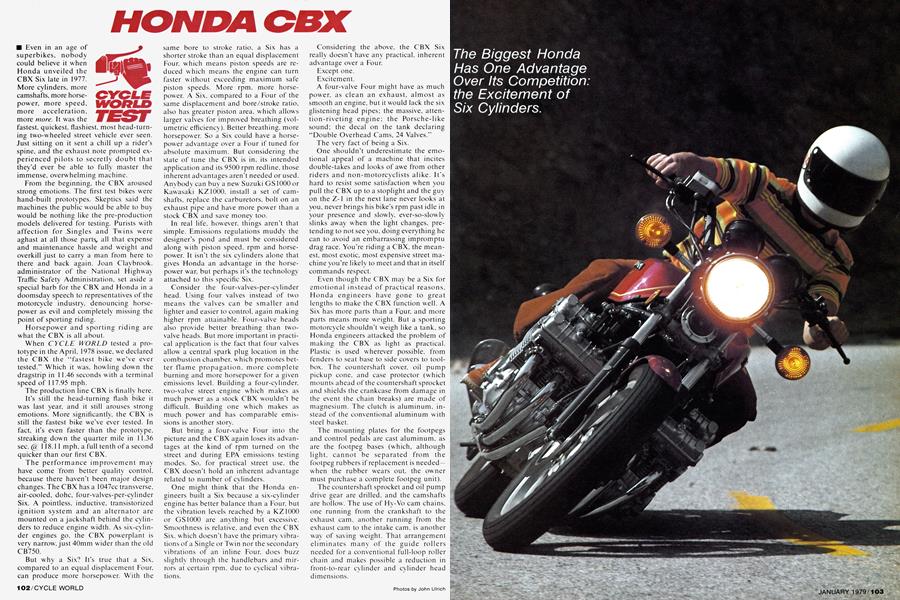
The Biggest Honda Has One Advantage Over Its Competition: the Excitement of Six Cylinders.
The forged aluminum handlebars are sometimes named as being weight savers but. at 4 lb.. 2 oz. for bars and fasteners, are actually a pound heavier than an equivalent conventional handiffe^ and mounting system. All-a!u3MBPi**ComStar wheels are lighter than cast wheels and steel-spoke ComStars. but hold only manufacturing cost and maintenance advantages. not a weight advantage, over conventional wire spoke wheels.
Probably the greatest single weight saving comes from the use of an open-cradle frame, in which the engine becomes a stressed member, eliminating downtubes and bottom frame rails. The CBX engine hangs from the frame backbone at four points, (two wide from the center of the cylinder head, two narrow from the rear of the cylinder head), and is bolted to the swing arm area of the frame in conventional fashion. Whether or not such an open frame can be made rigid enough for good handling under racing conditions with sticky tires is a matter for debate, but the CBX is a street bike and the engineers felt the weight savings justified the frame design.
Great attention was taken to minimizing transverse width as well. Besides the already-mentioned jackshaft mounting of the alternator and ignition, much of the engine's relatively narrow cross-section is the result of extensive thermal studies con ducted during CBX design stages. Con ventional air-cooled engines usually re quire a distance between cylinder bore centers of at least 1.4 times the actual bore. As a result of Honda's research into heat conduction and engine cooling, the en gineers were able to build the CBX with center-to-center bore distances of just 1.2 times actual bore. Water cooling could have further reduced width, but at a weight penalty.
Because it is a Six. the CBX doesn’t require massive crankshaft counterweights for smooth power delivery, and to further reduce width, the outboard counterweights are thinned and trimmed, allowing the ends of the crankcase to be beveled at the point which would normally limit cornering clearance. The result of all the narrowing and beveling—along with appropriate attention to tucking in the exhaust system and stands—is that the CBX can be leaned to 60 degrees from vertical (static and unladen) before anything major enough to threaten a crash begins to drag. The first warnings to the rider that he’s approaching maximum lean are sounded by acorn nuts on the tips of the footpegs, with the sidestand loop soon chiming in on the left side. But even after the pegs drag, there’s plenty of lean angle left before things become serious.
Besides requiring that the engineers address the basic problems of weight and width, the CBX also demanded solutions to smaller dilemmas. For example, because the Six can change rpm very quickly and violently (partly due to little flywheel effect), a clutch drive for the alternator had to be used to avoid damage from sudden acceleration or deceleration.
The design features mentioned apply to both the production line CBX tested here and the pre-production prototype tested in the April 1978 issue. But there have been several changes made between prototype and production status.
The prototype had sand cast engine cases, cylinders and cylinder head, along with a transmission carved out of solid stock by a machinist. The production bike still has a sand cast head, but the cylinders and engine cases are die cast and the transmission gears and shafts are finishmachined from forged blanks. Other alterations include relocation of the tach> drive from the intake camshaft to the exhaust camshaft for easier access and maintenance; the addition of an 8mm bolt at each end of the cylinder head to improve head gasket sealing and eliminate a leakage problem encountered during coldweather-starting tests at -4°; rubber mounting of the countershaft sprocket cover to reduce chain noise; the addition of a magnesium case protector in front of the countershaft sprocket; two more oil collector plates (for a total of six) in front of the intake camshaft (to hold a pool of oil at the cam lobes for start-up lubrication— the oil naturally runs forward to the exhaust cam due to the angle of the engine); reshaped turn signal bodies; restyled speedometer face numbers; one more throttle housing screw' (for a total of three) to prevent housing rotation; and a chain guide fitted on top of the swing arm near the pivot to prevent damage if the chain breaks.
The major difference between prototype and production test bikes is in the gearbox. The prototype transmission clicked into gear so easily and positively and with so little effort that it seemed more like magic than mechanical fact. The bike also had less drive-line snatch than any motorcycle we’ve experienced before or since. The production bike not only had more driveline snatch from accumulated tolerances (although still better than most other machines), the transmission wasn’t remarkable in any way. It clunked into gear sometimes, just like the old CB750 transmission. On occasion it shifted noisily; a few times it stuck in the same gear even after the rider had moved the shift lever for an upshift; several times it jumped out of second gear after an upshift from first (a function of straight-cut engagement dogs, versus back-cut dogs); and at times it missed the second-third shift completely. After the rider adjusted to the production model’s shift lever throw’ and made an effort to shift positively, the CBX’s transmission worked about as well as other production Hondas.
No matter what the theory or the outcome of any prototype versus production argument, what really counts is the performance of the CBX you can buy at the dealer’s showroom.
The sound of the engine is still electrifying. The CBX starts easily when cold and demands varying amounts of choke for one or two minutes, but can be ridden away about 60 seconds after firing up if the choke is used. The bike will leave a stop at almost idle if the clutch is used carefully and will pull smoothly from 1500 rpm to redline in fifth gear. Few people start away from a stop at idle or lug down to 1500 rpm in fifth, but the fact that the CBX will do just that says a lot about the motorcycle’s smooth power delivery. As for vibration, there isn’t much, but it is present at about 4000 rpm, generating a slight buzz through the handlebars and blurring the mirrors slightly.
Serious power kicks in about 4500 rpm and by the time the tach needle passes 6000 rpm the rider better be pointed in whatever direction he wants to go because the CBX is headed there fast. The Six is the hardest-accelerating carbureted stocker ever built, and has enough power to thrill anybody. (If 11.36 in the quarter isn’t enough to warm your heart in these cold days of gutless automobiles and governmental types ranting about too much power, see “Taking it to the Tens” in the November, 1978 issue.)
The CBX. for all its clever weight-saving touches, is a heavy motorcycle. Yet yanking open the throttle at 6000 rpm makes the front end decidedly light, and will loft the wheel in combination with a jerk on the bars or an appropriately shaped and placed bump, dip, or a driveway entrance. So will power-shifting into second. Burning the rear tire for as long a distance as the rider’s tire-budget will allow is no problem-just grab a handful and drop the hammer.
The CBX turns about 4200 rpm at an indicated 65 mph and the speedometer is surprisingly accurate. But cruising at 65 isn’t when the rider needs worry most about tickets. It’s around town, on streets with 35 or 40 or 45 mph speed limits and lots of stoplights, situations wherein the fact that it feels and sounds so good to get a launch and shift through the first few gears may have man and machine traveling at 55 or 65 mph with a squad car in pursuit before the rider realizes how fast he’s going. Don’t laugh: two staff members fell prey to the same scenario, and neither are noted for racking up speeding tickets on test bikes.
Carburetion is perfect except for a slight hesitation noticeable at very low throttle openings near 3500 rpm. To pass EPA emissions standards, the CBX is jetted very. lean in the low-speed carburetor circuits; an accelerator pump feeding all six carbs overcomes the resulting flat spot when the throttle is opened enough to activate the pump.
Waiting through interminable red lights during an in-town traffic jam on a hot day, the rider’s shins are roasted by waves of heat rolling off the cylinders and head. The CBX isn’t a handful to maneuver at low speeds, and actually feels much lighter than it is. The difference in low-speed feel between a CBX and a Gold Wing is substantial.
If the rider blips the throttle at a stoplight when the engine is warm, he’ll often hear a racheting noise from the engine, the sound of the alternator clutch at work.
On the highway, the CBX is smooth and quiet, and fork compliance ranks with the best available on Japanese machines. The FVQ brand shocks absorb small road irregularities well except in the case of the worst and roughest concrete roadway expansion joints, when the rear end sets up a rhythmic front-to-rear rocking motion. At the lowest preload position, the shocks bottomed when one 160-lb. staffer sailed through a rain-draining cross dip built into the road near his home. Set at the secondfrom-maximum preload position, the shocks resisted bottoming from large jolts and still provided enough small bump reaction to suit another, 140-lb. staff member, but still bottomed when ridden twoup. Shock action had degraded significantly after 1500 miles, causing the bike to wallow in fast, sweeping curves and pogo in hard, tighter corners, especially when confronted with pavement irregularities.
Gas mileage varied wildly depending upon use. The CBX turned in 39.2 mpg when run on the official CYCLE WORLD mileage test loop, a mixture of highway, city and expressway riding. City riding with heavy emphasis on brief trips from stoplight-to-stoplight brought mileage down to 28.2 mpg, while the tank which included 35 miles on a road race course and 18 trips down the drag strip mixed *with street use lowered the figure to 26 mpg. A mixture of brisk street riding and Gong stretches of freeway cruising at 65 mph produced 36 mpg with reserve required at 176 miles, so anyone interested in touring the CBX should be able to cover a reasonable distance between fuel stops.
> The CBX’s seat will probably have more of a limiting effect on highway range between stops than gas mileage will. The 5G 1" editor assigned to test the CBX’s highway capabilities was complaining about the seat after just 25 miles, and standing on the footpegs for brief periods by the time 50 miles had been covered. A taller staffer thought the rider’s seat was adequate, but all agreed that the passenger seat lacked comfort.
Handlebar and footpeg position influence a rider’s seating position and can affect perceived seat comfort. The CBX ^cornes standard with American style bars and forward-mounted footpegs to match, Lbuta European-style low-bar-and-rearset-pegs kit is available as an extra cost option for $180. It’s possible that the rider’s section of the CBX seat would seem more comfortable with the optional bars and pegs.
A special tire tread developed for the CBX doesn’t follow rain grooves in the highway, and throttle return spring pressure is light enough to avoid tiring the rider on long trips.
For street use—even sporting street use— the CBX handles and stops well (we already know' it accelerates well for any use). It’s impossible for the rider to ignore the fact that he’s on a large and fast motorcycle, but as in the case of anything, one gets used to it. When the CB750 first came out, some riders worried that they couldn’t handle such a heavy, powerful machine. Now, people think nothing of thrashing a CB750, which as big, powerful bikes go, isn’t noteworthy anymore. The CBX is much the same. It dazzles the rider inexperienced with its charms and capabilities, and creates self doubts. A couple of hundred miles later, a good rider finds himself wringing out and tossing around the CBX as if he grew' up on motorcycles weighing close to 600 pounds and providing 100 horsepower, enjoying the bike as much on trips to the corner market as on journeys down the highway.
At speeds reasonably attainable on the street, the CBX feels much lighter than it is and is surprisingly neutral in handling. Good cornering clearance and smooth power delivery help a rider peel off into a tight turn with confidence and come out the other side without any harrowing occurrences in between. In fast, sweeping turns on the open road, bumps started the CBX wallowing, especially after 1500 miles on the shocks. The brakes seem plenty powerful, but the front discs on our test bike warped, before we had put 1000 miles on the odometer, causing the front brake to pulsate and grab as the bike rolled to a stop under moderate to light brake lever pressure. The problem may be caused by Honda’s high metallic content brake pads, which are designed to work well in wet weather conditions. Honda spokesmen say that discoloration of the discs is normal with the new-compound pads, and the CBX discs did quickly turn dark grey in areas of pad contact. (The pads are also deeply grooved to improve water film dispersion in wet braking situations.) Replacing the discs cured the problem temporarily, but it returned after 100 miles. The condition would be covered under warranty, but we’re not sure of the cure.
Finding the limits of a large street motorcycle is too dangerous on the street. While motorcycle racing can never be classified as safe, the controlled conditions of a road racing track free a rider’s mind from worries over the dangerous variables of fast street riding—pavement conditions, blind turns, unseen hazards, loose dogs, children, pedestrians, traffic, police, etc. It’s also cheap, since a race entry typically costs $20-$25 and testing during an open track day usually costs $ 15—$35.
Racetrack riding is worlds apart from street riding and that’s where the limits of the CBX appeared. The racetrack has no easy part to let the rider and machine loaf. It’s constantly all out, and has a way of pointing out flaws not detectable elsewhere. But it’s important to note that a motorcycle will do things on a racetrack that it won’t do elsewhere, and the things that a racetrack demands are not necessarily the same things required of a good street motorcycle.
The pulsating, grabbing brake problem experienced on the street never even showed up on the racetrack. That’s because the pulsating only showed up at speeds less than 40 mph at moderate lever pressure, and there isn’t any such thing as a moderate-pressure stop.or sub-40-mph speed at Riverside Raceway.
But the front brakes which were adequate and appeared limited only by available tire traction for street use didn’t seem strong enough for hauling the heavy CBX down to cornering speed at the end of faster track sections; and the rear brake, which was slightly touchy at street speeds, became violent and hard to control under the demands placed upon it by racetrack speeds. It was impossible to find the point between lockup and maximum braking in the case of the rear brake, and the rear wheel spent most of its time skittering and skidding at turn entrances.
Setting the shocks up to maximum pre-> load helped, but the CBX still wallowed and wobbled in turns at speeds above 100 mph, and was particularly upset by bumps and road irregularities after a few laps at that speed. The rider had to be very careful with the throttle exiting turns, especially bumpy turns, or else a combination of inadequate shock damping and losing and regaining rear tire traction threatened to send the CBX into tankslappers. Highperformance aftermarket shocks would probably greatly improve CBX handling at speed.
Different shocks, however, couldn’t alter the feel of the CBX at 100 mph or faster— the feel of a larger, wide machine which must be picked up from one side and pushed down to the other in esses. The CBX has enough weight and mass to make the rider work in transitions from straight to turn or from left to right at speed.
But handling at over-the-ton speeds has less bearing on everyday use and practicality than things like control design; instrument readability and night lighting; headlight and taillight brightness. The CBX controls are the best in the industry, big and easy to find and use without looking, all located in the logical place on the bars. The instruments, inspired by the cockpit of a jet fighter, are readable at a glance day or night and odometer and tripmeter lighting is excellent. The quartz iodine headlight is as good as anything found standard on a motorcycle, but given the speed quickly attainable by the CBX, illustrates the need for new technology— and much more power—in motorcycle lighting. The taillight is huge and brilliant with two bulbs and a narrow-step surface. The face of each ridge and depression in the taillight is fully reflective, while light from the bulbs flows out from the sides of the raised sections. It sounds odd, looks great, and functions perfectly.
Even more impressive than the controls and instruments is the centerstand. It used to be that most motorcycle centerstands threatened to give the rider a hernia with each use, and the Gold Wing is still like that. But the CBX, heavy as it is, has one of the easiest-to-deploy centerstands in motorcycle history, not quite as light and quick as the BMW R65’s stand, but better than just about anything else.
There are, of course, drawbacks to every machine, and the CBX has a weak point in maintenance and crashworthiness. Its true that the electronic ignition doesn’t require any attention and that one of the advantages of CV carbs is that they seldom need adjustment. It’s true that every major case and cover on the CBX is secured by 8mm hex head bolts, which don’t strip like Phillips head screws and can’t fill with dirt or grime like Allen head bolts. But the CBX does have 24 valves, and sooner or later they will have to be adjusted.
To make the job less time and money consuming, Honda engineers have sealed the one-piece cam cover with a T-shaped reusable rubber gasket. But to remove the cover, a mechanic must first pull the two outboard engine mount plates, and if a torque wrench isn’t used to reinstall the cover, it’s reasonable to expect that the cover could warp and leak.
Valve adjustment is achieved by replacing shims located on top of the individual valve buckets; cam lobes ride directly on the shims, and shim thickness determines valve lash. The system is simple and reliable, but if adjustment is required, each bucket must be depressed so the shim can be replaced with one of a different thickness.
Honda has taken most of the work out, by designing a special tool which will hold the valve open and thus expose the shim bucket so the shims can be juggled about. The factory is selling the tool to and through dealers, along with careful instructions as to how to keep track of all those valves, the proper sequence, etc. Still, when the job has to be done, it will take time and patience.
(Unexpected note on the Six vs Four discussion earlier. Due to the firing ordet;, and crank layout of the six, and because the intake and exhaust camshafts are actually in two pieces, if you need to remove one section of the camshaft, you can rotate the engine until all six of the valves controlled by that section are fully closed, which means when you remove and replace the cam you can do it without having to compress a valve spring or confuse your torque wrench. Try that on your singlestick Four.)
The CBX drive chain uses small rubber O rings to seal lubricant inside the chain rollers. External plates and contact points with the sprocket must be lubricated as well, but most aerosol chain lubes contain solvents that attack the O ring rubber. Honda recommends that the owner apply 90-weight gear oil every 300 miles. That’s not very convenient, but there is an answer. At least two chain lube manufacturers, Kal-Gard and PJ-1, claim that their prod-* ucts will not damage the O rings. We tried both lubes on our test bike’s chain, with no ill effects.
There is also the question of crash worthiness (a buzz word meaning the ability to survive crashes). A simple slide-out at moderate speed could damage the crankcases, cylinder and cylinder head of a CBX, plus one handlebar, the fuel tank; one muffler, maybe the front brake master cylinder, two turn signals, seat and rear" spoiler. Suggested list price for a set of crankcases is $542.19; cylinders, $349.70; cylinder head, $483.60; handlebars, $80 each (one side). Add more speed or have the bike suddenly grab traction while sliding and flip over to the other side and it’s easy to see why one insurance adjustor said that an average CBX crash would ring up a $2000 repair bill to return everything to unscathed condition.
Of course, an owner who could live with a dented tank or a few fins missing fron\ the cylinder or head could get off more cheaply. Honda has an optional CBX en-gine guard available for $37.95, which may be a worthwhile investment. The best thing is to avoid crashing a CBX at all costs.
There’s a good chance that the man who^ lays down $4000 for a Honda CBX won’t worry much about the practicality or crash worthiness or maintenance demands. If he did, he’d go buy a Suzuki or a Kawasaki or a Yamaha, or maybe a smaller Honda.
The one thing the CBX has over the alternatives is the excitement factor; the sound, the feel, the look of six cylinders,^ which has more to do with its very existence than most people think, and which will probably have more to do with why people buy it than they’ll ever admit.
HONDA
CBX
$3998
Fork compliance is greatly improved on the production-model CBX, compared to the pre-production prototype tested in April, 1978 CYCLE WORLD, without any big-bump reaction penalty. Like the prototype CBX, the production model wallows in high_speed turns, which is partly due to fork spring rates (too soft) and partly due to shock action (see below).
The CBX shocks need. more rebound damping to control the rear end when. accelerating out of turns and to. prevent a serious wallow and wobble in high speed curves, especially bumpy highspeed curves. Not shown on the graph is the fact that the shocks were worn out after iust 1500 test miles, allowing the rear end to pogo in slower turns and contributing to the wallow at speed.