Bmw R32 Salon
BMW R32 Salon
It's Easy to See Why the R32 Started a Trend Which Hasn't Halted to the Present Day
Henry N. Manney III
Despite its slightly musty aura of the backdrop in "Die Walkure" BMW is not one of those firms that traces back its name to the dawn of automotive time but instead came into being as an amalgamation between the Bayerische Flugzeug Werke (headed by Gustav Otto, son of the “Otto-cycle” engine’s inventor) and the neighbouring Bayerische Motoren Werke (formerly Rapp M.W.), this event being in 1917 sometime. As there was a war on and all that, most of BMW’s attention was directed (and continued to be until after WW2) onto aircraft engines and in fact Richtofen’s Jagdstafel were tipped to get the first series of the advanced 6cylinder BMW III-a powerplants in their Fokker D7s. Anyway, the Armistice sort of depressed fighter-engine manufacture so BMW had to look for something else to do, especially since the postwar depression was playing hell with the economy. About this time there was still more corporate maneuvering in which Suddeutsche Bremsen (a brake firm) bought up the whole shebang but in the confusion an engineer named Franz Joseph Popp (Austrian, naturally), who had been the real head of Rapp, bought up all the motorcycle patents, name, and emblem (Bavarian colours on a spinning propellor) of BMW and found himself a place to do business in Munich, in fact an abandoned aircraft engine warehouse.
Motorcycles were nothing new' to BMW as the Rapp Motoren Werke had a history of making proprietary engines for other makes, much as Sachs does today. In times of social upheaval there is always a need for really cheap transportation; thus the first BMW. even if it was called BFW, offering in the early twenties was a 148cc two-stroke with outside flywheel and inclined barrel, called the “Flink”. This must have been built with typical BMW attention to detail as it provided enough capital to generate the flat-Twin M2B15 engine of 486cc (68 x 68mm), four-stroke this time, which was also peddled to a variety of motorcycle manufacturers of which Victoria is the best known. Intended to be slung fore-and-aft in the frame, the M2B15 shared a great many design features with the subject of this article and in fact did so well that BMW brought out its own bike under the name of “Helios.” Contemporary reports indicate that this version left something to be desired so, according to some authorities, the BMW Direktion locked their talented engineer Max Friz (who couldn’t care less about motorcycles) up in a room w ith a fewcases of beer and told him to produce something better.
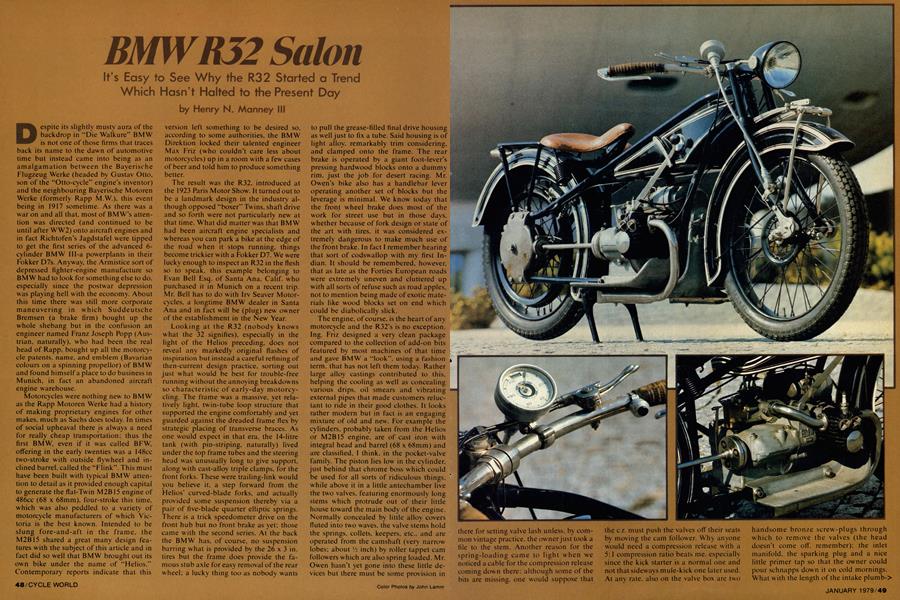
The result was the R32, introduced at the 1923 Paris Motor Show. It turned out to be a landmark design in the industry although opposed “boxer” Twins, shaft drive and so forth were not particularly new at that time. What did matter was that BMW had been aircraft engine specialists and w hereas you can park a bike at the edge of the road when it stops running, things become trickier with a Fokker D7. We were lucky enough to inspect an R32 in the flesh so to speak, this example belonging to Evan Bell Esq. of Santa Ana, Calif, who purchased it in Munich on a recent trip. Mr. Bell has to do with Irv Seaver Motorcycles, a longtime BMW dealer in Santa Ana and in fact will be (plug) new owner of the establishment in the New Year.
Looking at the R32 (nobody knows what the 32 signifies), especially in the light of the Helios preceding, does not reveal any markedly original flashes of inspiration but instead a careful refining of then-current design practice, sorting out just what would be best for trouble-free running without the annoying breakdowns so characteristic of early-day motorcycling. The frame was a massive, yet relatively light, twin-tube loop structure that supported the engine comfortably and yet guarded against the dreaded frame flex by strategic placing of transverse braces. As one would expect in that era, the 14-litre tank (with pin-striping, naturally) lived under the top frame tubes and the steering head was unusually long to give support, along with cast-alloy triple clamps, for the front forks. These were trailing-link would you believe it, a step forward from the Helios' curved-blade forks, and actually provided some suspension thereby via a pair of five-blade quarter elliptic springs. There is a trick speedometer drive on the front hub but no front brake as yet; those came with the second series. At the back the BMW has, of course, no suspension barring what is provided by the 26 x 3 in. tires but the frame does provide the famous stub axle for easy removal of the rear wheel; a lucky thing too as nobody wants to pull the grease-filled final drive housing as well just to fix a tube. Said housing is of light alloy, remarkably trim considering, and clamped onto the frame. The rear brake is operated by a giant foot-lever’s pressing hardwood blocks onto a dummy rim, just the job for desert racing. Mr. Owen’s bike also has a handlebar lever operating another set of blocks but the leverage is minimal. We know today that the front wheel brake does most of the work for street use but in those days, whether because of fork design or state of the art with tires, it was considered extremely dangerous to make much use of the front brake. In fact I remember hearing that sort of codswallop with my first Indian. It should be remembered, however, that as late as the Forties European roads were extremely uneven and cluttered up with all sorts of refuse such as road apples, not to mention being made of exotic materials like wood blocks set on end which could be diabolically slick.
The engine, of course, is the heart of any motorcycle and the R32’s is no exception. Ing. Friz designed a very clean package compared to the collection of add-on bits featured by most machines of that time and gave BMW a “look”, using a fashion term, that has not left them today. Rather large alloy castings contributed to this, helping the cooling as well as concealing various drips, oil smears and vibrating external pipes that made customers reluctant to ride in their good clothes. It looks rather modern but in fact is an engaging mixture of old and new. For example the cylinders, probably taken from the Helios or M2B15 engine, are of cast iron with integral head and barrel (68 x 68mm) and are classified, I think, in the pocket-valve family. The piston lies low in the cylinder, just behind that chrome boss which could be used for all sorts of ridiculous things, while above it in a little antechamber live the two valves, featuring enormously long stems which protrude out of their little house toward the main body of the engine. Normally concealed by little alloy covers fluted into two waves, the valve stems hold the springs, collets, keepers, etc., and are operated from the camshaft (very narrow lobes; about Vi inch) by roller tappet cam followers which are also spring loaded. Mr. Owen hasn’t yet gone into these little devices but there must be some provision in there for setting valve lash unless, by com mon vintage practice. the ownerjust took a file to the stem. Another reason for the spring-loading came to light when we noticed a cable for the compression release coming down there: although some of the bits are missing. one would suppose that the c.r. must push the valves off their seats by moving the cam lollower. Why anyone would need a compression release with a 5: 1 compression ratio beats me. especially since the kick starter is a normal one and not that sideways mule-kick one later used. At an~ rate. also on the valve box are two
handsome bronze screw-plugs through which to remove the valves (the head doesn't come off. remember): the inlet manifold, the sparking plug and a nice little primer tap so that the owner could pour schnapps down it on cold mornings. What with the length of the intake plumb-: ing. the R32 must have been a bear to start on those damp German winter days.
Further into the engine, we find tubular, welded-up, aircraft type rods with plain bearings (the R32 had full-flow pressure lubrication) plus the biggest castellated rod nuts you ever saw and as you would expect, a sizeable crankshaft. The flattopped pistons are worth a glance as they resemble some aircraft ones I have seen by being enormously long, boast three rings at the top plus one at the bottom that has holes under it, and unlike today's slipper pistons show five wide grooves, about Vs in. deep I suppose. spaced out between the top and bottom sets of rings on the body of the piston. Rings by those days were fairly sophisticated. at least the parts book shows both compression and oil rings, but the grooves may be an effort to cut down on piston slap or perhaps (aha!) to control undue expansion under hard slogging conditions. We assume that the piston was alloy.
Gearboxes designed in common with the engine were nothing new in those days but pretty rare just the same, as most of the manufacturers preferred to buy their gearboxes “out”. Anyway the R32’s has three speeds (1st, 1:10.03; 2nd, 1:6.64; 3rd, 1:4.75) operated by hand shift through a gate on the tank and even as on today’s BMWs, was declutched by a sizeable cartype disc and ran the spindly drive-shaft back to a final drive of 1:4.4 for the solos or 1:5.36 for the Seitenwagen. Most photographs show a “Hardy” or flexible coupling at the forward end of the drive shaft (bigger on Series 2) but Mr. Owen’s doesn’t have one. His R32 is a very early example, No. 41 in fact, so it is possible that the cush drive didn’t get fitted till later or, alternatively, that parts were unavailable and a solid drive shaft was turned up. You just don’t know with old bikes. With the engine producing 8.5 PS (however that works out) at 3300 for the first series, perhaps the cush drive wasn’t really needed.
Electrics (yes, Virginia) were looked after by a magdyno living on top and driven by gears, I think, up the front of the crankcase. Rectification for the wondrous headlight on its graceful metal arms is taken care of by a series of carbon piles and attention to detail is shown by about nine click-stop positions for the headlight at its side mountings. You turn it on by the switch at the back. Equally wondrous or even more so is the carburettor, which not only draws its air from the clutch cavity through a screen but has no fewer than two barrel-type slides, one behind the other. BMW themselves made this device and it looks very aircraft to me. Operated by two neat little wood-tipped alloy levers on the cowhorn handlebars, one of the slides must be for air and the other one for fuel, with the added complication of a sort of tapered tornmybar with various sized holes in the end that fits into a tapered sheath in the float bowl, said sheath having a pipe leading upwards into the air intake. Perhaps that was some sort of elementary choke or ricfiener as there is a clip to hold it in the “running” position. Threaded passages at the back of the carburettor body accept the intake pipes and the best of luck. Just be happy with your Mikuni.
Looking backwards at the early motorcycles, vibrating and dripping oil and shaking bits off right and left, it is easy to see why the R32 started a trend which hasn’t halted to the present day. The first R32s were raced and improved, the present RIOOs are raced and improved. As Harley would probably say, why change something just because it works? S3