Sachs Hercules Gs250 Enduro
SACHS HERCULES GS250 ENDURO
CYCLE WORLD TEST
Seven Speeds, Super Handling and Good Value for the Money
If you’ve been following off-road racing for a few years, the name Sachs will bring back memories of heavily built 100cc and 125cc German motorcycles with strange looking leading-link forks, cylinders with extra large fins, bullet-proof engines and, perhaps the most vivid memory of all, neutrals between each gear. The shifting mechanisms had so many small parts that proper adjustment required a dial indicator and, even properly adjusted, their shifting was best described as marginal.
Why, you ask, would anyone put up with such a motorcycle? Easy. The engines were unbreakable. More important, the bike handled better than almost anything else built at the time. The strange front end used a pair of shocks to control frontwheel travel and in downhills the front of the bike would actually rise when either the front brake or the throttle was applied. This unusual characteristic led many riders to claim that these creatures were the fastest motorcycles made . . . downhill.
The odd-but-efficient forks also helped to make the bike one of the ugliest around. Model after model was introduced without much improvement in shifting quality or cosmetic appeal, an approach that worked OK when the small dirt bike field was thin. Then came the Japanese and before long Japan was producing small motorcycles that handled badly but had powerful engines and transmissions that anyone could shift. Sachs (later called DKW) responded by offering conventional forks as an option, but basically the bikes stayed the same, which resulted in both the name and dealer network gradually fading into obscurity. Unless you’ve been into dirt motorcycles for at least three years, chances are you’ve never even heard of a Sachs.
What’s this? A brochure from the U.S. branch of Sachs Motors Corporation telling about a new line of motorcycles called Hercules. Available in enduro models with 125-, 175-, 250and 350cc engines and 7speed transmissions, it says here. Hmm.
Sachs USA had just received a shipment of new 250 Enduros. We hoped to land a 350, but the 250 (which is 245cc) turned out to be the best choice. The bigger engine is only 255cc; the larger engine
being just enough to make it legal for the open class.
When the bike arrived a few days later, we weren’t astonished, because we’d been looking at the pictures in the Sachs literature. But we still weren’t quite prepared for the snappy-looking machine that rolled off the truck. Ugly is out and good looking is in at Sachs. The beauty goes deeper than the striking red, silver, white and black color scheme. Everything on this Sachs is new; there’s not a single item to bring to mind the DKW of yesteryear. The more we probed beneath the surface, the more interesting items we discovered, enough to warrant a separate examination of the allnew Sachs engine. Results of our teardown are detailed elsewhere on these pages. Then we turned to the 7-speed transmission, which is about as rare on an enduro bike—or any bike, for that matter—as a set of wings. The new engine uses two transmission shafts and a pair of idler gears to make seven speeds. The wide selection of cogs combines with the engine’s smooth performance to make the Sachs remarkably easy to ride. In fact, we can’t remember when we’ve seen such a combination of docility and performance. The Sachs is not only manageable, it’s also fast.
The new Sachs transmission also embodies one of the bike’s most welcome breaks with the past. The boxful of neutrals that onee characterized these machines has been consigned to history. Although the shifting on our test bike was somewhat stiff at first, it loosened up as the miles rolled by. A definite clunk could be heard and felt during gear changes, but the test riders quickly became accustomed to it. The only shifts anyone missed with it were downshifts from second to first, and that proved to be mostly a matter of technique. If the downshift was not made aggressively, neutral came up.
On the other hand, neutral was easy to find and could be located with the engine running and the motorcycle stationary. This is a handy touch if the steep hill you're getting ready to climb is full of stalled riders and you have to wait your turn.
The Sachs employs a healthy, velvetsmooth multi-plate clutch (see accompanying story for details on this interesting item) that can be operated with one finger. Best of all, when the lever is pulled the clutch disengages completely and doesn't creep or grab. The clutch and 7-speed gearbox transmit power to the rear wheel via a #530 drive chain, an item that’s in keeping with the generally rock-ribbed character of this bike. Same goes for the nylon routing block that keeps the chain properly aligned. When the new horizontally split engine cases were designed, the countershaft sprocket was moved rearward as far as possible. The sprocket is thus close to the swing arm pivot and exactly in line with it on a horizontal plane. This means the problems common to most long travel rear suspensions won’t plague the Hercules. With the sprocket and swing arm close together and on the same plane horizontally the chain adjustment doesn’t change radically when the w heel moves up and down.
The kick starter is on the left side, as it is with most European bikes, and primary starting is employed. We like this touch since searching for neutral in the 7-speed box can be frustrating.
In any case not much kicking is required to bring the Sachs to life, thanks to the Motoplat CDI ignition, 36mm Bing carburetor and handlebar-mounted choke lever. The Sachs started so willingly that we caught ourselves wondering what was wrong on thoserare occasions when it failed to light at first kick. The Bing was jetted perfectly and ran as cleanly in a 5 mph trials section as it did at 80 mph. the indicated top speed on the VDO speedometer. We used the speedo’s full travel riding bolt upright on a dirt road in the desert, and that’s fast for a 250 enduro that’s also happy at a slow walk. These speed extremes are both obtainable with
the stock gearing in the neat 7-speed transmission.
The exhaust system is another item that shows careful planning. A stamped pipe goes over the head and through the frame under the seat, exiting just ahead of the left shock. Two hefty pipe mount brackets are used and isolate the pipe from the frame with rubber blocks. The pipe is tucked in nicely and doesn’t burn legs. A large muffler helps keep exhaust noise to an acceptable level. Unfortunately, this device isn’t equipped with a spark arrester, so if the bike is to be used in restricted areas an aftermarket arrester will have to be fitted. Like the exhaust pipe, the muffler is solidly mounted with a heavy bracket and double rubber blocks. It’s strong and well made.
The Hercules has one of the strongest and nicest looking frames going. All parts are chrome-moly steel and big, beefy gussets abound. The steering head gussets extend below' the tank and wrap around the double downtubes in front, where they're welded together. In fact, large gussets are welded on at almost every tube junction. Under the bike a heavy plasticskid plate protects the engine cases and the extension on the front of the plate helps keep the front tire from throw ing mud onto the barrel. All this conspires to make the bike rather heavy, but the aim of the designers was strength and no compromises were allowed if that aim was likely to be adversely afifeeted.
This also goes for the suspension. The chrome-moly sw ing arm is double braced at the front and rides in tapered rollers mounted in double gusset plates on the frame, rather than the arm itself. They're adjustable for wear and have plastie plugs
covering them to keep out various liquids and semi-liquids (read mud). Incidentally, these covers should be glued in place before the bike is used or the brush will likely remove one—as it did on our test bike.
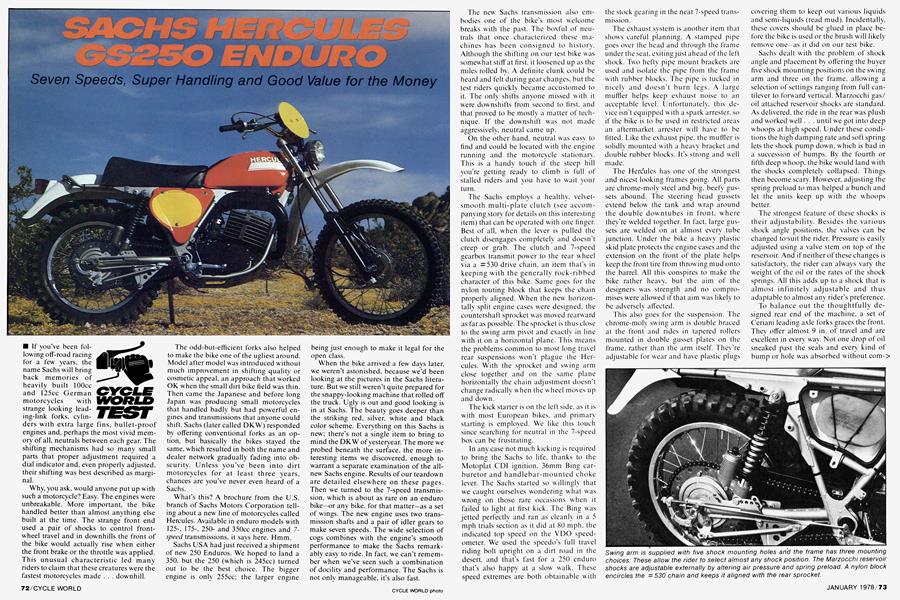
Sachs dealt with the problem of shock angle and placement by offering the buyer five shock mounting positions on the swing arm and three on the frame, allowing a selection of settings ranging from full cantilever to forward vertical. Marzocchi gas/ oil attached reservoir shocks are standard. As delivered, the ride in the rear was plush and worked well. . . until we got into deep whoops at high speed. Under these conditions the high damping rate and soft spring lets the shock pump down, which is bad in a succession of bumps. By the fourth or fifth deep whoop, the bike would land with the shocks completely collapsed. Things then become scary. However, adjusting the spring preload to max helped a bunch and let the units keep up with the whoops better.
The strongest feature of these shocks is their adjustability. Besides the various shock angle positions, the valves can be changed to-suit the rider. Pressure is easily adjusted using a valve stem on top of the reservoir. And if neither of these changes is satisfactory, the rider can always vary the weight of the oil or the rates of the shock springs. All this adds up to a shock that is almost infinitely adjustable and thus adaptable to almost any rider’s preference.
To balance out the thoughtfully designed rear end of the machine, a set of Ceriani leading axle forks graces the front. They offer almost 9 in. of travel and are excellent in every way. Not one drop of oil sneaked past the seals and every kind of bump or hole was absorbed without communicating much jolt to the rider. We couldn’t detect any flex and the 30-degree rake angle and 5 in. of trail made steering accurate and stable at high speeds.
Metzeler tires are standard and proved to be an excellent choice, augmenting the top notch componentry.
Beautiful conical hubs, home-grown by Sachs, are employed at both ends of the bike. Not only do they look good, they cover outstanding brakes; the Hercules’ system is absolutely first rate, offering quick, progressive braking in all conditions. Seems like the word “best” comes into play far too often in describing motorcycles, but nevertheless we think the brakes on this machine are better than those on any dirt motorcycle we’ve ever tested. Stopping power is equal to the Yamaha YZ, but with none of the touchiness associated with that brand. Feedback—and hence control—is good. The rear brake pedal length is just right and the rod connects to the pedal at a common pivot point with the swing arm, which makes for less suspension lockup on bumps. Front and rear brake lining areas are identical and the front brake is particularly powerful without being over sensitive. Both brakes work with a minimum of lever effort and give a good feeling of security.
The Hercules sports Falk plastic fenders that look identical to the ones Maico uses on their WRs. They’re high quality, flexible and keep most of the goo off the rider, although it wouldn’t hurt for the front one to be a few inches longer.
The 7-Speed Sachs: How It Works
When we first received the new Hercules, most of our questions centered around the 7-speed transmission. How does it work? How many gears are in there? We decided to tear it down and find out.
The engine is bolted in the frame with a conventional mount at the rear. A similar mount is cast into the cases at the front but for some reason the frame lacks mounting tabs in front to accommodate it. Two studs protrude from the underside of the cases and go through an oval frame member where self-locking nuts secure them.
Engine removal proved simple and straightforward until it came time to unhook the primary w ires. Although a fistful of plug-in connectors reside to the left rear of the carburetor, the black and blue lead going to the secondary coil didn’t have plug-ins. This gives a choice between removing all the wiring looms or cutting the two wires and adding the necessary connectors. We chose the latter.
After the engine was out, the oil was drained and the engine side covers removed. Although the cases are horizontally split, the Motoplat flywheel and backing plate have to come off. This is because the plate for timing adjustment is connected to both case halves.
On the clutch side, the shift linkage connects to both halves and necessitates clutch removal before this linkage can be taken off.
After the sides are mostly stripped (everything that connects to both halves) 14 nuts have to come off and then the cases are ready to tap apart. The only special tool required to split the cases on the Sachs is a flywheel puller. This may sound time consuming but with the help of an air wrench, total time required to pull the motor, strip the side cases and split the cases was less than one hour.
If only the transmission needs inspection/repair, the cylinder and head need not be removed.
The cases tap apart without much difficulty and what’s this? Only four gears on each shaft? Sure enough. The bottom case half holds the secret to the seven speeds. Nestled in it is a pair of cast-together idler gears, which compound the ratios. By using this method seven speeds are available using only 10 gears; the same amount needed to supply five speeds on a conventional transmission layout.
The lighting is enduro legal, which means you can at least see some sort of glow from the headlamp when it gets really dark—don’t depend on it for real illumination—and a feeble little horn resides on one of the front downtubes. Strangely absent (on what appears to be a motorcycle
designed for rugged six-day-type events) is a center stand. However, Sachs may have regarded this item as unnecessary, since Americans normally end up taking them off anyway. A good side stand is mounted on the left side of the swing arm, a la Husky and KTM.
The brilliant red steel gas tank is rated at 2.9 gal. capacity but 2.2 gal. ran it over starting from dry. It’s bolted to the bike in four places and has two nice petcocks that
click positively into the on, off and reserve positions. Although the tank is nicely shaped and finished, its looks are somewhat marred by four welded-in threaded holes. They’re attaching points for a tool bag that will be available as an option at a later date. This arrangement will certainly make for a solid bag mounting, but it looks bad without the bag.
The seat-handlebar relationship is good, although the bike feels a little deep from> seat to footpegs. The low pegs are especially noticeable in woodsy or rocky terrain, where it's easy to kick a rock or get your foot caught in a tree root. The pegs themselves are excellent—they’re nicely cleated and spring-loaded—but we'd like to see them mounted an inch or so higher.
The engagement system is also unique. Synchronizing rings move on the transmission shafts and slide over six drive pegs on the selected gear. Most makers prefer to slide a driven gear into a freewheeling gear and engage by locking them together. By employing the Sachs method, fewer gears are necessary to produce seven speeds. It also helps keep engine weight low (64 lb. without oil). All the transmission shafts run on roller and ball bearings. First cabin.
The primary drive gears are robust helical cut items that look large enough to handle a 500cc powerplant. Power to the clutch basket is shock mounted, using eight replaceable rubber biscuits. The six clutch plates have driven dogs that are bent at a 90-degree angle, to transmit the load to a much greater surface area. Anyone who’s had to purchase a new clutch basket because of damage from straight dogs will appreciate this bit of trickery.
After inspecting the bottom end operation we removed the head and cylinder to find out what makes the remarkable power. The transfer ports are huge on the crankcase side but not overly large where they enter the barrel. Secondary boost ports are also utilized but look too small. Both exhaust and intake ports are bridged and wide. The exhaust port is also winged and extends over the transfer port. The intake port had been hand aligned where the casting and liner meet but the rest of the ports were untouched. Still more power is available by aligning the rest of the ports by hand if the owner thinks it necessary. The barrel and radial finned head are a whopping 11 in. wide! Nothing will be able to overheat a motor finned like this one. These large fins are braced by casting them together at key points and, as might be expected, fin noise is high. By adding rubber blocks between the fins a lot of this noise can be muffled. A Mahle piston with a Dykes L-style ring is used and the rod top end runs in needle bearings. The rod itself is an adequate size and the crank runs in three large main bearings—two on the primary side.
Everything looks as if it was designed to run a long time. Not one item looks cheap or under designed. The initial price of this bike seems very high but after thoroughly inspecting all its excellent components, we wonder how they can sell it so cheaply.
SACHS HERCULES
$1698
With the stock oil rebound damping is insufficient and allows the forks to occasionally top out. Use heavier fork oil to alleviate this problem. Dual seals produce excessive static friction; gut the top seal and/or switch to aftermarket seals to increase fork compliance.
The Marzocchi shocks worked acceptably in the upright mounting positions, but had excessive rebound damping which caused the bike’s rear to pack. Change the shock’s valving to reduce rebound damping, retaining the stock springs.
Tests performed at Number 1 Products
The seat is superior, with radiused top edges and just the right combination of
width and padding. Seat height is 34‘/2 in., which is low by today’s standards and this also contributes to the bike's wide appeal. Almost anyone can get both feet flat on the ground sitting on the Hercules.
Chrome-moly bars are used in conjunction with Magura Power Levers and a quick-turn Magura throttle. Unfortunately. the hard-style Magura grips are still
employed; guaranteed to put blisters on your hands in the first half-hour. A nice waterproof kill button is mounted sensibly near the end of the left handlebar and lever covers are furnished to keep muck out of the pivots.
It wasn’t long before the indicator needle on the VDO speedo on our bike began leaping around like the Dow Jones during elections. The odometer was worse. Although we used the reset knob several times (until it fell off and got lost) the reset mileage nevertheless surpassed total mileage by test's end. Total mileage: 208 miles; reset mileage: 238 miles. Figure that one.
On our first test ride we went to the high desert, where the bike quickly showed great potential as a desert machine. Lowgear is lowenough for the steepest rock hill and seventh is good for 80 mph-plus on the dry lakes. No one ever knew w hat gear they were in but it didn’t seem to matter. Another gear is always available above or below if the current selection is unsatisfactory. The engine is strong in any gear (even in sand) and speed is limited more by rider ability than by power. Balance is exceptional. The frame and swing arm are the most rigid and flex-free of any bike in memory. The solid geometry mates with the Metzelers to produce an unusual combination of steering precision and highspeed stability. The front end has a tendency to search somewhat at high speeds in sand, but this is pretty much normal on all bikes with leading axle forks and the rider soon learns to disregard it.
We did encounter one recurring problem the first day w ith engine stoppage, and it had us scratching our heads for awhile. After a hard run of a mile or so the motor would die as though the kill button had been pushed. It would re-start readily after a minute or so. We spent a lot of time checking w-iring and such without curing this. Finally, sometime during the 20th diagnostic session, someone heard the gas cap hissing. Aha! The gas cap hadn't leaked a drop but it wasn't venting verv well. We slapped on a Preston Petty aluminum cap and cured the stalls.
From the desert we trucked up the San Bernardino mountains for some pines and water action. Thanks to the Motoplat ignition. good plug cap and snorkel inlet on the excellent plastic airbox (its Phase II foam filter lives behind the right side number plate), not one misfire occurred. The brakes got wet. of course, but good stopping distances required only a little extra pressure on the levers. The bike can be maneuvered at a crawl down creek beds and trials-style riding is easy on it.
But it’s not an instant trials winner. The low engine and peg height caused us some problems by dragging on large rocks and logs, which is the trade-off for the low seat height.
Mileage w'as good. Even with its smallish gas tank (for a cross country/enduro bike) the Sachs went 75-80 miles without running out of gas. That’s excellent fuel efficiency for a 250cc bike with 32 lip.
It isn’t often that we lay hands on a bike that everyone likes, but the Hercules definitely meets this description. It’s not surprising when you think about the package. How often does a new bike employ the absolute best available components attached to a Rock of Gibralter frame and swing arm. an excellent new engine, a 7speed transmission and an operating range from 2 to 80 mph? Rarely. The Hercules is quality from end to end, and if $1698 sounds like a hefty bite for a 250cc enduro, we can't imagine you getting any more for the money. It’s worth it.