New Ideas In Exhaust And Leathers
NEW IDEAS IN EXHAUST AND LEATHERS
J&R COLLECTOR FOR KAWASAKI KZ650
Science, Sweat and Old-Fashioned Faith Put Our Longterm KZ650 into the Twelves
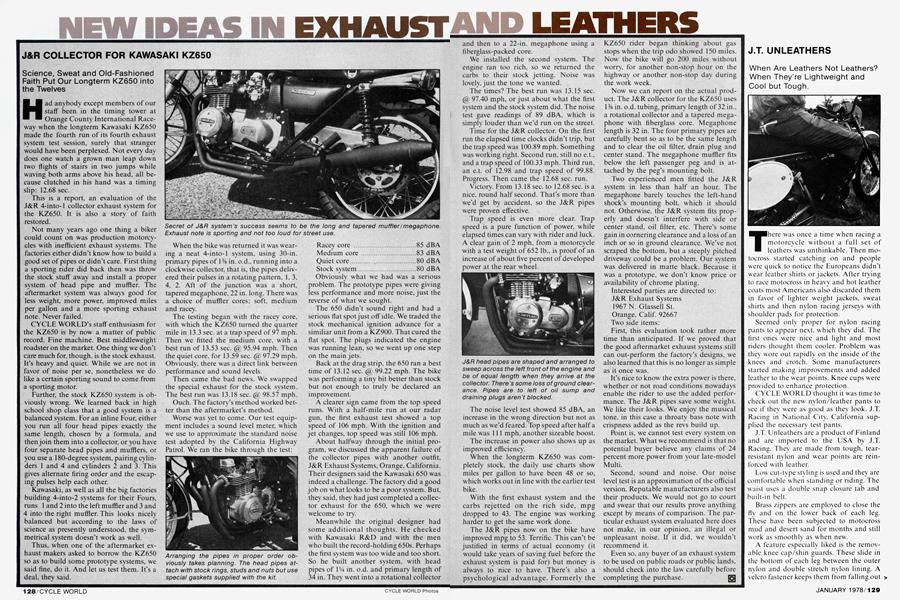
Had anybody except members of our staff been in the timing tower at Orange County International Raceway when the longterm Kawasaki KZ650 made the fourth run of its fourth exhaust system test session, surely that stranger would have been perplexed. Not every day does one watch a grown man leap down two flights of stairs in two jumps while waving both arms above his head, all because clutched in his hand was a timing slip: 12.68 sec.
This is a report, an evaluation of the J&R 4-into-l collector exhaust system for the KZ650. It is also a story of faith restored.
11Not many years ago one thing a biker could count on was production motorcycles with inefficient exhaust systems. The factories either didn’t know how to build a good set of pipes or didn't care. First thing a sporting rider did back then was throw the stock stuff away and install a proper system of head pipe and muffler. The aftermarket system was always good for less weight, more power, improved miles per gallon and a more sporting exhaust note. Never failed.
CYCLE WORLD’S staff enthusiasm for the KZ650 is by now a matter of public record. Fine machine. Best middleweight roadster on the market. One thing we don’t care much for, though, is the stock exhaust. It’s heavy and quiet. While we are not in favor of noise per se, nonetheless we do like a certain sporting sound to come from a sporting motor.
Further, the stock KZ650 system is obviously wrong. We learned back in high school shop class that a good system is a balanced system. For an inline Four, either you run all four head pipes exactly the same length, chosen by a formula, and then join them into a collector, or you have four separate head pipes and mufflers, or you use a 180-degree system, pairing cylinders 1 and 4 and cylinders 2 and 3. This gives alternate firing order and the escaping pulses help each other.
Kawasaki, as well as all the big factories building 4-into-2 systems for their Fours, runs 1 and 2 into the left muffler and 3 and 4 into the right muffler. This looks nicely balanced but according to the laws of science as presently understood, the symmetrical system doesn’t work as well.
Thus, when one of the aftermarket exhaust makers asked to borrow the KZ650 so as to build some prototype systems, we said fine, do it. And let us test them. It’s a deal, they said.
When the bike was returned it was wearing a neat 4-into-l system, using 30-in. primary pipes of 1% in. o.d., running into a clockwise collector, that is, the pipes delivered their pulses in a rotating pattern, 1, 3, 4, 2. Aft of the junction was a short, tapered megaphone, 22 in. long. There was a choice of muffler cores; soft, medium and racey.
The testing began with the racey core, with which the KZ650 turned the quarter mile in 13.3 sec. at a trap speed of 97 mph. Then we fitted the medium core, with a best run of 13.53 sec. @ 95.94 mph. Then the quiet core, for 13.59 sec. @ 97.29 mph. Obviously, there was a direct link between performance and sound levels.
Then came the bad news. We swapped the special exhaust for the stock system. The best run was 13.18 sec. @ 98.57 mph.
Ouch. The factory’s method worked better than the aftermarket’s method.
Worse was yet to come. Our test equipment includes a sound level meter, which we use to approximate the standard noise test adopted by the California Highway Patrol. We ran the bike through the test:
Obviously what we had was a serious problem. The prototype pipes were giving less performance and more noise, just the reverse of what we sought.
The 650 didn’t sound right and had a serious flat spot just off idle. We traded the stock mechanical ignition advance for a similiar unit from a KZ900. That cured the flat spot. The plugs indicated the engine was running lean, so we went up one step on the main jets.
Back at the drag strip, the 650 ran a best time of 13.12 sec. @ 99.22 mph. The bike was performing a tiny bit better than stock but not enough to truly be declared an improvement.
A clearer sign came from the top speed runs. With a half-mile run at our radar gun. the first exhaust test showed a top speed of 106 mph. With the ignition and jet changes, top speed was still 106 mph.
About halfway through the initial program. we discussed the apparent failure of the collector pipes with another outfit, J&R Exhaust Systems, Orange, California. Their designers said the Kawasaki 650 was indeed a challenge. The factory did a good job on what looks to be a poor system. But, they said, they had just completed a collector exhaust for the 650, which we were welcome to try.
Meanwhile the original designer had some additional thoughts. He checked with Kawasaki R&D and with the men who built the record-holding 650s. Perhaps the first system was too wide and too short. So he built another system, with head pipes of VA in. o.d. and primary length of 34 in. They went into a rotational collector and then to a 22-in. megaphone using a fiberglass-packed core.
We installed the second system. The engine ran too rich, so we returned the carbs to their stock jetting. Noise was lovely, just the tone we wanted.
The times? The best run was 13.15 sec. @ 97.40 mph, or just about what the first system and the stock system did. The noise test gave readings of 89 dBA, which is simply louder than we’d run on the street.
Time for the J&R collector. On the first run the elapsed time clocks didn’t trip, but the trap speed was 100.89 mph. Something was working right. Second run, still no e.t., and a trap speed of 100.33 mph. Third run, an e.t. of 12.98 and trap speed of 99.88. Progress. Then came the 12.68 sec. run.
Victory. From 13.18 sec. to 12.68 sec. is a nice, round half second. That’s more than we’d get by accident, so the J&R pipes were proven effective.
Trap speed is even more clear. Trap speed is a pure function of power, while elapsed times can vary with rider and luck. A clear gain of 2 mph, from a motorcycle with a test weight of 652 lb., is proof of an increase of about five percent of developed power at the rear wheel.
The noise level test showed 85 dBA, an increase in the wrong direction but not as much as we’d feared. Top speed after half a mile was 111 mph, another sizeable boost.
The increase in power also shows up as improved efficiency.
When the longterm KZ650 was completely stock, the daily use charts show miles per gallon to have been 48 or so, which works out in line with the earlier test bike.
With the first exhaust system and the carbs rejetted on the rich side, mpg dropped to 43. The engine was working harder to get the same work done.
The J&R pipes now on the bike have improved mpg to 53. Terrific. This can’t be justified in terms of actual economy (it would take years of saving fuel before the exhaust system is paid for) but money is always to nice to have. There’s also a psychological advantage. Formerly the
KZ650 rider began thinking about gas stops when the trip odo showed 150 miles. Now the bike will go 200 miles without worry, for another non-stop hour on the highway or another non-stop day during the work week.
Now we can report on the actual product. The J&R collector for the KZ650 uses 1% in. o.d. tubing, primary length of 32 in., a rotational collector and a tapered megaphone with fiberglass core. Megaphone length is 32 in. The four primary pipes are carefully bent so as to be the same length and to clear the oil filter, drain plug and center stand. The megaphone muffler fits below the left passenger peg and is attached by the peg’s mounting bolt.
Two experienced men fitted the J&R system in less than half an hour. The megaphone barely touches the left-hand shock’s mounting bolt, which it should not. Otherwise, the J&R system fits properly and doesn’t interfere with side or center stand, oil filter, etc. There’s some gain in cornering clearance and a loss of an inch or so in ground clearance. We’ve not scraped the bottom, but a steeply pitched driveway could be a problem. Our system was delivered in matte black. Because it was a prototype, we don't know price or availability of chrome plating.
Interested parties are directed to: J&R Exhaust Systems 1967 N. Glassell St. Orange, Calif. 92667 Two side items:
First, this evaluation took rather more time than anticipated. If we proved that the good aftermarket exhaust systems still can out-perform the factory’s designs, we also learned that this is no longer as simple as it once was.
It’s nice to know the extra power is there, whether or not road conditions nowadays enable the rider to use the added performance. The J&R pipes save some weight. We like their looks. We enjoy the musical tone, in this case a throaty bass note with crispness added as the revs build up.
Point is, we cannot test every system on the market. What we recommend is that no potential buyer believe any claims of 24 percent more power from your late-model Multi.
Second, sound and noise. Our noise level test is an approximation of the official version. Reputable manufacturers also test their products. We would not go to court and swear that our results prove anything except by means of comparison. The particular exhaust system evaluated here does not make, in our opinion, an illegal or unpleasant noise. If it did, we wouldn’t recommend it.
Even so, any buyer of an exhaust system to be used on public roads or public lands, should check into the law carefully before completing the purchase.
J.T. UNLEATHERS
When Are Leathers Not Leathers? When They’re Lightweight and Cool but Tough.
There was once a time when racing a motorcycle without a full set of leathers was unthinkable. Then motocross started catching on and people were quick to notice the Europeans didn’t wear leather shirts or jackets. After trying to race motocross in heavy and hot leather coats most Americans also discarded them in favor of lighter weight jackets, sweat shirts and then nylon racing jerseys with shoulder pads for protection.
Seemed only proper for nylon racing pants to appear next, which they did. The first ones were nice and light and most riders thought them cooler. Problem was they wore out rapidly on the inside of the knees and crotch. Some manufacturers started making improvements and added leather to the wear points. Knee cups were provided to enhance protection.
CYCLE WORLD thought it was time to check out the new nylon/leather pants to see if they were as good as they look. J.T. Racing in National City, California supplied the necessary test pants.
J.T. Unleathers are a product of Finland and are imported to the USA by J.T. Racing. They are made from tough, tearresistant nylon and wear points are reinforced with leather.
Low' cut-type styling is used and they are comfortable when standing or riding. The waist uses a double snap closure tab and built-in belt.
Brass zippers are employed to close the fly and on the lower back of each leg. These have been subjected to motocross mud and desert sand for months and still work as smoothly as when new.
A feature especially liked is the removable knee cap/shin guards. These slide in the bottom of each leg between the outer nylon and double stretch nylon lining. A velcro fastener keeps them from falling out and makes removal easy. The knee cap/ shin guards are made from high impact plastic and backed with felt; very comfortable.
Internal hip pads are furnished, held in place with two snaps. These pads are made from high density foam and are nylon covered. They are about '/2 in. thick and unnoticed when installed.
One small pocket is sewn inside with the opening facing the fly zipper. This pocket is intended to be used for rider classification cards. These fit well but sometimes work their way out. Since the pocket is on the inside it is impossible to lose anything but rather annoying when the wearer has to undress to chase his cards down. We sewed a small spot of1 velcro to the pocket flap and cured the problem.
Although designed for motocross, these pants have been used for fun trailing, enduros and desert racing. The only thing that keeps them from being perfect for these uses is the lack of large pockets or at least one large pocket.
Unleathers are available in several bright color combinations with custom lettering offered at extra cost.
The colors seem to stay bright and haven’t run together after numerous washings.
All seams and stitching are still intact and look like they will be many more months before failing.
If finding riding leathers with large enough legs is a problem for you, look no further. These have roomy legs without being baggy.
Riding comfort in all weather extremes seems better than with 100-percent leather pants, and total garment weight is less.
Scientific evaluation of the rider protection offered by these pants, or in comparison to leather motocross wear, isn't possible without what we’d call destructive testing, like two riders falling on the same rock at the same speed to see whose knee ached worse. Not practical. What we can report is that the test rider who’s been wearing the J.T. pants has fallen hard and was not hurt. So they do offer protection.
J.T. Unleathers sell for $89.95.
J.T. Racing 303 W. 35th St., Suite D National City, Calif. 92050 (714) 479-9696