Will the Real Larry Huffman Please Stand Up?
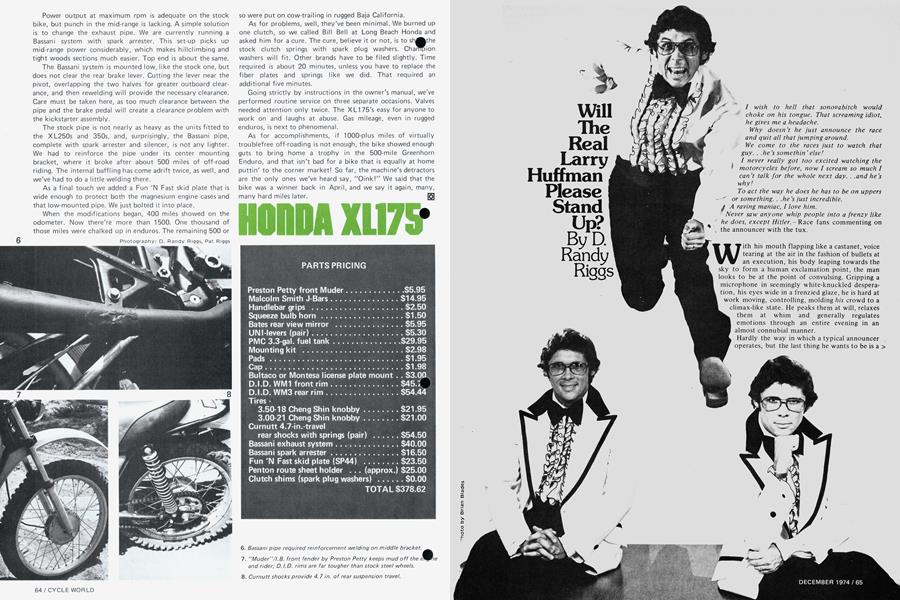
Will The Real Larry Huffman Please Stand Up?
Randy Riggs
With his mouth flapping like a castanet, voice tearing at the air in the fashion of bullets at an execution, his body leaping towards the sky to form a human exclamation point, the man looks to be at the point of convulsing. Gripping a microphone in seemingly white-knuckled desperation, his eyes wide in a frenzied glaze, he is hard at work moving, controlling, molding his crowd to a climax-like state. He peaks them at will, relaxes them at whim and generally regulates emotions through an entire evening in an almost connubial manner.
Hardly the way in which a typical announcer operates, but the last thing he wants to be is a > typical announcer. And the results are astounding. His sensational and raucously heady mannerisms have become fisticuff controversial, while making him a star in his own right. He has vaulted himself from a nearly broke apprentice grocery store checker into property holdings, five homes, a $10,000 Pantera and more than $50,000 in annual income. He is motorcycle racing’s highest-paid announcer and his credits are spreading coast to coast in rapid fashion. The man? Larry Huffman. Motormouth. Mr. Lungs.
I wish to hell that sonovabitch would choke on his tongue. That screaming idiot, he gives me a headache.
Why doesn’t he just announce the race and quit all that jumping around.
We come to the races just to watch that guy. . .he’s somethin’ else!
I never really got too excited watching the * motorcycles before, now I scream so much I can’t talk for the whole next day. . .and he’s why!
To act the way he does he has to be on uppers or something. . .he’s just incredible.
A raving maniac, I love him.
Never saw anyone whip people into a frenzy like he does, except Hitler.-Race fans commenting on the announcer with the tux.
Ask an average, run-of-the-mill spectator at a motorcycle race the name of the person doing the announcing, and more than probably you’d get an unemotional, uncaring answer. . .“I dunno.” Ask that same question at an event where Larry Huffman is manning the microphone and you’ll get a much more definite response. . .“That crazy Huffman, that’s who!” It is difficult for even the most mundane person to ignore such a spasmodic nerve ending, which is exactly what Huffman often becomes.
So at a time when most announcers, particularly in motorcycle racing, are floundering deep in the chasm of indifference, Huffman is bridging that chasm with a wave of enthusiasm and excitement the likes of which motorcycling has never seen. Larry is very nearly a show of his own, but he never lets it go quite that far.
“The riders are there, the fans are there. . .1 am the catalyst between the two.” And he is just that, particularly at the Ventura and Costa Mesa Speedway bike races in Southern California. The aura at these events is carnival-like in a good way; crowds are in a small fairgrounds bowl in a closely-grouped bunch. . .the air is literally charged with an almost electric excitement. It is the perfect arena for Huffman to operate in. . .and there is only one Larry Huffman.
For roughly three solid hours on Tuesday and Friday nights, Mr. Motormouth works himself into physical exhaustion doing what he likes best: announcing Speedway racing. It all looks innocent enough to the first time spectator when he seats himself in the stands and looks over the situation. . .a bubbly crowd, well-lit track, manicured infield, can’t see any bikes or riders yet, but hey, there’s some guy walking across the infield with a tuxedo on! Wonder what he’s doing here? The man entei^kie announcer’s booth, sifts through ^Kne papers, greets a few people and picks up the microphone. An unseen technician flips a switch and both sound systems are turned on simultaneously.
Initially, the look remains innocent; Huffman intones a quiet but attentiongetting “Good evening ladies and gentlemen. My name is Larry Huffman, I’m your announcer and I’d like to welcome you to speedway.” Innocent. Nothing out of the ordinary (save for the tux). Basically above suspicion, with the possible exception of an occasional wisecrack about the promoter or someone associated with the event. It all looks normal until the bikes are wheeled out to the track for the first race of the evening. That is when all hell begins to break loose.
Introductions begin and pity^ae crowd if they do not respond wl^Pa show of emotion. Huffman resorts to epiplexis. A snoring noise rolls out of the loudspeakers. “ALLRIGHT YOU PEOPLE, I WANTA HEAR SOME NOISE! THIS ISN’T A QUIET ZONE. . .THIS IS SPEEEEDWAY. . . AND COMING OUT FOR EVENT NUMBER ONE, A, HANDICAP HEAT, DO IT WITH ME NOW. . .NUMBER 41. . .W-I-L-D B-I-L-L C-O-D-Y!” The crowd is suddenly wide awake and picking up on Huffman’s cues. They’re with him now and behind the riders with gut-bellowing enthusiasm. “AND THIS GUY IS HOT TONIGHT. . . LOOKING FOR A BIG WIN HERE, AFTER HIS WIN LAST NIGHT AT IRWINDALE. . .RIDING FOR PREMIER HELMETS. . .NUMBER 22 (the voice gets high-pitched, gutteral and raspy)DANNNNNY B-E-R-S-E-RÄ) BECKER!” ”
By the time the start ribbons spring for the evening sky, the crowd is stomping its feet, booming for its favorites. Press photographers in the infield wear earplugs, not because the motorcycles are noisy, but because Huffman’s high-pitched wailing is enough to blow the needle off a decibel meter. But get him good and warmed up, on a night when the racing is especially close. . . and top-of-the-lung roaring, the kind that would be enough to unhinge a normal person’s jaw, still isn’t enough for Mr. Huffn’Puff. And one can tell when he’s gettin’ there.
Off comes the custom-made jacket. Then the tie. Then he’s up on top of that announcer’s table loosening the shirt collar. The fans respond accordingly, waiting to see the now fam^s Huffman “Hop.” Up in the air he g^ß, still clutching that all-important mike. . .maybe once more. . .maybe twice more, both he and the crowd have been worked into a dither. The race runs, the climax is reached and it’ll be awhile before the fans settle back down aggB
^rarry has baited them for some of the best racing imaginable. . .they were primed and ready. . .and the riders delivered because they knew the crowd was behind them. Very simply put, Huffman makes for a better motorcycle race. He has done the same at the Astrodome, the Superbowl of Motocross (where more than 40,000 responded to his call), and is now getting a strong following of listeners on the radio stations who are eager to hear any of his many radio commercials. Imagine someone wanting to hear a radio commercial. But once you’ve heard one you can understand why.
It’s his many advertising accounts that keep Huffman busy when he’s not doing a speedway number or a major event on a weekend, and much of his income is derived from this type of tf^p. Most feel that when they buy Hunman, they get more than their money’s worth. As a result, Larry stays pretty busy, even to the point of turning away some of the business.
His radio spots vary in style according to the wishes of the advertisers, of course, but his wilder ones have been about a deer park, Levis, and, oh yeah, motorcycle racing. It’s all unmistakably Huffman. . .jabs of electrified spasms beaming out over the radio waves. Words pour from his mouth much like raindrops in a cloudburst. “Like a motor he talks,” says a fan. Like a very fast motor, so fast that many disc jockeys, playing the tapes he records, can’t even believe it. “The speed is phenomenal, yet you can understand every word. I don’t know how he does it.”
^|me of these commercials are to be fonWved with a “live tag” by the announcer at the station. Not one jockey that I’ve heard has been able to follow through with Huffman’s rhythm and speed. And these are people trained in the art of speaking fast, cramming as many words into 30 seconds space as is humanly possible. Huffman has had no such training.
“I always wanted to be in show business, right from the first grade. I used to get up and get the teacher to let me talk. I’d tell stories, usually the latest Milton Berle jokes. When they counselled me in fourth grade about what I wanted to do when I grew up, there wasn’t a doubt in my mind. I wanted to be in show business.” But by the time he turned 20 he was not in show business, he was a checker in a grocery store.
^Back then I was riding a war-surplus Triumph back and forth to work and college. I wasn’t making much money and I still wanted to get into show business, but I didn’t know how to go about it’ But a guy used to come into the store where I worked, he was a disc jockey. I found out and started bugging him about letting me hang around the station, which was handy, because he was on the all-night show. He’d meet a lot of chicks. . .a lot of chicks would be calling him up and he got lots of attention. . .and all he did was talk! I thought, boy, this is for me!”
Huffman wasted no time. He dropped out of college, quit his grocery checker job and enrolled in radio school to get a station operator’s license. There were no voice training or speech lessons; just the Technical nuances that allowed him to pass the test for his FCC license. Success was still a long way off.
“My first disc jockey job in Elko, Nevada lasted only three weeks. I guess I was a little too far out for them, playing Buddy Holly records on Sunday and telling jokes. . .they weren’t ready for that. Besides, I had a really high voice, nothing like you’d expect a disc jockey to have, so I didn’t last long!” Not many radio stations were too keen on hiring an announcer who sounded as though he’d received a swift kick in the groin only moments before.
Huffman went to Idaho, then Hawaii, in search of radio employment with a successful tenure. State number 50 had it for him. He managed to land a job on the all-night program of KGMB in Honolulu, the top-rated station in Hawaii. There he met J. Akuhead Pupule, the highest-paid jockey in the world. Better known as “Aku,” he is in actuality a very clever man by the name of Hal Lewis. Huffman watched the way Aku handled people and audiences; he also told and wrote jokes for his program. He picked up a lot from the man they call Aku.
It was also around this time that he met his wife Bev. When she became pregnant with the first of his two daughters, the Huffmans returned to the mainland, where Larry took a job with KWIZ in California. His long-time love of motorcycles and motorcycling prompted him to start a motorsports show, “The Sound of Speed.” This role carried him one night to Lions Drag Strip, where the announcer impressed Larry to no degree at all. Lions was looking for another announcer to fill in when their regular wasn’t there, and Larry volunteered.
“I got out there and I didn’t know what the hell I was doing; it was new to me. . .but I started yelling and screaming and the people dug it. I built up the drivers and everything just turned out more exciting. I could watch the crowd and could see them responding to the things I was saying; they would react immediately and God, what a feeling of power! My first motorcycle event was a local scrambles track; shortly afterward Vic Wilson hired me to announce the big Trans-AM A Motocross at Saddleback Park that CYCLE WORLD sponsors. I was hooked after that.”
Larry took in his first speedway race in 1969 and talked to the promoter, Harry Oxley, about announcing for him. “I told Harry I could do a better job than the guy he had. . .and I knew I could.” Now, five years later, with a weekly attendance of nearly 10,000 people, more than one person thinks Huffman had the right idea. But Huffman’s ideas always were 180 degrees apart from what the established announcers had told him about how to announce a motorcycle race. “They’d always say. . .‘Oh, you can’t do that, those people will never buy anything like that!”’ Huffman’s success has proven that established principles are not always the way to fly.
If any comparisons are ever drawn between Larry and other announcers in his field, it invariably winds up being with the well-established and popular Roxy Rockwood. Roxy is known as the “golden throat of the National trail,” but often finds Larry fast encroaching on his territory. Roxy’s methods are totally unlike Huffman’s, and each has a heavy following of fans, who are also totally different. Rockwood’s appeal lies largely with old timers and people who have been into motorcycling for many years. . .the real enthusiasts. Huffman draws the newcomers and the people who have other interests in life besides motorcycles. Extreme purists even go so far as to say that an announcer is not needed at all at an event; that the people who really care know what’s going on without anyone telling them. That, of course, is total idiocy, if the sport is ever to grow at all. Huffman’s detractors accuse him of everything from popping pills to being on a one-way ego trip, but only the people close to Larry know how^^lly dedicated and professional he “I announce motorcycling because I love the sport and the people in it. I always have and I always will.”
One critic had the audacity and stupidity to suggest that since Huffman didn’t race a speedway bike, he had no business announcing the speedway racing. But I wonder how many motorcycle announcers are motorcyclists and own and ride motorcycles; Huffman does and has for years.
Larry is not a part-time announcer. . .he is a professional, it is a full-time and all-encompassing job. His wife Bev claims that he is working all the time, even when he’s trying to go to sleep. He writes commercials in his head, talks to himself; he’s constantly going. “On the way to the track he’s preparing himself, all day before a race he prepares himself. . .he wraps himself up mentall^^nd dedicates himself to the job at mmd. That’s the difference between a professional and an amateur. Larry is never caught unaware, because he thinks about what’s going to happen before it happens and he prepares for any situation.”
After a race Huffman is totally exhausted and spent, mentally and physically. And once you’ve witnessed a Huffman performance you can understand why. The man is a health nut; he works out in a gym four or five times a week, rides a bicycle five miles a day, he doesn’t smoke either kind, his strongest drink is wine and the only pills he pops are vitamins. Perhaps his only weakness is dedication and sensitivity to adverse criticism. And his desire to learn more about the phases of the sport with which he’s not as familiar is unmatched.
“People will damn near crudf^Éme for a mistake over the P.A. at a road race or motocross, yet the regulars make the same mistakes. I’d like to see how they’d do at speedway. And no, I don’t know who won such and such race in 1956, but 99 percent of the fans out there don’t know either, and 100 percent don’t give a damn anyway. They want to know what’s happening now. Let the other announcers talk all they want about me, but they’re going to have to come up to my level, I’m not going down to theirs.”
So the baby-faced, straight-looking guy, whose voice finally changed at 28, is much more than the raving maniac he at times appears to be. He is sincere, honest and dedicated to his profession. Most of all, he is a real person with an inborn talent and sensitive nature. The arousal created by his presence ^^the most rapid fermentation of excit^Pmt in motorcycledom. Whether you like it or not, the Huffman epoch is upon us. The sport will gain because of it. [5]
More From This Issue
-
 Departments
Up Front
December 1974 -
 Letters
Letters
December 1974 -
 Departments
Feed Back
December 1974 -
 Departments
Round·up
December 1974 -
 Features
Going Down On the Hook
December 1974 -
 Features
Faster Than A Speeding Bullet, More Powerful Than A Locomotive, Able To Leap Wide Canyons At A Single Bound...Almost.
December 1974