Yamaha Rz 201 Wankel
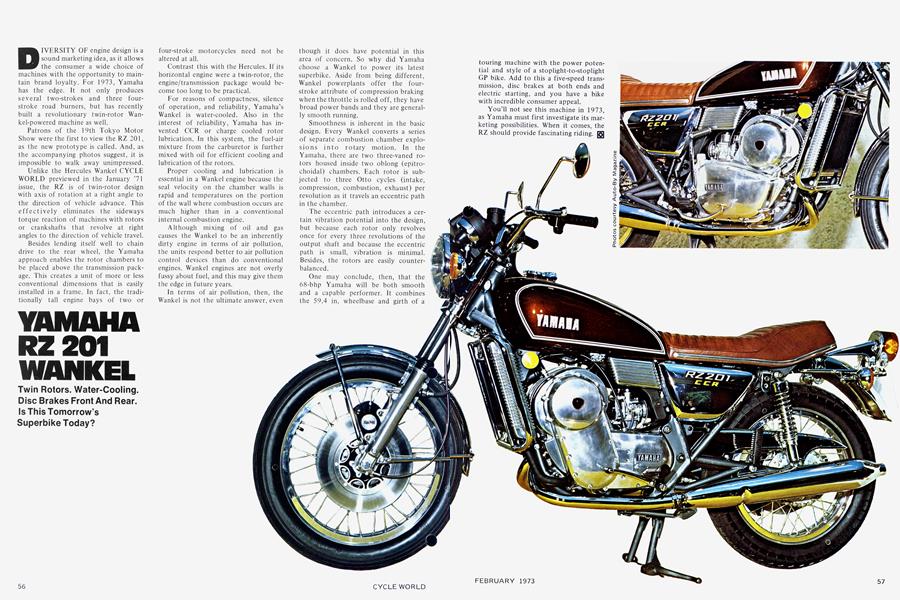
YAMAHA RZ 201 WANKEL
Twin Rotors. Water-Cooling. Disc Brakes Front And Rear. Is This Tomorrow's Superbike Today?
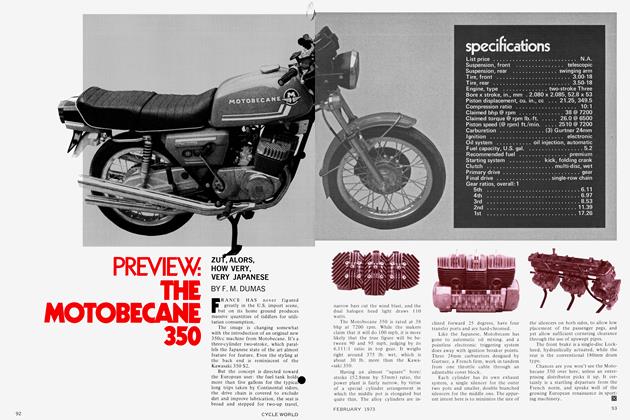
DIVERSITY OF engine design is a sound marketing idea, as it allows the consumer a wide choice of machines with the opportunity to maintain brand loyalty. For 1973, Yamaha has the edge. It not only produces several two-strokes and three four-stroke road burners, but has recently built a revolutionary twin-rotor Wankel-powered machine as well.
Patrons of the 19th Tokyo Motor Show were the first to view the RZ 201, as the new prototype is called. And, as the accompanying photos suggest, it is impossible to walk away unimpressed.
Unlike the Hercules Wankel CYCLE WORLD previewed in the January ’71 issue, the RZ is of twin-rotor design with axis of rotation at a right angle to the direction of vehicle advance. This effectively eliminates the sideways torque reaction of machines with rotors or crankshafts that revolve at right angles to the direction of vehicle travel.
Besides lending itself well to chain drive to the rear wheel, the Yamaha approach enables the rotor chambers to be placed above the transmission package. This creates a unit of more or less conventional dimensions that is easily installed in a frame. In fact, the traditionally tall engine bays of two or four-stroke motorcycles need not be altered at all.
Contrast this with the Hercules. If its horizontal engine were a twin-rotor, the engine/transmission package would become too long to be practical.
For reasons of compactness, silence of operation, and reliability, Yamaha’s Wankel is water-cooled. Also in the interest of reliability, Yamaha has invented CCR or charge cooled rotor lubrication. In this system, the fuel-air mixture from the carburetor is further mixed with oil for efficient cooling and lubrication of the rotors.
Proper cooling and lubrication is essential in a Wankel engine because the seal velocity on the chamber walls is rapid and temperatures on the portion of the wall where combustion occurs are much higher than in a conventional internal combustion engine.
Although mixing of oil and gas causes the Wankel to be an inherently dirty engine in terms of air pollution, the units respond better to air pollution control devices than do conventional engines. Wankel engines are not overly fussy about fuel, and this may give them the edge in future years.
In terms of air pollution, then, the Wankel is not the ultimate answer, even though it does have potential in this area of concern. So why did Yamaha choose a Wankel to power its latest superbike. Aside from being different, Wankel powerplants offer the four-stroke attribute of compression braking when the throttle is rolled off, they have broad power bands and they are generally smooth running.
Smoothness is inherent in the basic design. Every Wankel converts a series of separate combustion chamber explosions into rotary motion. In the Yamaha, there are two three-vaned rotors housed inside two oblong (epitrochoidal) chambers. Each rotor is subjected to three Otto cycles (intake, compression, combustion, exhaust) per revolution as it travels an eccentric path in the chamber.
The eccentric path introduces a certain vibration potential into the design, but because each rotor only revolves once for every three revolutions of the output shaft and because the eccentric path is small, vibration is minimal. Besides, the rotors are easily counterbalanced.
One may conclude, then, that the 68-bhp Yamaha will be both smooth and a capable performer. It combines the 59.4 in. wheelbase and girth of a touring machine with the power potential and style of a stoplight-to-stoplight GP bike. Add to this a five-speed transmission, disc brakes at both ends and electric starting, and you have a bike with incredible consumer appeal.
You’ll not see this machine in 1973, as Yamaha must first investigate its marketing possibilities. When it comes, the RZ should provide fascinating riding, gj