Preview: Benelli's Six-Cylinder 750
PREVIEW: BENELLI'S SIX-CYLINDER 750
...And Some Interesting Snippets From The Reviving Italian Motorcycle Industry
Ivan J. Wagar
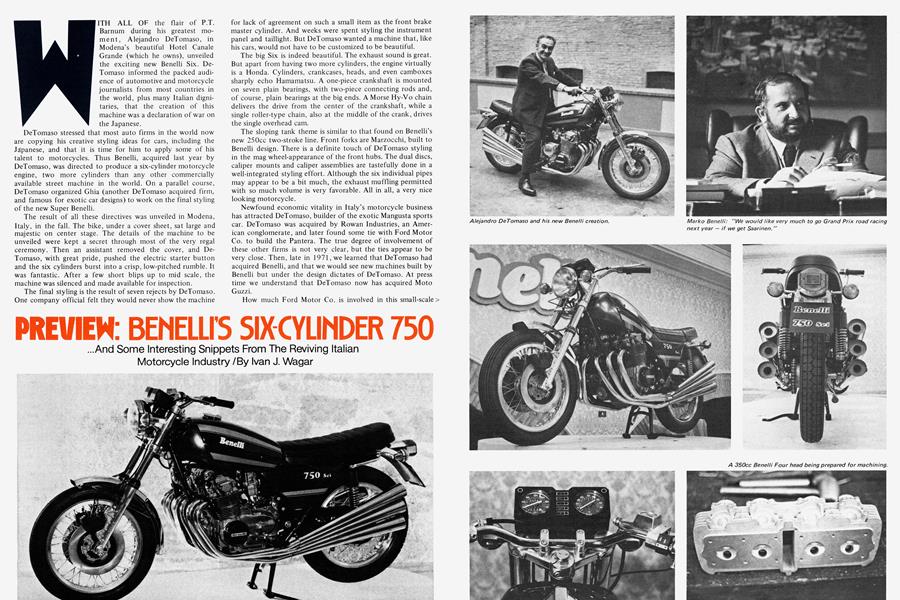
WITH ALL OF the flair of P.T. Barnum during his greatest moment, Alejandro DeTomaso, in Modena’s beautiful Hotel Canale Grande (which he owns), unveiled the exciting new Benelli Six. DeTomaso informed the packed audience of automotive and motorcycle journalists from most countries in the world, plus many Italian dignitaries, that the creation of this machine was a declaration of war on the Japanese.
DeTomaso stressed that most auto firms in the world now are copying his creative styling ideas for cars, including the Japanese, and that it is time for him to apply some of his talent to motorcycles. Thus Benelli, acquired last year by DeTomaso, was directed to produce a six-cylinder motorcycle engine, two more cylinders than any other commercially available street machine in the world. On a parallel course, DeTomaso organized Ghia (another DeTomaso acquired firm, and famous for exotic car designs) to work on the final styling of the new Super Benelli.
The result of all these directives was unveiled in Modena, Italy, in the fall. The bike, under a cover sheet, sat large and majestic on center stage. The details of the machine to be unveiled were kept a secret through most of the very regal ceremony. Then an assistant removed the cover, and DeTomaso, with great pride, pushed the electric starter button and the six cylinders burst into a crisp, low-pitched rumble. It was fantastic. After a few short blips up to mid scale, the machine was silenced and made available for inspection.
The final styling is the result of seven rejects by DeTomaso. One company official felt they would never show the machine for lack of agreement on such a small item as the front brake master cylinder. And weeks were spent styling the instrument panel and taillight. But DeTomaso wanted a machine that, like his cars, would not have to be customized to be beautiful.
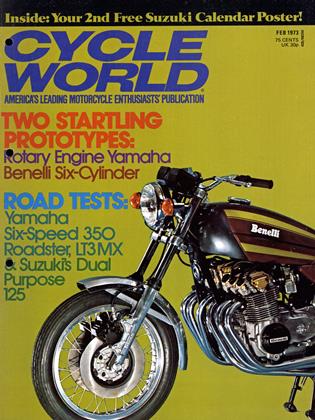
The big Six is indeed beautiful. The exhaust sound is great. But apart from having two more cylinders, the engine virtually is a Honda. Cylinders, crankcases, heads, and even camboxes sharply echo Hamamatsu. A one-piece crankshaft is mounted on seven plain bearings, with two-piece connecting rods and, of course, plain bearings at the big ends. A Morse Hy-Vo chain delivers the drive from the center of the crankshaft, while a single roller-type chain, also at the middle of the crank, drives the single overhead cam.
The sloping tank theme is similar to that found on Benelli’s new 250cc two-stroke line. Front forks are Marzocchi, built to Benelli design. There is a definite touch of DeTomaso styling in the mag wheel-appearance of the front hubs. The dual discs, caliper mounts and caliper assemblies are tastefully done in a well-integrated styling effort. Although the six individual pipes may appear to be a bit much, the exhaust muffling permitted with so much volume is very favorable. All in all, a very nice looking motorcycle.
Newfound economic vitality in Italy’s motorcycle business has attracted DeTomaso, builder of the exotic Mangusta sports car. DeTomaso was acquired by Rowan Industries, an American conglomerate, and later found some tie with Ford Motor Co. to build the Pantera. The true degree of involvement of these other firms is not very clear, but the ties appear to be very close. Then, late in 1971, we learned that DeTomaso had acquired Benelli, and that we would see new machines built by Benelli but under the design dictates of DeTomaso. At press time we understand that DeTomaso now has acquired Moto Guzzi.
How much Ford Motor Co. is involved in this small-scale take-over of the Italian industry can only be speculation. It is a fairly open secret that Ford has taken a serious look at the growth of motorcycling in this country on a few occasions. It also is a fact that the money required to buy firms such as Benelli and Moto Guzzi is quite enormous.
One thing that is very certain is that we are going to see even more exciting motorcycles from Italy. DeTomaso is determined to bring the same degree of sophistication and exotica to motorcycling that he rocked the car world with a few years ago. His efforts will mean that other firms, if they are to compete, will have to do better and better.
Benelli already has 350 and 500 Fours waiting to be introduced. These virtually are two-valve per cylinder versions of the new racers on which Jarno Saarinen beat Agostini at Pesaro last autumn. There are no release dates for the Fours at this time. DeTomaso has directed that he will wait for feedback on the Six’s styling before styling the Fours. So it will probably be late in the year before we know what the smaller machines will look like.
BENELLI
SIX-CYLINDER 750
ON TO MV AGUSTA
Not many journalists get into MV Agusta. So it was with apprehension that we turned in our passports at the main gate of the helicopter plant in Gallarate. Because of the government work connected with the aircraft work, and the number of armed guards around the place, I now understand why not many outsiders get into MV.
I was met by Arturo Magni, MV’s racing director for 22 years, after having served three years with the famous Güera racing team. Unlike most racing managers, Arturo has never raced himself and does not favor hiring former racing people to work on the team. One exception to this rule is Alberto Pagani, who was also on hand. Pagani has been hired as a development rider, and backup for Agostini on occasion. Alberto is the son of the first Italian world champion, Nello Pagani (who picked off the title in 1949). He began his own fairly successful racing career in 1956.
Explaining MV’s domination of grand prix racing, Magni pointed out that the machines are built to helicopter specifications. Castings come from the same foundry, and machining is done in the same tool room. The engine assemblers have the same level of skill as those who put together the aircraft units. Pre-race checks and rechecks are modeled after aircraft techniques. And that helps to understand the fact that MV has won 2973 classic motorcycle races. Rarely does a machine ever fail due to a mechanical breakdown.
Questioning Magni, I learned that Carlo Bandirola, ace of the early Fifties, was the most difficult rider to please. Often adjustments were still being made on the starting line. The easiest rider to please was Mike Hailwood. “Mike rarely asked us to alter anything, he just got on the thing and went fast,” was the comment. Magni felt the most “complete” rider ever to race MVs was the late Gary Hocking of Southern Rhodesia, explaining that Hocking was so much a natural that he in fact never worked at racing.
FUTURE RACING PLANS
When asked about future plans, Magni and Pagani both said they would like to do Daytona. Magni attended the Florida classic in 1972 as a spectator and said he enjoyed the climate, the people, and in particular the fairly relaxed race atmos phere. It would be necessary for MV to certify through the FIM that the approved machine is homologated. At this point there has been no discussion about possible riders, but Magni feels that a minimum of two would be required for Daytona. Obviously the whole plan would need the Count’s blessing. He runs a tight ship.
I had a chance to sample the 750 GT model around the runways, and was most impressed with the silky smooth engine, brisk acceleration and excellent handling. MV prefers to stick with drum brakes, while most firms now employ discs for the big jobs. But the GT’s brakes were superb in every way. The five-speed transmission shifts beautifully; it’s really a great motorcycle. There was also a street racer 750, but since it was identical to the one tested in CYCLE WORLD. Aug. ’71, I passed it up for the little 350 Twin SS. It also is a treat to ride, and makes you wonder if all of this exotica and race for more and more cylinders is really necessary after all. It’s fun to get on a light, good handling, mild mannered machine and gas it around an airport.
Some of Ago’s racing bikes were there, but only to look at. On the question of more cylinders for racing, Magni explained that the new four-cylinder racer is more difficult to ride than the Three. Although the Four is quicker, the power curve is sharper and the rider must be a little more careful than with the Three. The now-shelved 350 Six was an even better example. Producing 70 bhp at 15,000 rpm, and with more top speed than the Three, the Six had a problem with lap times, and the average speed on any given circuit just was not up to expectations.
MV seems quite eager to sell machines on the American market. The Fours are expensive. The firm has not worked out just how expensive they would be in this country, but feel they would not give up aircraft quality for price competitiveness.
Next month: We explore further what is happening in this new “Italian Renaissance.”