Preview: the Motobecane 350
PREVIEW: THE MOTOBECANE 350
ZUT, ALORS, HOW VERY, VERY JAPANESE
F. M. DUMAS
FRANCE HAS never figured greatly in the U.S. import scene, but on its home ground produces massive quantities of tiddlers for utilitarian consumption.
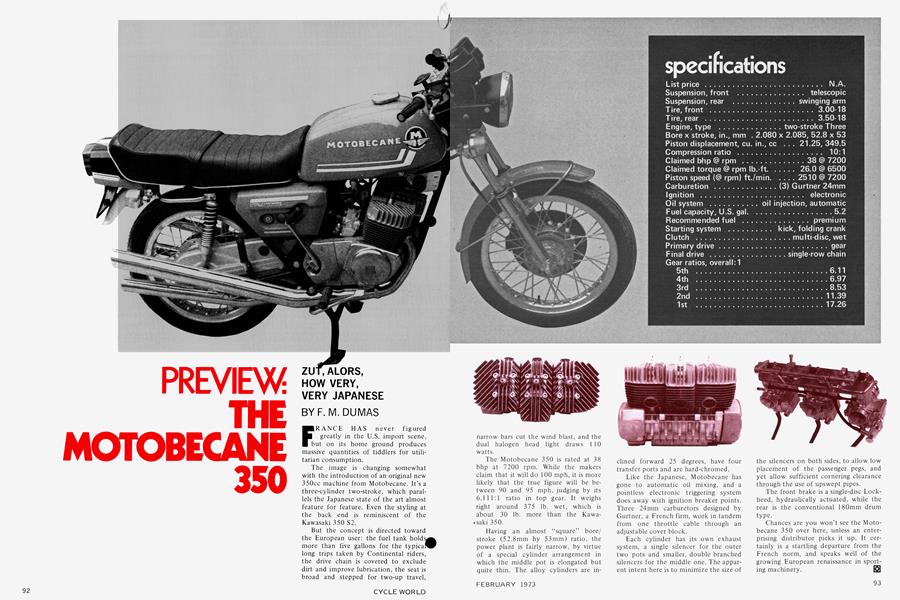
The image is changing somewhat with the introduction of an original new 350cc machine from Motobecane. It’s a three-cylinder two-stroke, which parallels the Japanese state of the art almost feature for feature. Even the styling at the back end is reminiscent of the Kawasaki 350 S2.
But the concept is directed toward the European user: the fuel tank hold^^ more than five gallons for the typica^^ long trips taken by Continental riders, the drive chain is covered to exclude dirt and improve lubrication, the seat is broad and stepped for two-up travel, narrow bars cut the wind blast, and the dual halogen head light draws 1 10 watts.
The Motobecane 350 is rated at 38 bhp at 7200 rpm. While the makers claim that it will do 100 mph, it is more likely that the true figure will be between 90 and 95 mph, judging by its 6.111:1 ratio in top gear. It weighs right around 375 lb. wet, which is about 30 lb. more than the Kawasaki 350.
Having an almost “square” bore/ stroke (52.8mm by 53mm) ratio, the power plant is fairly narrow, by virtue of a special cylinder arrangement in which the middle pot is elongated but quite thin. The alloy cylinders are inclined forward 25 degrees, have four transfer ports and are hard-chromed.
Like the Japanese, Motobecane has gone to automatic oil mixing, and a pointless electronic triggering system does away with ignition breaker points. Three 24mm carburetors designed by Gurtner, a French firm, work in tandem from one throttle cable through an adjustable cover block.
Each cylinder has its own exhaust system, a single silencer for the outer two pots and smaller, double branched silencers for the middle one. The apparent intent here is to minimize the size of the silencers on both sides, to allow low placement of the passenger pegs, and yet allow sufficient cornering clearance through the use of upswept pipes.
The front brake is a single-disc Lockheed, hydraulically actuated, while the rear is the conventional 180mm drum type.
Chances are you won’t see the Motobecane 350 over here, unless an enterprising distributor picks it up. It certainly is a startling departure from the French norm, and speaks well of the growing European renaissance in sporting machinery.