Kenny Roberts
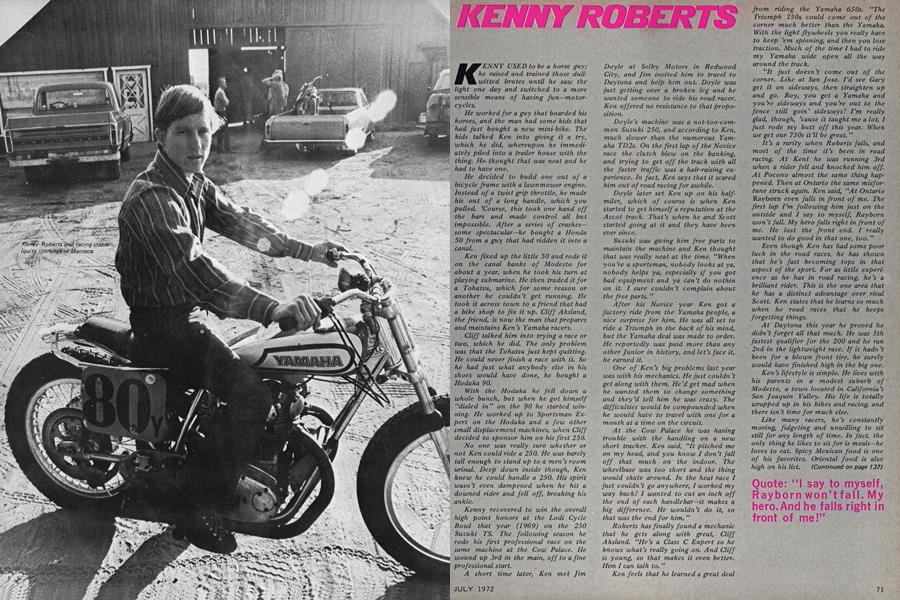
KENNY ROBERTS
KENNY USED to be a horse guy; he raised and trained those dullwitted brutes until he saw the light one day and switched to a more sensible means of having fun—motorcycles.
He worked for a guy that boarded his horses, and the man had some kids that had just bought a new mini-bike. The kids talked Ken into giving it a try, which he did, whereupon he immediately piled into a trailer house with the thing. He» thought that was neat and he had to have one.
He decided to build one out of a bicycle frame with a lawnmower engine. Instead of a twist grip throttle, he made his out of a long handle, which you pulled. ’Course, this took one hand off the bars and made control all but impossible. After a series of crashes— some spectacular—he bought a Honda 50 from a guy that had ridden it into a canal.
Ken fixed up the little 50 and rode it on the canal banks of Modesto for about a year, when he took his turn at playing submarine. He then traded it for a Tohatsu, which for some reason or another he couldn’t get running. He took it across town to a friend that had a bike shop to fix it up. Cliff Aksland, the friend, is now the man that prepares and maintains Ken’s Yamaha racers.
Cliff talked him into trying a race or two, which he did. The only problem was that the Tohatsu just kept quitting. He could never finish a race with it. So he had just what anybody else in his shoes would have done, he bought a Hodaka 90.
With the Hodaka he fell down a whole bunch, but when he got himself “dialed in” on the 90 he started winning. He worked up to Sportsman Expert on the Hodaka and a few other small displacement machines, when Cliff decided to sponsor him on his first 250.
No one was really sure whether or not Ken could ride a 250. He was barely tall enough to stand up to a men ’s room urinal. Deep down inside though, Ken knew he could handle a 250. His spirit wasn’t even dampened when he hit a downed rider and fell off, breaking his ankle.
Kenny recovered to win the overall high point honors at the Lodi Cycle Bowl that year (1969) on the 250 Suzuki TS. The following season he rode his first professional race on the same machine at the Cow Palace. He wound up 3rd in the main, off to a fine professional start.
A short time later, Ken met Jim Doyle at Selby Motors in Redwood City, and Jim invited him to travel to Daytona and help him out. Doyle was just getting over a broken leg and he wanted someone to ride his road racer. Ken offered no resistance to that proposition.
Doyle’s machine was a not-too-common Suzuki 250, and according to Ken, much slower than the numerous Yamaha TD2s. On the first lap of the Novice race the clutch blew on the banking, and trying to get off the track with all the faster traffic was a hair-raising experience. In fact, Ken says that it scared him out of road racing for awhile.
Doyle later set Ken up on his halfmiler, which of course is when Ken started to get himself a reputation at the Ascot track. That’s when he and Scott started going at it and they have been ever since.
Suzuki was giving him free parts to maintain the machine and Ken thought that was really neat at the time. “When you’re a sportsman, nobody looks at ya, nobody helps ya, especially if you got bad equipment and ya can’t do nothin on it. I sure couldn’t complain about the free parts. ”
After his Novice year Ken got a factory ride from the Yamaha people, a nice surprise for him. He was all set to ride a Triumph in the back of his mind, but the Yamaha deal was made to order. He reportedly was paid more than any other Junior in history, and let’s face it, he earned it.
One of Ken’s big problems last year was with his mechanics. He just couldn’t get along with them. He’d get mad when he wanted them to change something and they’d tell him he was crazy. The difficulties would be compounded when he would have to travel with one for a month at a time on the circuit.
At the Cow Palace he was having trouble with the handling on a new short tracker. Ken said, “It pitched me on my head, and you know I don’t fall off that much on the indoor. The wheelbase was too short and the thing would skate around. In the heat race I just couldn’t go anywhere, I worked my way back! I wanted to cut an inch off the end of each handlebar—it makes a big difference. He wouldn’t do it, so that was the end for him. ”
Roberts has finally found a mechanic that he gets along with great, Cliff Aksland. “He’s a Class C Expert so he knows what’s really going on. And Cliff is young, so that makes it even better. Him I can talk to. ”
Ken feels that he learned a great deal from riding the Yamaha 650s. “The Triumph 750s could come out of the corner much better than the Yamaha. With the light flywheels you really have to keep ’em spinning, and then you lose traction. Much of the time I had to ride my Yamaha wide open all the way around the track.
“It just doesn’t come out of the corner. Like at San Jose. I’d see Gary get it on sideways, then straighten up and go. Boy, you get a Yamaha and you’re sideways and you’re out to the fence still goin’ sideways! I’m really glad, though, ’cause it taught me a lot. I just rode my butt off this year. When we get our 750s it’ll be great. ”
It’s a rarity when Roberts falls, and most of the time it’s been in road racing. At Kent he was running 3rd when a rider fell and knocked him off. At Pocono almost the same thing happened. Then at Ontario the same misfortune struck again. Ken said, “At Ontario Rayborn even falls in front of me. The first lap I’m following him just on the outside and I say to myself, Rayborn won ’t fall. My hero falls right in front of me. He lost the front end. I really wanted to do good in that one, too. ”
Even though Ken has had some poor luck in the road races, he has shown that he’s fast becoming tops in that aspect of the sport. For as little experience as he has in road racing, he’s a brilliant rider. This is the one area that he has a distinct advantage over rival Scott. Ken states that he learns so much when he road races that he keeps forgetting things.
At Daytona this year he proved he didn’t forget all that much. He was 5th fastest qualifier for the 200 and he ran 2nd in the lightweight race. If it hadn’t been for a blown front tire, he surely would have finished high in the big one.
Ken ’s lifestyle is simple. He lives with his parents in a modest suburb of Modesto, a town located in California’s San Joaquin Valley. His life is totally wrapped up in his bikes and racing, and there isn’t time for much else.
Like many racers, he’s constantly moving, fidgeting and unwilling to sit still for any length of time. In fact, the only thing he likes to sit for is meals—he loves to eat. Spicy Mexican food is one of his favorites. Oriental food is also high on his list.
(Continued on page 137)
Quote: ‘‘I say to myself, Rayborn won’t fall. My hero. And he falls right in front of me!”
Although he has no steady girlfriend, his roving eye is constantly on the lookout for females. The inspection he gave the waitress that served us in a restaurant was classic. He looked her over like a bank manager studying a $20 counterfeit bill. He doesn’t miss a thing.
Unlike Scott, who gestures with his hands when he talks, Ken makes little noises with his mouth to emphasize a point. He’s not as conservative as Gary, he’s more on the wild side. He drives his van lickety split and unconsciously dices with other traffic.
He, like Gary, rarely badmouths anyone. Even if he says something bad about someone, he counters with something good about them. When you first meet him as a stranger, he’s apt to act like he has no time for you. After a bit he settles down and opens up.
He’s a colorful, spectacular rider, and one of the places that this shows up best is Indoor Short Track. He seldom loses at indoor, and holds most of the records at the Cow Palace. He’s happiest when he beats Gary, as that’s when he’s usually under the most pressure.
Ken has the knack of getting by someone, even if there’s no possible way to do it. Somehow he sticks a wheel underneath and elbows past. Gary Scott is one of the few that can hold him off, but not always.
Roberts likes the pace of non-national AMA races. “Everybody is friendly and in no big rush. At the Nationals everybody is ordering ya to do this and ordering y a to do that. That referee back East, Charlie Watson, he’s a real pill. Thinks he’s a Gestapo agent. Always yelling, ‘Get your leathers on and get out there’ and stuff like that. Makes you feel like a prisoner of war. ”
I asked Ken if there was anything in the AMA that he would like to see changed. His answer was simple, “Charlie Watson. ” Then he added, “The numbering system is messed up. You should get the number of the place you finished in.” Most younger riders agree.
Ken’s weakest point is his memory. He never can remember names and personal things like that. In fact, he couldn’t even remember his home address when I asked him. But ask what position Gary Scott finished in a particular race and you’ll get the right answer—y ou know what his mind is on.
Presently, Roberts is the National Point Leader and is going all out for that Number One plate. He has the talent, the confidence, and the guts to pursue it. With luck, Number One is not a remote, but a distinct possibility. Ken Roberts just might pull it off... [Ö]