The Hercules 2000
DAN HUNT
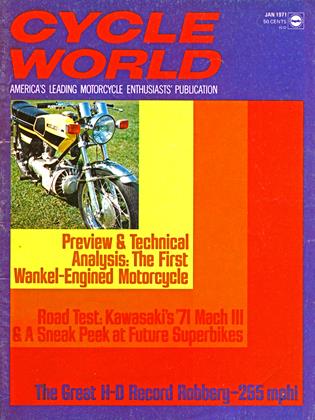
WHILE THE WANKEL engine has most intriguing possibilities, it has been the black sheep of the automobile industry for more than a decade and has virtually been ignored by the motorcycle industry. Now a West German machine powered by a Wankel engine has made its debut in prototype. Should it be hailed as a great breakthrough, or a temporary mechanical diversion?
Conventional four-stroke and two-stroke engines have passed through a long period of development to reach a high level of efficiency and reliability. The rotary combustion Wankel, which possesses many advantages of these engines, without the disadvantage of reciprocating pistons, is relatively young. It has been around in the automobile world since 1964 when NSU, co-holder of the Wankel patent rights, began production of its Spider sports car. Several other manufacturers have experimented with the NSU/Wankel design, notably Daimler-Benz, Citroen, GM, and lately Toyo Kogyo, which has introduced three rotary-combustion models of the Mazda car into the United States in recent months.
The reticence of the motorcycle industry to jump into the Wankel pond with both feet is perhaps warranted. Early bugs in the Spider and the subsequent R08O luxury car practically put NSU out of business. The Birmingham Small Arms research department was toying with a rotary combustion machine, but, as BSA does not appear on'the current list of 17 manufacturers licensed to produce the Wankel engine, they can be assumed to have dropped the idea.
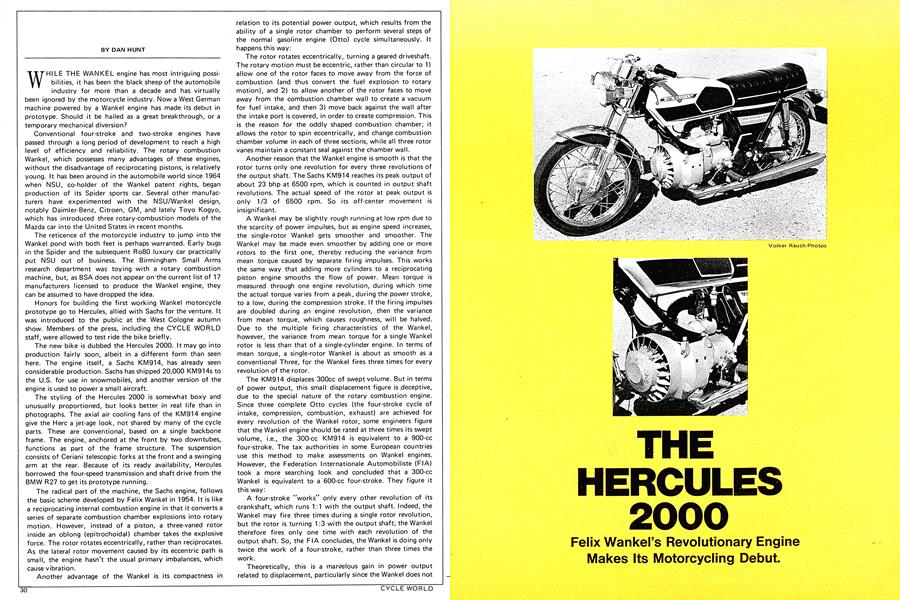
Honors for building the first working Wankel motorcycle prototype go to Hercules, allied with Sachs for the venture. It was introduced to the public at the West Cologne autumn show. Members of the press, including the CYCLE WORLD staff, were allowed to test ride the bike briefly.
The new bike is dubbed the Hercules 2000. It may go into production fairly soon, albeit in a different form than seen here. The engine itself, a Sachs KM914, has already seen considerable production. Sachs has shipped 20,000 KM914s to the U.S. for use in snowmobiles, and another version of the engine is used to power a small aircraft.
The styling of the Hercules 2000 is somewhat boxy and unusually proportioned, but looks better in real life than in photographs. The axial air cooling fans of the KM914 engine give the Here a jet-age look, not shared by many of the cycle parts. These are conventional, based on a single backbone frame. The engine, anchored at the front by two downtubes, functions as part of the frame structure. The suspension consists of Ceriani telescopic forks at the front and a swinging arm at the rear. Because of its ready availability, Hercules borrowed the four-speed transmission and shaft drive from the BMW R27 to get its prototype running.
The radical part of the machine, the Sachs engine, follows the basic scheme developed by Felix Wankel in 1954. It is like a reciprocating internal combustion engine in that it converts a series of separate combustion chamber explosions into rotary motion. However, instead of a piston, a three-vaned rotor inside an oblong (epitrochoidal) chamber takes the explosive force. The rotor rotates eccentrically, rather than reciprocates. As the lateral rotor movement caused by its eccentric path is small, the engine hasn't the usual primary imbalances, which cause vibration.
Another advantage of the Wankel is its compactness in
relation to its potential power output, which results from the ability of a single rotor chamber to perform several steps of the normal gasoline engine (Otto) cycle simultaneously. It happens this way:
The rotor rotates eccentrically, turning a geared driveshaft. The rotary motion must be eccentric, rather than circular to 1) allow one of the rotor faces to move away from the force of combustion (and thus convert the fuel explosion to rotary motion), and 2) to allow another of the rotor faces to move away from the combustion chamber wall to create a vacuum for fuel intake, and then 3) move back against the wall after the intake port is covered, in order to create compression. This is the reason for the oddly shaped combustion chamber; it allows the rotor to spin eccentrically, and change combustion chamber volume in each of three sections, while all three rotor vanes maintain a constant seal against the chamber wall.
Another reason that the Wankel engine is smooth is that the rotor turns only one revolution for every three revolutions of the output shaft. The Sachs KM914 reaches its peak output of about 23 bhp at 6500 rpm, which is counted in output shaft revolutions. The actual speed of the rotor at peak output is only T/3 of 6500 rpm. So its off-center movement is insignificant.
A Wankel may be slightly rough running at low rpm due to the scarcity of power impulses, but as engine speed increases, the single-rotor Wankel gets smoother and smoother. The Wankel may be made even smoother by adding one or more rotors to the first one, thereby reducing the variance from mean torque caused by separate firing impulses. This works the same way that adding more cylinders to a reciprocating piston engine smooths the flow of power. Mean torque is measured through one engine revolution, during which time the actual torque varies from a peak, during the power stroke, to a low, during the compression stroke. If the firing impulses are doubled during an engine revolution, then the variance from mean torque, which causes roughness, will be halved. Due to the multiple firing characteristics of the Wankel, however, the variance from mean torque for a single Wankel rotor is less than that of a single-cylinder engine. In terms of mean torque, a single-rotor Wankel is about as smooth as a conventional Three, for the Wankel fires three times for every revolution of the rotor.
The KM914 displaces 300cc of swept volume. But in terms of power output, this small displacement figure is .deceptive, due to the special nature of the rotary combustion engine. Since three complete Otto cycles (the four-stroke cycle of intake, compression, combustion, exhaust) are achieved for every revolution of the Wankel rotor, some engineers figure that the Wankel engine should be rated at three times its swept volume, i.e., the 300-cc KM914 is equivalent to a 900-cc four-stroke. The tax authorities in some European countries use this method to make assessments on Wankel engines. However, the Federation Internationale Automobiliste (FIA) took a more searching look and concluded that a 300-cc Wankel is equivalent to a 600-cc four-stroke. They figure it this way:
A four-stroke "works" only every other revolution of its crankshaft, which runs 1:1 with the output shaft. Indeed, the Wankel may fire three times during a single rotor revolution, but the rotor is turning 1:3 with the output shaft; the Wankel therefore fires only one time with each revolution of the output shaft. So, the FIA concludes, the Wankel is doing only twice the work of a four-stroke, rather than three times the work.
Theoretically, this is a maryelous gain in power output related to displacement, particularly since the Wankel does not
THE HERCULES 2000
Felix Wankel’s Revolutionary Engine Makes Its Motorcycling Debut.
have as restricted an aspiration period as does the piston-port, two-stroke engine, which also fires once for every crankshaft revolution. As usual, the theorists have had to sit by and blush while the engineers work out the bugs besetting the new design. As Hercules and Sachs enter the scene, the major problems are mostly behind them.
The worst of these was the difficulty in maintaining a proper seal of the Wankel chambers. A rotor not only must have side seals to maintain chamber compression, but must also have spring-loaded apex seals to maintain a compression seal between each of the three sections created by the rotor. The apex seals have a function similar to that of piston rings, only on a much more marked scale. Seal velocity on the chamber wall is rapid, as are side loadings on the tips, and the temperatures on the portion of the wall where combustion occurs are much hotter than those encountered by a conventional piston ring. NSU used a wide apex seal made of graphite, which would crack if ignition timing was off, and so switched to cast iron apex tips, running on a cemented carbide rotor housing, with some success. Toyo Kogyo, builders of the Mazda, still use graphite but impregnate it with aluminum to increase resistance to cracking. Running on a chromed housing surface, it seems quite reliable.
Nonetheless, the most reliable Wankel engines are that way because power output has been held far under theoretical limits. The KM914, accordingly, is also modest in its output, at 23 bhp for 300cc, or 76 bhp per liter; matched against a 600cc machine, with which it is supposedly equivalent, that figure is halved to 38 bhp per liter. In comparison, the 325-cc Honda sohc Twin produces about 33 bhp, or 103 bhp per liter. The 100-bhp Mazda car, powered by a two-rotor Wankel, displaces about 500cc per chamber or 1000cc total, for a specific power output of 100 bhp per liter, or, FIA style, about 50 bhp per corrected liter. So, as you might guess, the Hercules 2000 is not exactly a fireball.
Nonetheless, it is a remarkable motorcycle to ride, and has a wide power band—wider than a four-stroke of equivalent (uncorrected) displacement normally has.
The Hercules has an electric starter, with a supplemental kick starter. At idle, it sounds like a two-stroke (like a two-stroke it must run on a gasoline/oil mixture, in a 50:1 ratio). Put it under load and accelerate, and the note coming from the single exhaust port acquires the more exciting overtones of a four-stroke Multi. The engine pulls practically from idle to its 6500-rpm peak with little change in effect; you cannot tell when it is lugging, or when it is about to run out of rpm. Roll off the throttle and the braking effect from engine compression is extremely strong, like that of a four-stroke. It is as smooth as grease at any rpm above idle.
Paradoxically, the Wankel engine's primary virtue, compactness in relation to high specific power output, is lost on the Hercules. This is because the engine must be air-cooled, and therefore is encumbered with finning and the gigantic shrouding for the axial fan. In this respect, the Wankel is much more suitable for automobiles, which have room to carry and enclose a water cooling system away from view. On the Hercules, the effect is like sitting behind the opposed cylinders of a BMW Twin; the shrouding bulges out just ahead of the feet.
As a total motorcycle, we rate the Hercules 2000 as a conservative sort of European touring bike. Surprisingly attractive in a Teutonic way, it is built solidly. The seating is comfortable and the handling is slow and graceful, due to a
longish wheelbase. The exhaust pipe, forced by porting position considerations to run straight down before turning back to the rear of the machine, looks too close to the ground for comfort.
It is hardly a sporting machine, nor does it have sporting performance. But it is flexible, smooth, comfortable and would undoubtedly prove a pleasure on extended journeys.
What is the future of the Wankel design in motorcycling? To an extent, we must be influenced by our reactions to the Hercules 2000, which, by virtue of being first, must be the butt of many objections as well as compliments.
In its favor, the rotary combustion engine has much going for it. It is flexible, and it is smooth running. It possesses the four-stroke attribute of compression braking, with a theoretical potential of twice the power output per (uncorrected) liter. As advance ignition timing is less of a factor in firing the Wankel, it may run on low-grade gasolines which you would hesitate to put in most conventional engines.
The Wankel is also a paragon of simplicity, and possesses fewer parts than most engines. It should therefore be inexpensive to produce.
For example, the Sachs KM914 engine consists of rotor housing, rotor and seals, drive shaft and gearing, Bosch ignition, Bing carburetor and cooling fan. There are no valves, only two open ports which are phased by the rotor itself; they do not even have to be covered during part of the aspiration cycle, and so have a distinct timing advantage over the aspiration cycle of a two-stroke or a four-stroke. There is positive gas expansion for two-thirds of a complete Wankel cycle of 360 degrees, compared to that of a four-stroke—onefourth of a 720-degree cycle.
So the Wankel engine potentially may be very light for its power output. An American company, Curtiss-Wright, has made a two-rotor version producing 185 bhp at 5000 rpm with the remarkably light weight of 237 lb.
On the negative side is compactness, or lack of it. A Wankel is compact in an automobile, but not necessarily so on a motorbike. The problems with aircooling a Wankel are critical, and the bulky housing of the KM914 is witness to that fact. The main engine body of the KM914 could be slimmed down if it were watercooled, but then the bulk would have to reappear somewhere else on the cycle as a radiator system, which must raise the center of gravity and increase weight at the same time.
Undoubtedly, research will improve the reliability of the rotary combustion engine at higher specific outputs, so that these engines may someday be used to power the sporting, high-performance type of motorcycle. Actually, the housing for the first rotor produces most of the bulk, and the addition of a second or third rotor, to double or triple the power output, would add only a few inches to the engine's length.
As the displacement increases, exhaust emission becomes a problem, and may become subject to governmental regulation. The Wankel is a relatively "dirty" engine compared to the four-stroke. But as it is less finicky about what it burns, it may take advantage of low-by-product fuels which may be developed. More thorough fuel burning is promoted on one Wankel engined car—the Mazda—by having two spark ‘ plugs per chamber; one plug serves as an "afterburner," firing a short interval after the first one.
Other improvements will come along, particularly with all the big automotive money going into Wankel development. The rotary combustion engine is relatively new and untried, and so looks like a lame duck. But, in retrospect, the reciprocating piston four-strokesNand two-strokes were rather rude beasts in their early years, too. Look at them now. IÔ!
This is a schematic of a rotor chamber of the experimental Mercedes C-111 car. Like the Mazda car, it uses a second plug, firing a short interval after the first, to promote more complete combustion. In this series of drawings, we may see how the WankeTs three-sided rotor carries out the four-stroke cycle.
1) As rotor face BC has just passed the combustion point, face AB is compressing a fuel charge, while face AC is finishing the exhaust phase at the C end and beginning an intake phase at the A end.
2) Intake is .in full swing on face AC, while firing will soon commence on the compressed charge of face AB. Exhaust has just begun on face BC.
3) The engine fires along face AB, while continuing the exhaust cycle on face BC. Intake continues along face AC.
4) Expansion takes place along face AB, while the exhaust phase nears its conclusion on face BC. When the apex of the rotor at C passes the intake port, the intake phase along face AC is concluded and compression begins.
Note that all phases of the four-stroke cycle have been performed, although rotor apex A has moved clockwise through only 120 degrees, one-third of a revolution.
A cross-section of the Sachs KM914 engine reveals its typical Wankel configuration. Rotor turns eccentrically on a geared crankshaft. Fuel is fired by a single spark plug. Intake from a conventional Bing carburetor is ducted down to the circular intake port at lower left. Additional oil is injected from a narrow nozzle in the left side of the chamber to aid lubrication and cooling. In this rotor position, firing has just occurred and expansion is taking place. In the lower right part of the chamber, exhaust is in progress. In the left part of the chamber, intake is practically completed.