History of Bultaco
HISTORY OF BULTACO
FROM BARNYARD BEGINNINGS CAME THESE TRIALS, ROAD RACE, & ENDURO CHAMPIONS
GEOFFREY WOOD
MANY OF THE world's motorcycle manufacturers began production under peculiar circumstances, but none can equal the bizarre tale of the Spanish Bultaco. Born quite literally in a barn, the Bultaco has, nevertheless, become one of the most famous names in world among the more sporting-minded motorcycle enthusiasts. The company still operates from farmyard. he narrow, rutted lane that leads to the sprawling set of buildings is a rough dirt affair that handily serves as a testing ground for new suspension systems.
The story of this young Spanish concern began in May 1958, at a board of directors meeting of the famous Montesa Company. Francisco Xavier Bulto was in attendance that day; he was one of the directors of the company, as well as being one of the original founders in 1946. The topic of discussion was whether Montesa should continue to participate in international grand prix road racing; the majority vote was negative.
This decision greatly saddened Francisco Bulto, because he had been the driving force, as well as the brains, behind the little 125-cc Montesa road racer which had performed so well during the middle 1950s. Sick at heart, Bulto resigned his position at Montesa to devote his time to other business interests—a textile plant and a piston manufacturing concern.
Señor Bulto soon learned, however, that he was not the only one who had resigned from Montesa, for within a few days he was invited to a dinner by former technical staff, mechanics, and riders of the company. At this dinner, the former employees asked the wealthy Francisco to start a motorcycle manufacturing company—one that would have a deep love for sport.
Greatly inspired by these men, Bulto quickly agreed to set about the task of creating a new name in the motorbike field. On June 3, 1958, a group of 12 technicians met at Francisco’s country home to design a 125-cc single-cylinder roadster that would sell in transportation-poor Spain. The long-range goal was more sporting, of course, but a sound production program was essential before emphasizing the racing game.
Later that month, the embryo company moved to a farm at San Adrian de Besos on the northern edge of Barcelona, where the offices were established in old outbuildings. To give some idea of the primitive conditions under which Bulto began his company, the lathe was set up in the barnyard with only a tin roof to cover it. Within four months, the design team had finished its work, and the lathes, boring bars, and milling machines soon turned the mechanical drawings into a real motorcycle. Señor Bulto rode the little Single 40 miles to his home that night. Then the work began to iron out the many little “bugs” that are inherent in prototype design.
By February of 1959, the time had arrived to hold a press day for the new motorcycle, but no one had thought of a suitable name for the company. John Grace finally came up with the now famous “Bultaco” handle, which was a contraction of Bulto and Paco-the latter name being a nickname for Francisco in Spain. John Grace is an Englishman, but he was, and still is, an influential member of the Bultaco concern. John also was a road racer in those days, and he was one of the energies behind Bultaco’s sporting image. The “thumbs up” trademark of Bultaco was conceived by Francisco himself, who had witnessed British road racers give the thumbs up sign to signify all was going well when they flashed by the pits.
This first Bultaco, named the Tralla 101, proved to be a good bike. It helped to establish the company at this critical point in its existence. The powerplant was a two-stroke Single with a bore and stroke of 51.5 by 60 mm, which gave 125 cc. The engine was tuned to pump out a very healthy 12 bhp, which put it in the “sports” class. Top speed was 71 mph, which was really moving for a 125-cc model in those days.
This new Bultaco was quite advanced for 1959, with a four-speed gearbox in unit construction behind the engine. The frame featured a swinging-arm suspension, and the front fork was especially flexible. A comfortable dual seat, large fuel tank, low handlebars, and good sized brakes set in alloy hubs combined to make the Tralla 101 a good looking model that appealed to
the Spanish riders. No less than 1136 models were sold during the first year.
Just two months later, in May of 1959, Bulto entered his first team in competition. The event was the “Clubman” or roadster class of the Spanish Grand Prix, and Bultacos finished in 2nd, 3rd, 4th, 5th, 7th, 8th, and 9th positions. John Grace was the marque’s fastest rider, and he finished only six inches behind the winning Montesa.
Bulto then decided to modify a Tralla 101 by replacing the 22-mm carburetor with a larger 29-mm unit, plus removing the muffler. This bike was entered in the Madrid International race in October. Other than a polishing of internal engine parts and stripping of excess weight, the “works” racer was nearly identical to the stock roadster version. Nevertheless, Marcello Cama rode the little Single into 6th place behind the established racing stars of the day.
The next week, at Zaragoza, the team again entered the production class. They had realized that they had little chance of defeating the great Carlo Ubialli on his double-knocker MV Agusta or Bruno Spaggiari on his desmodromic Ducàti. The officials, however, decided that the Bultacos were much too noisy to compete in the production model class, so the team was forced to compete in the pukka racing class. The mechanics toiled all night in an effort to convert the road bikes to “racers,” and the next day the team apprehensively went to the starting line.
Then came the rain, and on the slippery track the fine handling little Bultacos sailed around the more powerful, but heavier, four-stroke MVs and Ducatis in every comer-only to lose the advantage on every straight. Spaggiari then unloaded, leaving only world champion Ubbiali to hold off the pack of “Buis.” Two laps from the end, Carlo also unloaded, but this time he fetched off Johnny Grace who was right behind him. Marcello Cama, close behind also, went on to score a surprising and popular win for the barnyard concern from Spain.
This win was a tremendous encouragement for Francisco to proceed with the development of a real racer. It also gave the company added prestige, which
helped boost sales of the Tralla 101. The winning 125 Single pumped out 13 bhp at 8800 rpm, and would turn 9000 revs in the lower gears.
In 1960, Bulto expanded his range of machines by offering two new models— one for touring and one for off-the-road play. The new touring bike was called the 155 model; it was more refined than the Tralla 101. Top speed was 62 mph, and this “Taco” became known as a comfortable, good looking, reliable, and fine handling touring bike. The roughstuff model, the Sherpa N, had a larger 155-cc engine, wide ratio gears, upswept exhaust, and knobby tires. Produced as an enduro model, the Sherpa N helped boost sales to 4171 during 1960.
During 1961, Bultaco continued to make small changes in its basic designthey were making a good bike even better. The company also continued to compete extensively in Spanish production model road races, and it gradually began to dominate these events. This competition activity stimulated sales further, and total sales jumped to 7039 in 1961.
Bultaco still was known only in Spain, however. Factory leaders realized the company’s growth would continue only if a substantial export business were established. The question was how to gain the world’s attention. The unanimous decision was that competition was the best route. With the export goal in mind, Bultaco accelerated its research program in the race shop during 1960.
The first significant result of this research came in October 1960, when a specially prepared model was taken to Montlhery, France, for the purpose of breaking long-distance speed records. The Bultaco was a 175-cc two-stroke with standard piston-port induction (Bulto still scorns rotary valves as too expensive, temperamental, and unreliable). A sleek, streamlined shell completely covered the bike, but not the rider.
The powerplant was a 60.9by 60-mm Single, and it ran on a 9.0:1 compression ratio. Peak power was pumped out at 8000 rpm, with 18 bhp the output. Top speed was 107 mph, and lap speeds of 105 mph could be attained around the high banked bowl at Montlhery.
The riders were John Grace, Francisco Gonzales, Marcello Cama, Ricardo Quintanilla, and Frenchman Georges Monneret. The bike ran perfectly for 10 hours at well over 90 mph, only to develop a frame tube break. After a brief examination, John Grace restarted to complete the 12-hour record at 89.27 mph. Then the bike was pulled in to spend one and a half hours in replacing the frame. The streamliner then went out and nailed down the 24-hour record at 81.82 mph, which was a record speed
for even the 250and 350-cc classes! Finally, just to show the world how good his engines really were, Señor Bulto had John and Pierre Monneret go out and complete six laps each at over 100 mph. This 24-hour record still stands in the FIM record book. It certainly increased Bultaco’s recognition throughout Europe.
In 1961, Bultaco decided to take advantage of its racing knowledge by introducing the TSS road racing model.
This four-speed 125-cc Single was a beautiful bike, and it proved to be just about the best production 125-cc racer available then. The lusty mill churned out no less than 20 bhp. This model, known for its fine handling and powerful brakes, soon was in demand by enthusiastic private owners. The letters TSS, Bulto’s designation, signify nothing. However, Francisco was a great fan of the overhead cam KSS (sports roadster) and KTT (racing) Velocettes, and it is rumored that he wanted his racers to bear letter designations similar to the classical old Velos. (Francisco was a 1936 Spanish racing champion on a camshaft Velo, and, in 1949, on a
Montesa.)
The TSS models made a good start in 1961, with R.B. Rensen piloting his racer into 6th position in the Isle of Man ultra-lightweight TT. Rensen, the first private owner to finish, averaged a respectable 83.26 mph. The one point earned was Bultaco’s first point ever in world championship racing. John Grace followed this up with a 5th place in the Spanish GP, with Ricardo Quintanilla in 6th. TSS models also won national championships in Spain, Argentina, and Uruguay.
For 1962, the firm concentrated on improving its roadsters and introduced a new 200-cc Metralla model. It had a bore and stroke of 64.5 by 60 mm, and it pumped out 22 bhp at 7000 rpm. Top speed was listed as 84 mph, and the model was known for its good looks, fine handling, and powerful brakes. In this, its initial export year, the firm sent 470 machines abroad, while total sales jumped to 8796. The U.S. received just 82 bikes (good things often start on a modest scale).
The TSS model continued to do well in international road racing. By this time, any enthusiast worth his salt was well aware of the excellence of the Bultacos-racer and roadster alike. Dan Shorey, on an experimental 200-cc model, pegged down a 6th in the Isle of Man TT. John Grace pulled a 5th in the German GP 125-cc class, with another privateer getting 6th in the French event. TSS models also won national championships in Peru, Argentina, France, Sweden, and England; and Shorey won the British 250-cc crown on the works 200-cc model. Other notable achievements were the first 125-cc placing in the rugged 24 Hour Grand Prix d’Endurance at Barcelona and a pair of gold medals in the International Six Days Trial at Garmisch, Germany.
In 1963, the marque maintained the pace of design improvement with the new Tralla 102—a 125-cc mount with more power, better acceleration, improved road holding, and more powerful brakes. A new TSS road racing model also was added to the stable. Its 200-cc engine pumped out 30 bhp at 9500 rpm. Sales rose to 11,836 units—885 of which were exported. The U.S. consumption was 606 that year, so the Bultaco still was a fairly rare bike in this country.
The greatly expanded sales rate had provided funds for Francisco to pour all of his passion into the racing game, and the race shop became a place of frenzied activity. Water cooling and six-speed gearboxes were incorporated into the works bikes, and the latest bomb was given its baptism in the 1963 Monza Grand Prix. In the 125-cc race, John Grace came home in 5th position at 95.2 mph—only two miles down on the
winning Honda. This was a fantastic performance for such a simple engine design, and technicians the world over marveled at Bultaco’s two-stroke knowhow. Other Bultaco placings were 5th and 6th in the Spanish GP, 6th in the Belgian, and 2nd and 3rd in the Argentine GP. A modified Metralla model also won the European Grand Prix d’Endurance trophy for long-distance production machine racing.
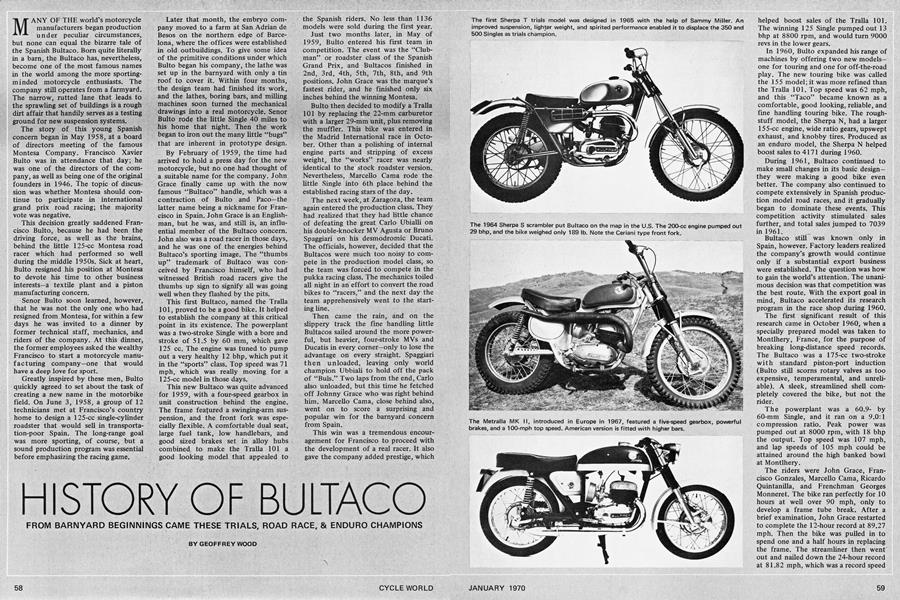
For 1964, the marque branched out even further by introducing new motocross models in 125, 175, and 200 sizes. Called the Sherpa S, these new bikes featured a Ceriani front fork that set a new standard in riding comfort. Performance was simply devastating. These three engines had the same bore and stroke measurements as previous models, but compression ratios were 13.0:1, 12.0:1, and 12.0:1 respectively. Larger carburetors provided power outputs of 22, 26, and 29 bhp. All three models had a four-speed gearbox, a 54-in. wheelbase, and 19-in. front and 18-in. rear tires. The dry weights of 182, 187, and 189 lb., respectively, made handling excellent. Because of these new scrambles bikes, exports to the U.S. shot up to 2161 of a total export of 2479 bikes. Total production was 13,449.
The TSS road racers continued to be highly successful in the hands of private owners. Bultaco riders generally were the first 125-cc private owners to finish. The 200-cc models also did well, and Oriol Puig Bulto, son of Francisco, won the Spanish 250-cc Motocross title. “Buis” were beginning to be used for scrambling all over the world.
For 1965, Bulto really warmed up to the dirt end of the sport, with the introduction of the 153-cc Campera, the 250-cc Sherpa T, and the 250-cc Pursang-Metisse. The Campera was a combination street and boon docking cycle, no doubt designed for the American market. In 1966, the Campera was enlarged to 175 cc, with a power output of 16.5 bhp. The super-fine suspension offered a generous 6 in. of front fork travel, and wide ratio gears were used. The Campera helped boost Bultaco sales to 17,392 in 1965 and 20,042 in 1966, with U.S. exports of 4906 in 1965 and 7199 in 1966.
The Sherpa T model, a pukka trials mount, was designed by the factory with the help of the great Irish trials rider, Sammy Miller. The Sherpa T had a wide ratio four-speed gearbox, a 4.00-18 rear tire, 2.75-21 front tire, a 53-in. wheelbase, and a dry weight of 202 lb. Power output from the 72by 60-mm engine was 18 bhp at 8000 rpm. A tiny 24-mm carburetor was used, and the compression ratio was 8.0:1.
The Pursang-Metisse was a fire-breathing 25 0-cc motocross model that
The great Sammy Miller is shown in action on the original Sherpa T in the 1965 Scottish Six Days Trial, which he won. This was the first win by either a two-stroke or a non-British bike in the classic highland event.
In 1960, this team of riders pounded the streamlined 175-cc Bultaco around Montlhery for 24 hours to average 81.82 mph. This record helped establish the name of Bultaco in Europe.
blended the famous Rickman-Metisse frame to a 36-bhp engine. A 32-mm carburetor was used, and the compression ratio was 12.0:1, This scrambles model became very popular with American riders for the fast TT-type scrambles races because of their terrific power. The Pursang helped establish Bultaco as a leader in the American rough-stuff competition scene.
Improvements to the TSS road racer for 1965 included water cooling and the increasing of the 200-cc model up to a full 250 cc. These were magnificent road racing models for the private owner, and their performance was good enough to win many national championships in the 125 and 250 classes. The addition of six-speed gearboxes also helped, and a constant improvement in the frame design, suspension, and braking strengthened overall performance.
Significant successes during 1965 included 3rd places in the 125 and 250 classes of the German GP, a 2nd in the Spanish 250 class, a 3-4-5 in the 250 French, 6th in the Ulster 125 and 250 races, 6th in the Finnish 250, and a 4th in the Monza 250 with a 6th in the 125 race. Then Sammy Miller won the famous Scottish Six Days Trial-the first time a non-British bike, or a two-stroke, had ever won this prestigious event. Sammy also won the British Trials Championship-something he has done every year since!
In 1966, the marque did even better in classical road racing, with a 6th in the IOM 250, 4th and 6th in the Spanish 250, as well as a 6th in the 125 race, a 6th in the Dutch 250, a 5th in the Czech 250, a 4th in the Finnish 250, and a 4th in the Italian 250 race. Then, in the fast Ulster GP, Ginger Molloy headed a Bultaco 1-2-3 win when the exotic Japanese 250-cc works multis tore their innards to shreds down the long straights. This was and still is the only outright win by Bultaco in world championship racing. It was earned by privateers who certainly had their day of glory.
The Bultaco line continued to expand for 1967. Models such as the four-speed Matador and the five-speed Pursang were two big reasons for the marque’s popularity in the U.S. The Matador was a combination street and boondocking model that was pushed out to five speeds (wide ratio) for 1968, while the Pursang is a brutal 34-bhp scrambler, always hard to beat in the 250 class.
The Sherpa T, after winning the 1967 Scottish Six Days Trial, was made a five-speeder for 1968, and Miller won
again that year! The gear ratios on the T model are so wide with this box that first gear is low enough for the worst obstacles, yet fifth is fast enough to really motor between observed sections. This gearbox, plus the 203-lb. weight and superb suspension, are probably the big reasons why Bultacos now dominate the European trials scene.
By 1968, the Bultaco range had been expanded to 21 models, a far cry from the one model that rolled out of the barnyard only nine years earlier. Included in the range were 100, 125, 175, 200, 250, 350, and 360 models in roadster, scrambles, enduro, trials, and road racing trim. The really big news in this lineup was the red hot 360-cc El Bandido motocross model that punched out a ghastly 43.5 bhp at 7500 rpm from its 85by 64-mm engine. The new 360 used a four-speed gearbox, and the weight was only 251 lb. The El Bandido featured the use of fiberglass in a rather striking manner for the fuel tank, fenders, and seat. Wheelbase was a longish 55.9 in.
Another popular model with American riders was, and still is, the Matador-a five-speed 250 combination street and woods bike complete with lights. With 22 bhp at 5500 rpm and a 247-lb. weight, the Matador is a fine dual purpose machine that performs exceptionally well in the rough. Its superb suspension offers the ultimate in rider comfort.
Probably the most popular model with the European crowd is the Metralla MK Il-a fast 250-cc roadster with a strong pseudo-racer accent. The Metralla mill shoves out a healthy 27.6 bhp at 8700 rpm, which provides a maximum speed close to the 100-mph mark. The sleek Single has a five-speed gearbox with ratios of 5.87, 6.44, 7.71, 10.0, and 17.24:1. Wheelbase is 51.0 in. The Metralla is known for its big, powerful brakes (which are housed in truly beautiful alloy hubs); the front binder has twin leading shoes and a massive air scoop. The Single, also known for its superb handling, will scratch around tight corners in true road racing fashion.
Another bonus with the Metralla is the “bolt-on” racing kit, which can be used to convert the roadster into a competitive racing bike. The kit includes a small head fairing, larger fuel tank, clip-on bars, seat, a rearset brakegearshift-footpeg setup, a special cylinder with wilder porting, a special squish head, larger carburetor, a piston, and an expansion box exhaust system. By fitting these parts, plus a set of road racing tires, an owner can go road racing in respectable manner—especially in “production” model races.
The race-kitted Metrallas have done well in international production model road races, such as the 1967 IOM 250-cc
race where they took 1st, 2nd, and 6th. The winning model averaged 88.63 mph, a good speed for this type of bike.
For the real grand prix enthusiast, the 1968-69 TSS models are the bikes that make the pulse pound. They are held in high esteem by private owners. The water-cooled 125 and 250 models, which have been under constant improvement, pump out 29 bhp at 11,500 rpm and 38.8 bhp at 9500 rpm, respectively. The performance through a sixspeed gearbox is fantastic for a singlecylinder piston-port engine. Top speeds with a fairing are claimed to be 118 and 130 mph. The gear ratios of the 125-cc racer are 7.3, 7.8, 8.5, 9.6, 11.5, and 15.5:1, while the 250’s are 5.2, 5.5, 6.2, 6.8, 8.2, and 11.1:1. The wheelbase is a short 51.0 in. on both models. Dry weights are 205 and 212 lb., respectively.
The TSS range was expanded late in 1968 with the addition of the new 350-cc model, a Single with bore and stroke of 83.2 by 64 mm. The new 350 is air cooled and runs a compression ratio of 11.0:1 (compared to 13.5:1 on the smaller racers), and the mill pumps out 50 bhp at 8500 rpm. Bulto claims a speed of 137 mph for the 350 which, combined with the 242-lb. weight and a five-speed gearbox, should make life interesting for other 350s. Carburetion on the 350 is by a 32-mm Amal GP unit, compared to a 30-mm size on its smaller brother.
These TSS models have continued to display an impressive performance in international grand prix racing, as well as winning many national championships. By 1968, the 125 and 250 TSS “Buis” generally were regarded as the finest production racers available to European private owners. In 1968, the marque was especially successful; Ginger Molloy placed 3rd in the 125-cc World Championship behind the exotic Yamaha V-4s, and S. Cannelas tied for 5th place. Molloy also finished 4th in the 250 class, as well as tying for 4th in the 350. All this on a simple piston-port two-stroke Single against the most exotic disc-valve two-stroke multis going today. In addition, are the magnificent victories by Sammy Miller in the 1967 and 1968 Scottish Trial, plus his 1968 European Trials Championship.
So ends this story of Francisco Xavier Bulto-a modern day genius of the international motorcycle scene. True, Bultaco never may be the world’s largest selling motorcycle, but somehow this doesn’t seem very important to Señor Bulto. The man appears to be a sportsman first and a manufacturer second, and upon such giants as this does the sport of motorcycling rest its case. Born in a barnyard and still a farm-based operation, the Bultaco already is a legend at the ripe old age of 10 years. i§)