Racing Review
RACING REVIEW
AND SO TO FLAT TRACK
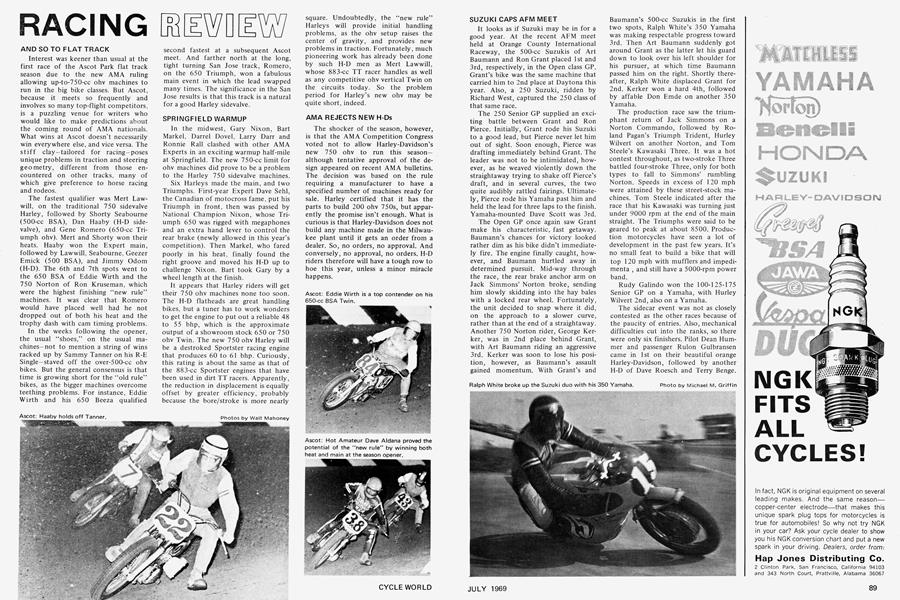
Interest was keener than usual at the first race of the Ascot Park flat track season due to the new AMA ruling allowing up-to-750-cc ohv machines to run in the big bike classes. But Ascot, because it meets so frequently and involves so many top-flight competitors, is a puzzling venue for writers who would like to make predictions about the coming round of AMA nationals. What wins at Ascot doesn’t necessarily win everywhere else, and vice versa. The stiff clay—tailored for racing—poses unique problems in traction and steering geometry, different from those encountered on other tracks, many of which give preference to horse racing and rodeos.
The fastest qualifier was Mert Lawwill, on the traditional 750 sidevalve Harley, followed by Shorty Seabourne (500-cc BSA), Dan Haaby (H-D sidevalve), and Gene Romero (650-cc Triumph ohv). Mert and Shorty won their heats. Haaby won the Expert main, followed by Lawwill, Seabourne, Geezer Emick (500 BSA), and Jimmy Odom (H-D). The 6th and 7th spots went to the 650 BSA of Eddie Wirth and the 750 Norton of Ron Kruseman, which were the highest finishing “new rule” machines. It was clear that Romero would have placed well had he not dropped out of both his heat and the trophy dash with cam timing problems.
In the weeks following the opener, the usual “shoes,” on the usual machines—not to mention a string of wins racked up by Sammy Tanner on his R-E Single—staved off the over-500-cc ohv bikes. But the general consensus is that time is growing short for the “old rule” bikes, as the bigger machines overcome teething problems. For instance, Eddie Wirth and his 650 Beeza qualified second fastest at a subsequent Ascot meet. And farther north at the long, tight turning San Jose track, Romero, on the 650 Triumph, won a fabulous main event in which the lead swapped many times. The significance in the San Jose results is that this track is a natural for a good Harley sidevalve. It looks as if Suzuki may be in for a good year. At the recent AFM meet held at Orange County International Raceway, the 500-cc Suzukis of Art Baumann and Ron Grant placed 1st and 3rd, respectively, in the Open class GP. Grant’s bike was the same machine that carried him to 2nd place at Daytona this year. Also, a 250 Suzuki, ridden by Richard West, captured the 250 class of that same race.
SPRINGFIELD WARMUP
In the midwest, Gary Nixon, Bart Markel, Darrel Dovel, Larry Darr and Ronnie Rail clashed with other AMA Experts in an exciting warmup half-mile at Springfield. The new 750-cc limit for ohv machines did prove to be a problem to the Harley 750 sidevalve machines.
Six Harleys made the main, and two Triumphs. First-year Expert Dave Sehl, the Canadian of motocross fame, put his Triumph in front, then was passed by National Champion Nixon, whose Triumph 650 was rigged with megaphones and an extra hand lever to control the rear brake (newly allowed in this year’s competition). Then Markel, who fared poorly in his heat, finally found the right groove and moved his H-D up to challenge Nixon. Bart took Gary by a wheel length at the finish.
It appears that Harley riders will get their 750 ohv machines none too soon. The H-D flatheads are great handling bikes, but a tuner has to work wonders to get the engine to put out a reliable 48 to 55 bhp, which is the approximate output of a showroom stock 650 or 750 ohv Twin. The new 750 ohv Harley will be a destroked Sportster racing engine that produces 60 to 61 bhp. Curiously, this rating is about the same as that of the 883-cc Sportster engines that have been used in dirt TT racers. Apparently, the reduction in displacement is equally offset by greater efficiency, probably because the bore/stroke is more nearly square. Undoubtedly, the “new rule” Harleys will provide initial handling problems, as the ohv setup raises the center of gravity, and provides new problems in traction. Fortunately, much pioneering work has already been done by such H-D men as Mert Lawwill, whose 883-cc TT racer handles as well as any competitive ohv vertical Twin on the circuits today. So the problem period for Harley’s new ohv may be quite short, indeed.
AMA REJECTS NEW H-Ds
The shocker of the season, however, is that the AMA Competition Congress voted not to allow Harley-Davidson’s new 750 ohv to run this season— although tentative approval of the design appeared on recent AMA bulletins. The decision was based on the rule requiring a manufacturer to have a specified number of machines ready for sale. Harley certified that it has the parts to build 200 ohv 750s, but apparently the promise isn’t enough. What is curious is that Harley-Davidson does not build any machine made in the Milwaukee plant until it gets an order from a dealer. So, no orders, no approval. And conversely, no approval, no orders. H-D riders therefore will have a tough row to hoe this year, unless a minor miracle happens.
SUZUKI CAPS AFM MEET
The 250 Senior GP supplied an exciting battle between Grant and Ron Pierce. Initially, Grant rode his Suzuki to a good lead, but Pierce never let him out of sight. Soon enough, Pierce was drafting immediately behind Grant. The leader was not to be intimidated, however, as he weaved violently down the straightaway trying to shake off Pierce’s draft, and in several curves, the two quite audibly rattled fairings. Ultimately, Pierce rode his Yamaha past him and held the lead for three laps to the finish. Yamaha-mounted Dave Scott was 3rd.
The Open GP once again saw Grant make his characteristic, fast getaway. Baumann’s chances for victory looked rather dim as his bike didn’t immediately fire. The engine finally caught, however, and Baumann hurtled away in determined pursuit. Mid-way through the race, the rear brake anchor arm on Jack Simmons’ Norton broke, sending him slowly skidding into the hay bales with a locked rear wheel. Fortunately, the unit decided to snap where it did, on the approach to a slower curve, rather than at the end of a straightaway. Another 750 Norton rider, George Kerker, was in 2nd place behind Grant, with Art Baumann riding an aggressive 3rd. Kerker was soon to lose his position, however, as Baumann’s assault gained momentum. With Grant’s and Baumann’s 500-cc Suzukis in the first two spots, Ralph White’s 350 Yamaha was making respectable progress toward 3rd. Then Art Baumann suddenly got around Grant as the latter let his guard down to look over his left shoulder for his pursuer, at which time Baumann passed him on the right. Shortly thereafter, Ralph White displaced Grant for 2nd. Kerker won a hard 4th, followed by affable Don Emde on another 350 Yamaha.
The production race saw the triumphant return of Jack Simmons on a Norton Commando, followed by Roland Pagan’s Triumph Trident, Hurley Wilvert on another Norton, and Tom Steele’s Kawasaki Three. It was a hot contest throughout, as two-stroke Three battled four-stroke Three, only for both types to fall to Simmons’ rumbling Norton. Speeds in excess of 120 mph were attained by these street-stock machines. Tom Steele indicated after the race that his Kawasaki was turning just under 9000 rpm at the end of the main straight. The Triumphs were said to be geared to peak at about 8500. Production motorcycles have seen a lot of development in the past few years. It’s no small feat to build a bike that will top 120 mph with mufflers and impedimenta , and still have a 5000-rpm power band.
Rudy Galindo won the 100-125-175 Senior GP on a Yamaha, with Hurley Wilvert 2nd, also on a Yamaha.
The sidecar event was not as closely contested as the other races because of the paucity of entries. Also, mechanical difficulties cut into the ranks, so there were only six finishers. Pilot Dean Hummer and passenger Rulon Gulbransen came in 1st on their beautiful orange Harley-Davidson, followed by another H-D of Dave Roesch and Terry Benge.
Continued from page 89
AFM SPEED TRIALS RECORDS
In addition to road races and observed trials, the American Federation of Motorcyclists is now sanctioning speed trials at the Laguna Salada dry lake bed in Mexico. Because the meet held there last April was the first of that type for the AFM, the fastest speed in each class stands as an AFM record. However, three machines attained speeds faster than existing AMA records.
Don Vesco of San Diego recorded a blazing 147.05 mph on a partially streamlined 350-cc Yamaha. Gary Scott was clocked at a record 87.29 mph on his unstreamlined Cimatti, and Jerry Mathel, also Cimatti mounted, sped to 65.48 mph on a 50-cc unstreamlined machine.
The speed runs were timed by the Southern California Timing Association, the organization that clocks the AMA’s speed runs at Bonneville Salt Flats.
In the 500-cc partially streamlined class, Alan Holloway recorded the fastest speed on his Kawasaki Three. He was timed at 121.45 mph. Another Three, the BSA of Roger Selby, went 123.28 mph to take the 1000-cc unstreamlined class. Brooks Harper sped his partially streamlined 750 Norton to an AFM record of 131.37 mph.
95-MILE NATIONAL ENDURO
Winning his second Southern New Jersey Championship in three appearances, Jack McLane of Port Huron, Mich., totaled 980 points on a not-sostock Honda to capture the “Curly Fern” 95-mile National Championship Endurance Run, Boyd Reynolds reports.
Within sight of the famous Lakehurst Blimp hangers, the contest started at Whitings and went into the woods. Except for crossing three macadam roads, that was the last pavement the 351 enthusiasts saw until the end of the run. They were in the rough all the way, dodging around a 20-square-mile area of virtual wasteland—scrub brush, sand and a few weathered, stubby pine trees. Except for four well-prepared, marked and roped-off spectator areas, there were no roads accessible to the people who usually get in the riders’ way. Photographers came home with their film still unexposed. The brush took its toll of cut and bruised faces and battered hands. Various devices were used to protect exposed limbs.
Illinois rider Bob Agans, rider No. 2, led for almost half the run, but winner McLane became trail breaker just before the gas stop. Four riders had started per minute, and McLane, No. 10, had passed almost 40 riders in 45 miles of tight, rugged trail.
Bob Fusan of Pittsburg, Pa., (Yamaha) followed the leader with a 971-point average to ease out John Penton (Husqvarna) with 968. Bill Osterkamp (Bultaco) also scored 968, but Penton gained the gold at the emergency check.
The highlight of the weekend was the absence of six-time National Champion Bill Baird. Injured last fall, Baird tried Stone Mountain Enduro this spring with a knee brace, but found riding too difficult. This, together with the increase in National contests, may sideline Baird from another sure win of the title crown.
The award is open for grabs, and some eager stump-jumpers are in contention to make the grade. The most obvious are John Penton, Jack McLane, Bob Fusan and John Young, in that order. Consistent placers Norman and Fred Ford are dark horse entries. This title can be won without ever winning a contest, provided the 1st place trophies are spread around.
AMERICAN ENTERS SCOTTISH
Victor Boocock, one of the United States’ better trials riders, has departed to compete in the Scottish Six Days Trials. Vic first will go to the offices of the Rickman Brothers, England’s Bultaco distributor, to take delivery of his new Bultaco Sherpa T. Next, to Sammy Miller’s shop for training and preparation for the grueling Six Days. Sammy and the Bultaco factory are helping Vic expand U.S. representation in true international competition.
NIGHT MOTOCROSSING
The California Moto-Sport Club has added a new dimension to the West Coast competition scene—night motocross racing. The events began in early May near the former Fontana drag strip. The 5/8-mile course is a generous 36 ft. wide and is surfaced with a graded loamy soil. Also, the entire course is bathed in mercury vapor light, allowing optimum visibility of the sweeping turns and high-speed jumps for riders and spectators alike.
The CMC provides each competing rider with $3000 medical coverage with the $5 entry fee. Another benefit offered by the club is ample practice time before the meet. Competition is divided into the following classes: 125-cc junior and expert, 250-cc junior and expert, and 500-cc open. Spectator admission is $2.
FIM TURN-AROUND
The FIM has had second thoughts about the formula for GP road racing machines in coming years. As international class road racing for the world championship stands now, Fours, Fives and or even V-8s may run together with machines of fewer cylinders in most displacement classes, and gearing seems limited only by the number of cogs an engineer can cram into the cases.
Then a rule change affecting the larger solo classes was proposed. The GP bikes would be limited to two cylinders and six-speed transmissions. Proponents of the new formula thought that the new limitations would be more realistic, i.e., relate better to the production motorcycle industry, and competition would be heightened, as, presumably, it would not require monolithic financing to build a competitive six-speed Twin. This would end the inevitable procession of three or four multis at the front of every GP race, followed by the less speedy hordes of Twins and Singles.
The proposal didn’t enthrall everybody, however. European and British enthusiasts, once having heard the eerie howl of an MV Three or Honda Four, not to mention the Güera, Guzzi or BeneUi multis, are not so willing to see them shelved for the sake of equality. Nor do the factories mentioned like the idea. The overseas motorcycling press treated the twin-cylinder formula very cooUy.
Now it appears that the FIM has retrenched, to a partial degree. At the spring meeting of the International Technical Commission it was decided to amend the previous proposals regarding the 350and 500-cc -classes. This decision is stül at the proposal stage and must be ratified by the FIM General Councü in October 1969. If the proposal is ultimately passed, it would normally go into effect on Jan. 1, 1970.
In the meantime, the new amendment wül leave some buüders who have embarked on developing Twins to conform to the original proposal wondering whether they did the right thing.