1st of the Great Champs

1st of the Great Champs
J. L. BEARDSLEY
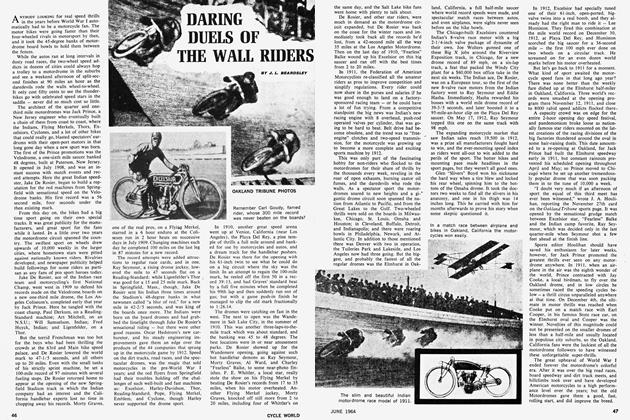
OTTO WALKER could roar through a sizzling mile on the high banks of great auto speedways, or run his opposition ragged in a 300-mile road race, and set world records at both ends of the scale. Walker was ace of Harley-Davidson’s mighty “Wrecking Crew” of professional racing greats from 1914 to the early 1920s.
Even Lady Luck was of little help in beating Otto and his “Gray Streak” Harley with its engine tuned by the skillful Walker, and ridden like nobody else ever could. A trained mechanic. Walker always worked something extra into his machines that gave them an edge over other bikes on the track. Otto had his bad moments, too. These never were minor mishaps. Walker’s spills were horrendous; they jarred spectators into a state of shock. Yet, Otto nearly always was able to walk to the ambulance.
Born in Lathrop, Calif., Otto entered his racing career in 1911 at age 21. His first mount was an Excelsior, and, though he didn't win his first race, he earned a 4th place which rewarded him with a plump Thanksgiving turkey.
The Elmhurst Motordrome in Okland, Calif., had just opened. Riders were needed, so Otto signed up. In addition to establishing some amateur records, Otto rode his Excelsior to seven wins in eight starts on the board bowl in 1911-12.
Though a major exercise of will power was required, Walker returned to complete his machinist apprenticeship that year. In 1913, he teamed with Earl Armstrong, who later became a famous rider for Indian, but who then was riding a ported Excelsior. They toured the California tracks, with Walker winning the 10-mile FAM western Amateur Championship at Sacramento, and later sweeping the entire card at Santa Rosa, Calif.
In 1914, Harley-Davidson was assembling its first professional race team. This brought Walker and Dud Perkins, later a hillclimb champ, to Milwaukee as fast as the trains would run. Both were signed to contracts without delay.
Walker’s first test as a salaried pro was to ride a new machine in a dirt track meet. He won all his races on a very slippery circuit. Team manager Bill Ottoway slapped Walker on the back, and said, “Kid, you're gonna go a long way in this business.”
Ottoway’s prediction very quickly started to come true. The first major meet for the Harley race team was the 300-mile Grand Prix at Venice, Calif., April 4, 1915.
No expense was spared to assure the best possible road course for this motorcycle speed extravaganza, promoted by Paul Derkum.
The course was laid over residential streets of Ocean Park, Santa Monica and Venice, but all sharp corners were rounded by cutting across vacant lots. At Rose Avenue and Washington Boulevard, part of a lumber yard and an office building were removed, and a banked plank curve was erected in their place.
At the opposite end of the course, two turns were combined into one, and a large section of the Playa del Rey Motordrome was used for perfect banking in this curve.
Never before or since has a combination road race and speedway course offered so many new angles to even experienced riders of both type tracks.
Among established stars such as Red
Parkhurst, Joe Wolters and Roy Artley, Otto Walker was a very dark horse on the Harley team.
The talent-laden Indian team included Ray Creviston, “Speck” Warner, Morty Graves, K. H. Verrill, AI Ward, and Lorenzo Boido, sensational winner of the San Diego-Phoenix “Cactus Derby.”
The Excelsior camp also ran to quality, with Bob Perry, Carl Goudy, Glen Stokes, and Bob Montgomery.
The Pope, Thor and Dayton factories also entered skilled, experienced competitors.
In reporting the race. Motorcycle Illustrated singled out three for special notice saying, “In the work of Walker, Parkhurst and Goudy, the feature was consistency.”
There were plenty who lacked this magic formula. Six Indian riders were forced out by minor spills or mechanical trouble.
Bob Perry, the Excelsior ace, was plagued by more than his share of bad racing luck. He started off in the lead, and held it for the first nine laps, until a flat tire put him in the pits. Once again on the track, he poured on the coal for a steady climb towards the top, though it was Lap 38 when he nosed out Otto Walker and Red Parkhurst for the lead, but Parkhurst battled him past the half-way mark; and Walker, after the last of three refueling stops, moved up to make it a three-way contest.
Parkhurst edged ahead in Lap 89 then Walker made his move. The Harley riders staged a wheel-to-wheel battle lap after lap that worked the crowd to a frenzy.
In Lap 98, Walker’s orange-and-blue sweater flashed past in the lead, and he opened up his edge to 200 yards as he took the checker first.
Walker had upset the greats of the bike derby sport with a brilliant ride and perfect pacing to set a 300-mile competition record average of 68.31 mph. Red Parkhurst was 2nd by only 15 sec.; Carl Goudy, Excelsior, 3rd; and Bob Perry, his teammate, 4th.
Walker is said to later that year have won a 234-mile road race at Ft. Dodge, Iowa, but details are lacking.
Soon professional riders representing seven makes of American motorcycles converged on the two-mile dirt track at Dodge City, Kan., for the second annual 300-mile International Championship, July 4, 1915.
Harley-Davidson readied its 8-valve, 61cu. in. twins. To reinforce the team, Otto Walker, Red Parkhurst, and Joe Wolters, were given the able help of Ray Weishaar, Bill Brier, Harry Crandall, Ralph Cooper, and AÍ Stratton.
The rival Indian all-star crew was made up of Earl Armstrong, Ray Seymour, Gene Walker (no relation to Otto), Glenn Boyd, Morty Graves, Eddie Hasha, Lee Taylor, and Charley “Fearless” Balke.
The valuable talent of the noted Floyd Clymer was added to Excelsior’s big three, Cary Goudy, Bob Perry and Glen Stokes.
Over 16,000 fans — some from hundreds of miles away, anticipated a memorable battle as the giants of racing clashed.
A mighty cheer sent the 29 riders on their way in the 1915 “Coyote Classic.” As expected, young Don Johns powered his fast overhead-cam Cyclone into the lead. He was followed by Lee Taylor on an Indian. Soon, however, the entire Excelsior crew started to crowd Johns. Indian’s veteran Morty Graves, 30 miles farther on, moved up to 2nd, closely followed by Otto Walker and Glen Boyd.
In a hard drive, Carl Goudy picked off the leaders and roared into first place at the 100-mile mark, with a track record of 1 hr., 14 min. and 10 sec.
Walker paced himself behind Goudy for another 40 miles before taking over the lead. It was evident by the half-way point that Walker would set a new record for as long as his engine lasted in the blazing July heat.
Morty Graves had the same idea, and was hanging doggedly onto 2nd place, with Joe Wolters 3rd.
A flat tire at 238 miles put Walker into the pits. Graves went ahead to the cheers of the Indian enthusiasts. Harry Crandall, H-D, now was runner-up, but Carl Goudy printed into 3rd as the race opened up.
It was always a mystery to other riders how Otto always carried a margin of reserve power in his famous “Gray Streak” Harley. This power edge, combined with Walker’s resourcefulness and stamina, made Walker a difficult man to head in the final stages of a long race. Morty Graves discovered this as he looked back to see Walker bearing down relentlessly. Otto forged ahead in the final laps to win the Dodge City classic with a new world flat track record of 76.27 mph.
In the last lap, Morty Graves’ machine went dead in the back stretch with a cracked fuel tank to give Harry Crandall 2nd; Carl Goudy, Excelsior, was 3rd; Wolters, Parkhurst, Stratton, and Cooper finished in that order in a solid HarleyDavidson victory parade.
Otto was to make history again when he and his “Gray Streak” entered the biggest motorcycle derby ever run on board tracks — he might have won the 300-mile American National Championship on Sept. 12, 1915, on the 2-mile Chicago Maywood Speedway, except for bad luck.
This smooth plank bowl was a race rider’s dream, compared with the dusty, rough, dirt and road courses. The boys rode its banks wide open early in the race. Even the cagy Walker rode as though it were a 5-mile sprint. At 100 miles, he had set a world speedway record of 1 hr., 7 min. and 43 sec. — a mark that was not beaten until 1923, and maintained his lead until 160 miles when a pit stop put Carl Goudy, the winner, in front. At 188 miles a broken valve ended Walker’s day.
In the spring of 1916, Walker returned to the Chicago Speedway for tests of some new Harley racing motorcycles intended for the Dodge City 300-miler. He was lapping the saucer at over 97 mph when a tire blew and Walker went into a 50-ft. slide that filled his anatomy with splinters enough to keep doctors busy for weeks pulling them out. A 14-in. gash on one leg was another item that kept him sidelined for three months.
Otto moved to New York after this, and was employed by Harley-Davidson Sales Co., of New York City. He was ready when the famous Sheepshead Bay Auto Speedway, in Brooklyn, staged the first motorcycle race meet on this beautiful 2mile oval July 4, 1917. This attracted 30 of the nation’s best riders, all mounted on pocket-valve machines as the 8-valve machines were barred from this meet.
Over 8500 spectators in the stands saw Otto Walker run away with the 10-mile professional event in 6 min., 58.2 sec. For the 20-mile professional race, L. G. Buckner rolled out his Indian 8-valve engined machine as a protest move to show up the pocket-valves as too slow. His effort was lost. Walker roared home an easy winner over Buckner, proving that racing brains are sometimes better than horsepower.
Walker experienced no trouble in winning the 100-mile feature to become the day’s big star.
This sensational showing won Otto Walker an opportunity to break the 24 hour sidecar record. On July 19 and 20,
1917, with Carl Rutgers as passenger, he circled the Sheepshead Bay boards all day and night to rack up 1158.75 miles for another world record for Harley-Davidson.
In December, 1917, Otto enlisted in the U.S. Army Air Corps for the duration of World War I. He went overseas in April,
1918, as a Master Signal Electrician. On discharge, in mid-summer 1919, he held the rank of Sergeant-Major.
Walker hadn’t lost his ability to swing through the high-banked curves at Sheepshead Bay, as he soon proved at the big postwar meet of Oct. 11, 1919. Once more in the saddle of a finely tuned Harley, he smashed the world competition record to win the 2-mile National Championship dash at 96.5 mph and possession of the Goodrich Cup.
From here, the professional teams shipped west to the 1-mile dirt Ascot Speedway in Los Angeles, Calif., for winter season competition. Walker scored in a 50miler Nov. 30, in 40 min., 30.6 sec.
A holiday crowd of 25,000 turned out to see him gun his pocket-valve Harley into first money in a hard 100-mile derby in 77 min., 42 sec. on Jan. 4, 1920, to beat Harley aces Ralph Hepburn and Red Parkhurst, who chased him from Lap 43 on.
A week later, on Jan. 11, Ascot fans saw the wildest exhibition of two-wheel speed, spills, and heroics ever witnessed at this famous arena. In the 25-mile Natonal, records fell from the first lap onward as AÍ Burns and Bob Newman, on Indians, and Walker clashed in a savage duel for the lead.
Lap 5 saw Ray Weishaar, H-D, blow a tire, crash, and escape unhurt.
Then in Lap 11, Bill Church’s Indian caught fire, and he skidded across the track in a trail of flames directly in front of Joe Wolters, who threw his Excelsior down to avoid the prostrate Church. Again, bruises were the only injuries.
Then, in the final lap, Otto Walker lost the race in a too-fast try to pass AÍ Burns. Walker was forced to go down or hit the outer rail. He jumped to his feet and was back on the machine in an instant to finish 3rd. Burns took this event with new records all the way from 1 to 25 miles.
They went back to battle for the 50-mile Ascot Championship, and, with no mishaps, Otto was the best man, 37 min., 47.4 sec. His teammates Fred Ludlow and AÍ Burns were 2nd and 3rd respectively.
Otto was at home on the dirt and was never better than on a 1-mile flat track. At the Kings County Fair in Hanford, Calif., Oct. 11, 1920, all riders agreed it was the best mile track they had ever ridden. The meet was electrically timed and governed by the M&ATA officials (predecessor of AMA).
The “Harley Hurricane” warmed up by setting a track record in a 25-mile race of 20 min., 30 sec., and then reeled off a world dirt track mark of 40 min., 12.6 sec. for 50 miles.
Only one visit from Otto Walker and the Harley “Wrecking Crew,” Hepburn, Davis, Weishaar and Ludlow, was required to make the Fresno, Calif., 1-mile board speedway the fastest motorcycle track in America. The H-D gang dueled with Indian all-stars AÍ Burns, Gene Walker, Bill Church, and Roy Artley, on Feb. 22, 1921, in a sanctioned M&ATA meet before 10,000 fans who saw history made in every event won at over 100 mph.
Riding 61-cu. in. machines, Walker’s mile in 33.4 sec., and 5 miles in 2 min., 52.8 sec., both set American records.
Walker defeated AÍ Burns in a 10-mile sprint in 5 min., 45.4 sec. for another certified mark. The 15-mile event was Walker’s, over Weishaar and Burns, at 105 mph.
Then came the 50-mile San Joaquin Valley Championship, a race without an equal in the annals of the sport. Walker’s winning time was 29 min., 34.6 sec., fast enough a Class A, Solo Board Track Record (with racing fuel) and a speed that has never been beaten by motorcycles!
Unfortunately, Walker’s machine carried no brakes. The record at that time was denied because the rules specified an operating brake system. The AMA later accepted the record. It remains in the “All Sports Record Book” today. With board tracks long gone, it will stand forever.
Beautiful Beverly Hills Speedway drew 11,000 Los Angeles and Hollywood fans, on April 24, 1921, when motorcycle greats — resplendent in bright-colored costumes — engaged in record-smashing contests.
The first thrill of the day came in the opening Miss-And-Out-race, when AÍ Burns shot his Indian ahead of Otto Walker just before the finish to edge him in a 103-mph chase.
Among the eleven starters for the 25mile Sunset Sweepstakes were some very fast people and machines such as H. Cogburn and the Ray Day Special; Ray Creviston on a Reading Standard; N. Cooper with a B Special; and Joe Wolters on an ohc Excelsior.
A1 Burns and Gene Walker were on Indians, and the Harley “Wrecking Crew,” rounded out the field.
Sporting a pure white uniform and helmet, Otto Walker was easy to watch as he streaked out in the lead. Burns climbed to a short lead in Lap 2, but Walker regained it in Lap 4. Speed was 106 mph.
Jim Davis, H-D, then took a hand in making it a three-way duel until unlucky Lap 13 in which Burns charged at the leaders with everything open and his engine seized, throwing him into a 50-ft. slide that stopped in front of the opendoored ambulance. Burns ignored this and walked to the First Aid Station, accompanied by a tremendous ovation.
Walker split the wind for another sensational victory on the boards, and with a machine conforming to the international code, his 10 miles in 5 min., 43.6 sec., 15 miles in 8 min., 36.4 sec.; 20 miles in 1 I min., 28.2 sec.; and 25 miles in 14 min., 21.8 sec. all claimed as world records.
Walker's great rides on California speedways can’t be listed in their entirety, but the race that marked the zenith of his remarkable career came at Beverly Hills on Jan. 23, 1922, when he was chosen by Harley-Davidson Co. to ride a new special 61-cu. in. machine in an assault on all board track records up to 100 mph.
His first mile was a new world mark of 32.94 sec., and he ran ahead of his old records up to 37 miles, when a fouled plug cost him a possible 50-mile mark. However, he sailed on to cover 98.64 miles in one hour, and score a total of six world records.
It was a smashing climax for the Harley ace who decided to hang up his goggles in 1922, for a quieter life in the trade.
For some 30 years before his death, Walker operated a sports fishing boat, “Keesa,” best known in San Francisco Bay and Sacramento River Delta regions.
At age 73, H. Otto Walker died Dec. 18, 1963, at the Veterans Hospital near his home in Oakland, Calif. May the memory of this pioneer motorcycle champion endure as long as his records — forever.