Round Up
ROUND UP
JOE PARKHURST
CYCLE WORLD is five years old with this issue. The phenomenon of a new magazine growing to these proportions in such a short time still amazes some. We now have several competitors who didn't even exist in our earlier days, many of whom apparently want to play "follow the leader." Evidently we have set an example, but I won't go into the buck-chasing aspects of some of CW's new rivals.
CYCLE WORLD continues to grow in every way. Plans for furthering our lead and for improving the magazine include some pretty exciting projects that should be a lot of fun and make good reading as well. We have a number of CW firsts in this issue, including a scoop on the newest 650 soon to enter the U.S. We also have a few surprises that Ivan Wagar, CW's editor, and I brought back from our recent trip to Japan, where we visited the entire Japanese motorcycle industry.
We began our hectic two-week trip at Suzuki, then to the Japanese Grand Prix at the FISCO circuit to watch Gary Nixon show them the way around. This was fol lowed by a hurried procession of visits to Honda, Marusho, NGK spark plugs, Hodaka, Kawasaki, Honda Research & Development and Bridgestone.
(Continued on page 6)
Ivan stayed on for the Tokyo Motor Show and the All-Japan Motocross, while I rushed off to meet Mrs. Parkhurst in Hawaii for a little rest before diving back into this issue. Quite a two weeks, I tell you!
We omitted the mighty Yamaha factory on this trip as I had visited all of their plants last year as their guest, in the company of their American dealers.
It would be difficult for me to describe the wonderful reception Ivan and I received in Japan, and how fond I have become of that incredible little country. Mr. Shunzo Suzuki, president of the company that bears his name, entertained us royally (it ain't true what you've heard about Geishas). We were also shown their fantastic test course, but were only given production machines to ride. Mr. Suzuki is like a great many Japanese businessmen I have met who get a tremendous kick out of life. Suzuki is a huge, well-run and efficient factory, producing an excellent product that has, in a very short time earned a position of high respect in the American market. Also, like so many in Japan, the company has worked against great odds to further the image of Japanese industry in the world. Suzuki rolled out the red carpet for us, delaying the departure of Mr. Suzuki, (who was to leave for the U.S.), and, the dedication of U.S. Suzuki's beautiful new headquarters. Their export manager, Y. Zenitaka, met us at the Tokyo Airport, entertained us, then escorted us to Hammamatsu City, where their head offices are located. Quite a reception!
On the way back north to Tokyo, we ran into Taiji Yamada, sales manager for Yamaha. Mr. Yamada was racing manager for them last year when I first met him in Japan and later at the Isle of Man. We met at the station, where we were waiting to board the fantastic New Tokaido Express, the 125 mph passenger train that zips from Tokyo to the north of Japan so fast it beats air travel. Mr. Yamada was in the company of Senji Nakamura, another Yamaha director I had met before in this country. We all went around "bowing" at what a small world it is! Of course, in Japan, it is a small world!
(Continued on page 8)
The Japanese Grand Prix is fully covered in this issue, so I won't go into it, except to say what a wonderful place for a race the Fuji International course is. We watched the GP with CW's Japanese counterparts' publisher, T. Sakai, of the Japanese Motorcyclist Magazine.
A superb, well-run and handsome racing plant it is, with everything but proper press accommodations. It's the first race course I have ever visited that did not allow photographers into all of the places they need to go to take pictures.
Honda's Hammamatsu factory, where they make all of the over lOOcc machines was next on the schedule. We were greeted with a welcome sign over the front entrance that was the first such greeting we were to see at all three Honda installations we visited.
(Continued on page 10)
After getting lost once and having a flat tire, we were too late to make it to the little Marusho plant. But, true to the courtesy and kindness typical of most Japanese, Mr. Ito, president of Lilac, as it is known in Japan, met us with Managing Director M. Fukuzawa in town. We had a very pleasant visit which included a long discussion regarding the future of the opposed twin Marusho in the U.S. We are receiving virtually their entire production in this country. Marusho is in the planning stages of many additions and improvements to the bike, already winning supporters among big bore riders.
Our next day was one that will not be forgotten. It began with an early morning stop at the fascinating NGK spark plug factory in Nagoya. As with my last visit to Japan, the factory I enjoyed seeing in operation most was not one producing motorcycles. Yamaha's unbelievable automated piano factory enthralled me last year; this time the really unbelievable NGK spark plug plant had us spellbound. They use the very latest manufacturing processes and machines, some of it highly secret, to make what may be the very best spark plugs in the world. S. Ogana, managing director, wouldn't let me take any photographs, so I can't illustrate the staggering number of spark plugs parading around the plant in various forms of completion, passing through some really clever machines, down to the last gap checking and the ingenious automatic packaging line.
We departed sadly, but a bit richer, since NGK kindly supplied me with a set of plugs for my Ferrari.
Next on the agenda was a stop at the little Hodaka plant in another part of Nagoya, wherewe were greeted by the genial genius, Henry Koepke, of PABATCO, the U.S. importers of Hodaka. Koepke was keeping good company with M. Oishi, Hodaka Industrial Co. Ltd. president, and other executives of PABATCO in Japan. We've been telling them to put the tidy, well-run plant into production on a 250cc version of the Hodaka 90 for years. Maybe some day they will! Hodaka's second efforts are in the making of industrial transmissions, and a little side effort is being spent on a 500cc engine for Japanese speedway racing. Not a big, glamorous place, but rather one utilizing every square inch of space, where attention to detail and conscientious workmanship go into the making of a superb little bike. We also crossed Nagoya a second time to see the assembly plant and watch the familiar red and chrome Hodakas being tested. I saw some of the most beautiful gear manufacturing being done at Hodaka that I have ever seen. A great deal of hand work goes into all of their products, accounting in no small measure for the high quality.
Our next stop followed a breathless drive in a Honda-furnished Ford sedan, driven by one of the best drivers in Japan who elected not to choose any opportunity that arose to prove his skill with an automobile. Japanese drivers may not be the best in the world, but they surely are skilled at avoiding obstacles,
(Continued on page 12)
Honda's Suzuka factory was our goal. This is where they make all machines under lOOcc. It is a fabulous plant that does credit to any in Detroit and it boasts the latest in automated systems and automatic machines, some of which they developed themselves.
Our technically minded editor went wild in several departments. The sight of Honda 50s and 90s pouring off the ends of two 10-man assembly lines at one every 18 seconds is enough to warm the heart of any genuine enthusiast. We were given a ride on the new "Little Honda," the moped with the overhead camshaft 50cc single mounted in the rear hub, (see Report From Japan, September 1966 issue). It pedals just like any bicycle, but when the engine is engaged, it will run up to about 30 mph so quietly you can hardly tell it is running at all. Honda does not plan on importing it to the U.S., though for the life of me, I don't know why. It would sell like hot cakes (and you know how they sell) over here, if for other reason than its price — $83 in Japan! I know well that other mopeds have failed on this market, but this one is different.
We were treated to a few laps on the Honda-owned Suzuka road race course, behind the wheel of one of the new 800cc Honda sports cars. Not as much fun or as challenging as a racing bike would have been, but fun anyway, and we got an excellent look at the course which was the site of the last three Japanese Grands Prix. A little Disneyland-like park is intermingled, as are several restaurants and amusements. We had a Japanese style barbecue of beef, peppers, bamboo shoots, lotus, egg-plant, eaten after dipping them in a soy bean sauce, accompanied by an endless supply of superb Japanese beer. Then we were off again for the distant city of Kobe and a visit to the mighty Kawasaki empire.
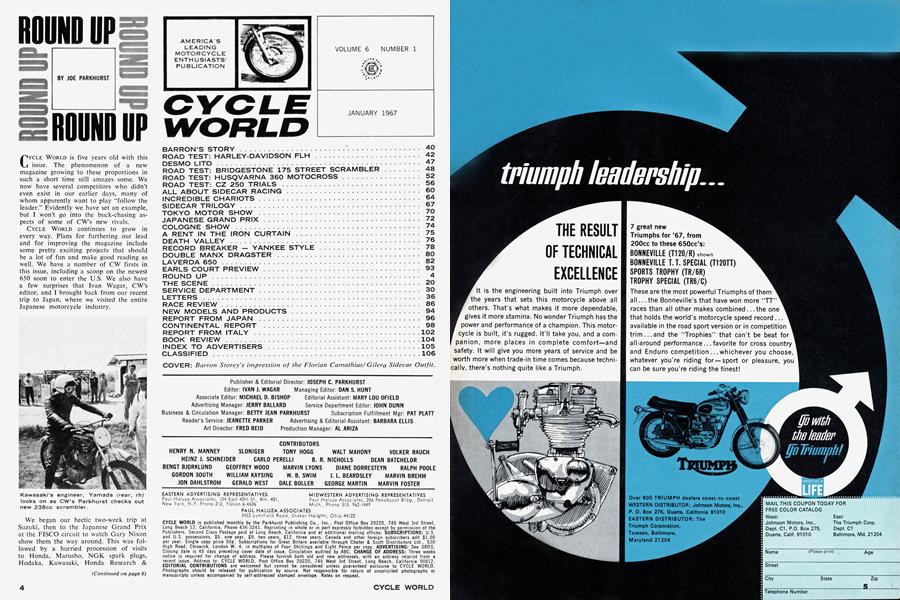
Kawasaki is the looming giant in the motorcycle world. No other Japanese motorcycle manufacturer has adapted itself so easily to the demands of the American rider. The new Samurai production 250 road racer version of our December test bike was offered to us for a ride, and Wagar rode the 125cc grand prix bike as well. I got a long, hard ride on a machine they had reserved judgment on, but have since decided to import into the USA -the 238cc scrambler, with a rotary valve two-stroke single cylinder engine mounted in a genuine double loop tubular scram bler frame and a marvelous pair of forks. Kawasaki will be the first Japanese maker to build a real scrambler, as opposed to the "street scrambler" types with which we are familiar. I predict great things for the bike. It handles and steers beautifully, is easy to control and comfortable. It is a bit short on wheel base, but most riders will probably like that. Of course we'll have a road test, and soon.
(continued on page 14)
The huge Kawasaki industrial complex of ship building, aircraft, heavy industrial equipment, busses and trucks, and, of course, motorcycles, is just beginning in the motorcycle field. Mr. Ryozo Iwaki, managing director of the Aircraft division, of which cycle-making is a part, took us on a personally guided tour of the plant, wined and dined us, and was extremely receptive to our suggestions and ideas. We were given some pretty rare opportunities by being allowed to ride factory racing equipment and to take a try at such things as the prototype of the 238cc scrambler. Ivan's ride on the 125cc was something to see, since the course was only a mile or so long — narrow, straight, and with a hairy loop at each end. I diced through the weeds on their 90cc factory scrambles racer, with Takashi Yamamoto, Kawasaki's ace motocross rider, who three days later, won the All-Japan Motocross.
Our visit to Kawasaki was the highlight of the trip, since they extended themselves so far and allowed us to do almost anything we wanted.
After yet another evening of fun and frolic, (and for those men who have been to Japan, I need say little in addition) and the warm hospitality of the friends we made in Kobe, we hopped on another Kawasaki product, the New Tokaido Express train which was built in their railroad division. Then we were off for Tokyo again, and a visit to Honda's Research «fe Development Center. Here we had a "gas" of a visit with Soichiro Honda, himself. This charming little man is an avid CYCLE WORLD reader and often uses CW for reference. Most flattering, needless to say.
Honda, that is Mr. Honda, operates the R&D as a separate enterprise and he devotes all of his time to just that — research and development of Honda products. We saw little that was new, other than a cryptic reference on a drawing board to the CL-450. We knew Honda would undoubtedly make a street scrambler version of the 450; it's just nice to see one's predictions coming true. We spent quite awhile in the engine testing rooms. They have over 20 dynanometers, performing hundreds of various stages of testing production units, developing the racing engines, testing even mundane things like power plants for cars, tractors, power plants, lawn mowers, etc. R&D is, indeed, Valhalla. The machines and equipment in use are of the type found only in institutions and laboratories, with much of it built and designed by Honda engineers. Mr. Honda gleefully showed us as much as the big corporate image would allow, since we were the snooping press. The staff of more than 800, 160 of whom are graduate engineers, almost worship the old man. R&D is a spotlessly clean, im maculate laboratory, which easily explains how Honda won all five world champion ships in 1966. Infinite care and attention to detail is given to every phase of design and manufacture, and all the products are given a make-or-break showdown. Al though this is true of all the Japanese motorcycle industry - it is prominently demonstrated at Honda R&D. We found much to talk about with Mr. Honda, even to embarrassing questions such as why Honda no longer builds production racers for their many thousands of supporters. His answer was simply that they are re luctant to sell complicated racing ma chines to private owners because of maintenance problems. It is a valid argument, but I pointed out the invaluable publicity they were missing; that men are racing their bikes all over the world and getting beaten. So why shouldn't Honda build something with which they can win?
(Continued on page 16)
I don't mean this as a castigation of Mr. Honda. It is merely that his huge corporation has a great deal at stake.
Our next day started bright and early with a visit to the Bridgestone factory, a few miles out of Tokyo. I have never seen a tidier manufacturing plant, or one with a more handsome country location. The factory is situated many miles from the harsh congestion found in most of the Japanese industrial areas. Bridgestone contracts several of their components on the outside. We were treated to a tour of the racing department and were shown to their new test course, where Ivan rode a 50cc and 90cc racer. Bridgestone's George Kumabe was an old familiar face, as he had been to the States before in his capacity as the manager of the Overseas Division. The red carpet was again unrolled, and we were shown every corner of the works. The 175cc Hurricane twins were rolling off the lines like crazy, all destined for the U.S. Later, in true Japanese fashion, Geishas again extended me every courtesy, and I spent an informative evening over a superb dinner, served by the sweetest little girls in the world. We discussed the American motorcycle market with Bridgestone executives S. Mizobuchi and Mark Ito, both of the overseas department.
Bridgestone is called "BS" in Japan; we couldn't talk them out of it. The name comes from the founder of the Bridgestone Tire & Rubber Co., whose name translates from Japanese into English as "Stone Bridge."
We terminated an exciting, informative, educational and productive visit to Japan with Bridgestone. It was a nice finale.
Japan is the capital of the motorcycle world, and the rest of that world apparently has a lot to learn about building bikes.
CROTONA ANNIVERSARY
This year marks the 50th anniversary of the Crotona Midnight Run. Quite an accomplishment to survive for so many years, particularly since it is a road run with dirt sections tossed in, that begins at midnight in New York State, but, worst of all, in January! I've begun to realize that a psychiatrist friend of mine was not so far out when he made the statement that some motorcyclists had masochistic tendencies.
(Continued on page 18)
History of the run goes back to the First World War, when it was run on cowpaths ridden on bikes that were mostly belt-driven. Originally, it began on New Year's Eve, but in the mid-thirties, increasing automobile traffic on the roads was the deciding factor in moving it to another date. This year's event will run January 21st and 22nd.
Crotona Motorcycle Club, Inc., is going all out for the 1967 running. They tell me that timing and mileage will be the best ever, and that the new trophies are superior.
In an invitation issued by the club, they asked the "thousands of true men (and some women, too), who have ridden this run before, (to) come on out and ride and know the true challenge of man and motorcycle against the elements." They even offer some sections for the "old timers," on some roads "untouched by time." Sure sounds like the toughest road run I've ever heard of. Nothing wrong with the old pros in New York State either, and their bailiwick is a lot colder than the ones out West.
SWEDISH MOTOCROSS ACE VISITS U.S.
Swedish motocross ace Torsten Hallman, holder of the title of "Motocross Triple Champion" in Europe, came through Los Angeles early in November on a goodwill tour of the U.S., and to also do a little racing. The staff of CYCLE WORLD met him at a reception at the home of Bengt Hofvander, Swedish Trade Council in Los Angeles, and like all motorcyclists, he is a heck of a nice young man.
Only 27, Hallman, a factory rider for Husqvarna, won his first world champion ship when he was only 23, in 1962. He did it again in 1966. Haliman's first win was in his third year of competition. He rode in a scrambles in California, and was scheduled for several other events, includ ing the famed Hopetown scrambles, and a special event being staged for him in New England.
U.S. Husqvarna importer Ed Dye, of MED-International, is the man behind the tour. It's doing a lot for international competition, especially since Hallman is such a personable young man, and a darn fine competitor as well.
PHOTO CONTEST WINNERS
Triumph Corporation, in Baltimore, has announced the winners of their annual photo contest, now a fixture on the motorcycle scene. Ben Hall of Thomasboro, Illinois, won first prize in the professional class with his excellent shot of AMA champion Gary Nixon in action. Amateur class first prize was earned by Randall A. Wagner, Cheyenne, Wyoming, for his action-stopping shot of Dan Perko, Denver, Colorado.
MATCHLESS OWNERS CLUB
Guide: MATCHLESS OWNERS CLUB. .
It's no secret that I am an old Matchless lover, especially the big single 500. I have owned several, and currently my Rickman Metisse is powered by a modified version of the reliable single. My passion for big singles received more than ordinary attention in England at the headquarters of the Matchless AJS Owners Club, and they have made me an honorary member.
It's official: my number is 1224. They also sent me a handsome car badge and my membership card. I have been receiving the club paper for some time now, since I mentioned the group in CYCLE WORLD. Purpose of the club is the promotion of a high standard of riding and behavior on the road, exchange of technical information, news and views, and to support and organize sporting and sporting events. It's gratifying to be a part of a group like this. If anyone is interested in joining, they will welcome your interest.