Those Incredible Chariots
THOSE INCREDIBLE CHARIOTS
KEN CRAVEN
In the following article, Britisher Ken Craven discusses the thrills of sidecar riding and the amazing capability of the three-wheeled machine to negotiate almost any terrain. The author has long been a twoand three-wheeler enthusiast and his name in England is synonymous with serious touring. He is president of the Federation of Sidecar Clubs in the United Kingdom.
MILLIONS OF MINDS the world over are indoctrinated with their own country's achievements and kept ignorant about what has been accomplished elsewhere. My topic, however, is not quite that momentous and I therefore will state that, to the best of my knowledge, Great Britain was the first country to take seriously the question of carrying a passenger on a motorcycle.
But, before the English ever put the passenger behind the rider, they put him alongside. Oddly enough, that second seat behind the rider had eluded the great minds of motorcycling, or, more likely, the lightweight frames were not strong enough to provide a suitable mounting for a second seat.
It is fitting, perhaps, that such a curious appendage as the sidecar (also called hack, chair, or, in toto, rig, outfit or combination) had its origin in a cartoon gag by George Moore which appeared in the British publication, Motor Cycling on January 7, 1903.
Well, Moore may have thought it was a gag, but the Graham brothers took him seriously, turning the artist's fantasy to reality just a few months later.
The cartoon appeared just at the time when sales of the motorcycle trailer were on the wane. That this rickshaw-like conveyance enjoyed even the briefest spell of popularity was doubtless'the result of propaganda by those who owned them, who wanted to ensure getting rid of them as quickly as possible with minimum financial loss. Luckless ladies were trailed along in a cloud of dust mixed with blue fumes. It was a wrecker of romances, and disgruntled maidens formed the first hard core of hitch hikers, thumbing their way home by other means.
Although the trailer may have been an abomination to the passenger, at least the assembled geometry was tolerable as a vehicular design. But to attach a carrier alongside the steed must have seemed absurd. Not only was it unorthodox but it wholly lacked symmetry in shape and wheel layout, and both power and weight were completely offset. Yet this weird improvisation prospered and spread to other countries and into the realms of sport. Nor did it perish with the introduction of the pillion seat, which merely accommodated one passenger; when the perched peach fell victim to matrimony, the sidecar was an inexpensive solution to the inevitable increase in passenger requirements.
For over half a century, the sidecar was to flourish in Britain but in recent years there has been a marked decline in total registrations, and an even greater recession in new ones being sold. The automobile has replaced it as a family conveyance and, at the risk of being burned at the stake for heresy, I can well understand the preference. My first outfit was obtained in 1950 for domestic conveyance. My wife and I had our own solos for private and pleasure use. When fully laden, the device was about as maneuverable as the Rock of Gibraltar and not a great deal faster. Nor was it a sociable vehicle; mother and daughter in the hooded chair were isolated from pop and son who, like as not, were being lashed by the rain. My family three-wheeler passed unlamented.
With the passage of two more years, my enduring pillionist began to suffer on our long continental tours as the result of an old knee injury sustained while playing hockey — a savage game which is compulsory in expensive English girls' schools. Once more a three-wheeler entered the stable, though this time it was a neat little chariot hitched to a more potent piece of machinery. At once I began to appreciate the unique virtues ascribed to the combination. Here was a sporting road vehicle that deserved to survive, and quite possibly regain its lost appeal in other countries.
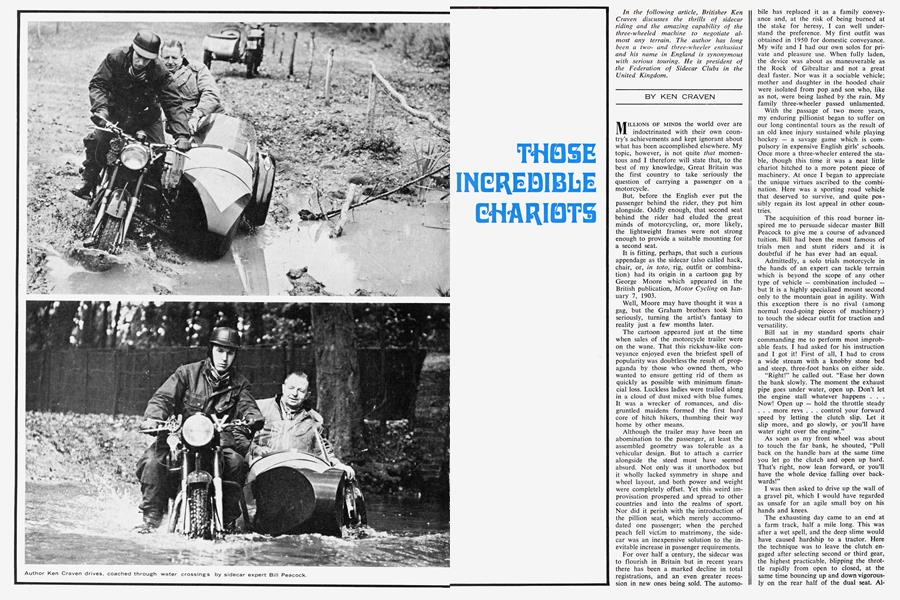
The acquisition of this road burner inspired me to persuade sidecar master Bill Peacock to give me a course of advanced tuition. Bill had been the most famous of trials men and stunt riders and it is doubtful if he has ever had an equal.
Admittedly, a solo trials motorcycle in the hands of an expert can tackle terrain which is beyond the scope of any other type of vehicle — combination included — but it is a highly specialized mount second only to the mountain goat in agility. With this exception there is no rival (among normal road-going pieces of machinery) to touch the sidecar outfit for traction and versatility.
Bill sat in my standard sports chair commanding me to perform most improbable feats. I had asked for his instruction and I got it! First of all, I had to cross a wide stream with a knobby stone bed and steep, three-foot banks on either side.
"Right!" he called out. "Ease her down the bank slowly. The moment the exhaust pipe goes under water, open up. Don't let the engine stall whatever happens . . . Now! Open up — hold the throttle steady . . . more revs . . . control your forward speed by letting the clutch slip. Let it slip more, and go slowly, or you'll have water right over the engine."
As soon as my front wheel was about to touch the far bank, he shouted, "Pull back on the handle bars at the same time you let go the clutch and open up hard. That's right, now lean forward, or you'll have the whole device falling over backwards!"
I was then asked to drive up the wall of a gravel pit, which I would have regarded as unsafe for an agile small boy on his hands and knees.
The exhausting day came to an end at a farm track, half a mile long. This was after a wet spell, and the deep slime would have caused hardship to a tractor. Here the technique was to leave the clutch engaged after selecting second or third gear, the highest practicable, blipping the throttle rapidly from open to closed, at the same time bouncing up and down vigorously on the rear half of the dual seat. AÍthough forward motion was rather less than a 1916 tank, it worked — until mud became wedged between the fenders and wheels, which had to be laboriously cleaned out. As I was later to learn, this wedging seldom takes place with snow, unless it is deep and of the adhesive variety. However, the driving technique is the same.
It is as a winter sport's device that the thing excels and no one has even convincingly explained to me why it is virtually a non-skid vehicle. It is true that it will drift quite widely on bends, and it would obviously slew out of control if all wheels were locked on an icy surface. Retardation, in such circumstances, calls for use of the gears with rapid on and off dabbing of the brakes. Yet on glazed ice at 60 per, it is perfectly under control, although its course may not exactly follow the steering angle of the front wheel. In fact, oversteering to a considerable degree may be called for, but one does this quite naturally.
The moment that road conditions become really dicey with freezing rain, or when hard-packed snow has turned to ice, both for fun and safety, I sacrifice the heated interior of a car and trundle out the three-wheeled warrior. At one time, my endurance was limited to the 25mile trip to or from my office, since the circulation in my fingers rapidly diminished after that period. But the discovery of a supplier of electric gloves gave the sport a new complexion.
My wife Mollie and I made our first long winter trip down to Gibraltar and back in the closing days of 1958. Two years later, we drove out to a winter sports center in Switzerland.
My most testing jaunt was in January 1963, when the whole of Europe was in the grip of a hard freeze. Barry Ryerson, then editor of Motor Cyclist Illustrated, seized the chance to accompany me to the Elephant Rally at Nurburgring with a factory BSA and sidecar, which he was road testing. It was night when we joined the thousands of other pilgrims who, though predominantly German, had come from most countries in Europe by motorcycle combination. Barry and I were among the enthusiasts the next day to pit our skills over the ice-clad race track, which, in summer, reverberates to the throb of international formula racing cars. I must admit we did not do too well against the habitués who obviously had practiced during previous years.
From here we undertook a thousandmile excursion to Austria, North Switzerland and back through France. I had supplied the heating for both of us, consisting of electric gloves, as well as electric body pads for the abdomen. This is a most vulnerable area from which the shivers start, and if you can keep the portion below the navel warm, it is my experience that the whole body will respond accordingly. Thus equipped, we were able to skate our way happily past cautious motorists, and by numerous ditched vehicles which had belonged to other not-so-cautious motorists. I particularly remember threading our way up through a knot of cars which were pointing at quite inappropriate angles on a hillside, the erstwhile drivers looking at us with incredulity as we glided upwards.
Lest it be imagined that the automobile gains any advantage from its twowheel drive, it should be remembered that the differential transmits the power to the side with the least resistance, and the moment that spin takes place, all the force of the engine is concentrated on the vulnerable wheel with the same perversity that makes a boxer go after a cut eye.
A word of warning to the beginner. The handling characteristics of a combination are entirely different from that of a solo. It will not respond to body lean and must be steered by the handlebars alone. This is alien to a motorcyclist. Then, on the bends, it heels over in the opposite direction to which one is accustomed and, with the sidecar on the righthand side, as it would be in the USA, on steering to the right, there is the illusion that the sidecar wheel is leaving the ground and the whole machine is about to topple over. Actually, without a passenger in the sidecar, the wheel can rise a short distance easily, but, unless one is really overdoing things, the vehicle remains fully controllable, and it can easily be pushed down again by turning on more "steam."
On tight bends, the outfit can be swung around in a power slide. This is not a difficult technique to acquire, as witness the competitors at our sidecar meets pirouetting around the posts during obstacle races. On one's first foray, the heart tends to get mixed up with the liver. But, assuming you escape a coronary occlusion in the initial stages, your chances of surviving to old age are better than that of drivers of other things on wheels — at least, British insurance companies seem to think so. They are hard, unsentimental men who calculate rates from cold statistics and the premium for a motorcycle combination is far below anything else.
The sidecar has traction approaching the caterpillar and responds on ice as though built for winter sports; but what about its performance on the open road? To this there is no quick answer, since to attach a one-two-five to a family chair would be like hitching a small tug to move an aircraft carrier in a choppy sea. My own 650cc AMC sports twin develops some 45 bhp, and when carrying rider and passenger plus luggage, it weighs about 900 pounds. This is one bhp per 20 pounds, somewhat better than my Jaguar Saloon, which is regarded as a high performance car, even in its sedate version.
Admittedly, theory and reality are not the same thing, and I have not had the inclination or opportunity to carry out comparative tests with these vehicles. Yet, based on impression and experiences in carrying out observed tests with an outfit some years ago, initial get-away with my present chariot would be somewhat dilatory up to 20 mph. But thereafter, second gear acceleration becomes searing and most things on four wheels are left behind whenever I have the inclination or feel competitive. Upwards from 50 mph drag progressively takes over, and the best maximum speed I have timed with a sleek chair and a full Avon fairing was 89 mph on level ground in still air. The average outfit is more of a wind pusher, but, even so, you will seldom have the chance to drive it flat out if you wish to stay within the law.
A major contributing factor which makes the combination the most agile and controllable road conveyance is the independent braking of all three wheels. There are a lot of permutations in the use of one brake or another in conjunction with either power or cut-off, but learning to drive with finesse is both fun and a challenge. The foot and hand manipulations involved on a winding mountain road are rather like playing an organ. The chair's capacity to stop in double quick time is almost unique. With a highly experienced technician co-operating in the chair, our brake test figures approached the theoretically possible from a range of speeds on a dry surface. From 30 mph, a favorite figure to quote, our stopping distance was 32 feet, only two feet above the possible and achievable by the same model without sidecar in the hands of an expert test rider (and this I cannot claim to be). It is in wet weather that it really excels, assuming that the brakes remain instantly operative which, alas is not always the case. On a series of tries over a saturated surface, we consistently improved on the theoretically possible for the prevailing coefficient of friction. At least, so we reckoned, as it was only feasible to use a gravity meter and this merely records the highest G force exerted at any instant. Thus, it is not possible to accurately calculate stopping distance in feet, yet we had a comparison, as we had deliberately taken records with the same instrument during the better-documented dry tests. The high readings in each case were almost identical and this we assumed was the result of weight transference to the front tire giving a rack and pinion effect. Beware! It is not advisable to throw out all anchors in the wet when there is close following traffic — a lesson I learned the hard way!
I am not single-minded or addicted to any one thing. A love-hate relationship quickly develops between me and all the contrivances which I take out on the road for any appreciable time. I feel slightly less anthropomorphic about a motor car, yet it becomes an adored thing when the weather outside is just plain "bloody," as we quaint English would say. And we ought to know.
On an interesting and varied route of my choice (which would not be a freeway), when the sun is beaming down, the two-wheeler is champagne. Inevitably I must now liken the motorcycle combination to caviar, and caviar is suited to more occasions, morning or night, the year round.
I am not usually given to analogies, but there are worse ways to describe an exhilarating, versatile creature that provides zest, utility and fun throughout the seasons. ■