A Most Versatile Motorcycle
A MOST VERSATILE MOTORCYCLE
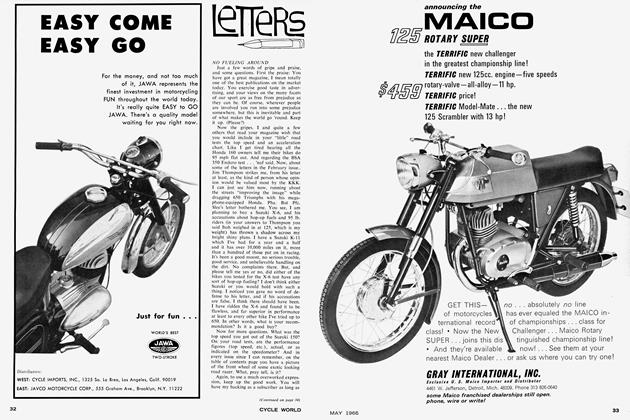
Eddie Mulder's winning mount.
PAT OWENS
FOR YEARS motorcycle racing in the United States has been confined for the most part to standard production machines, of the type generally available to the public. This is the core of the American Motorcycle Association's Class C rule, it has not been exactly inviolate. In most cases, the successful machines were built for one specific type of competition, most remain in their idiom until the end of their usefulness or until they are worn out. Some are converted back to street use.
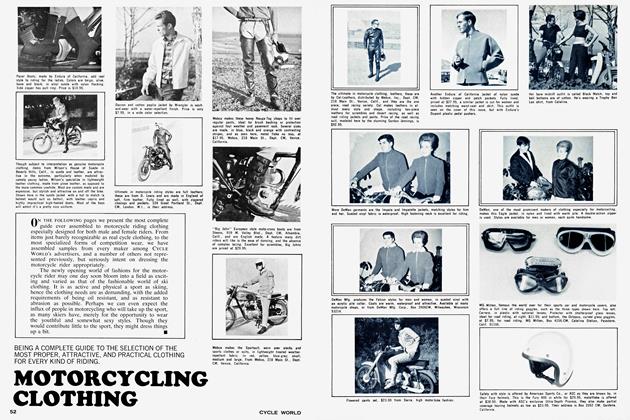
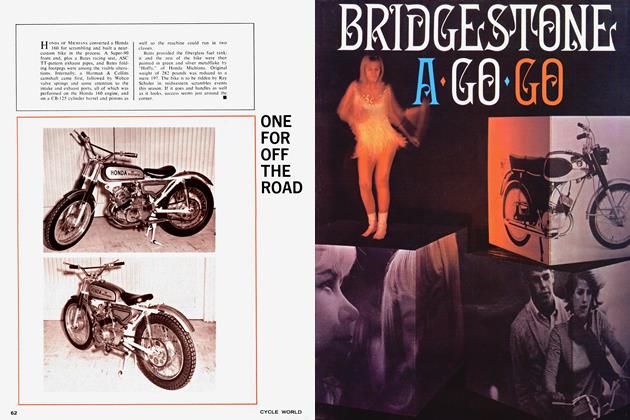
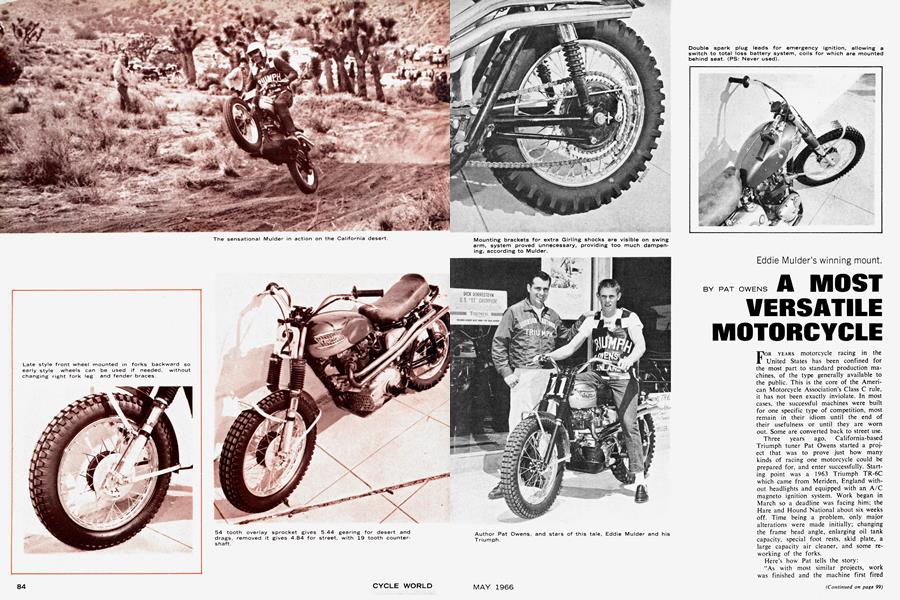
Three years ago, California-based Triumph tuner Pat Owens started a project that was to prove just how many kinds of racing one motorcycle could be prepared for, and enter successfully. Starting point was a 1963 Triumph TR-6C which came from Meriden, England without headlights and equipped with an A/C magneto ignition system. Work began in March so a deadline was facing him; the Hare and Hound National about six weeks off. Time being a problem, only major alterations were made initially; changing the frame head angle, enlarging oil tank capacity, special foot rests, skid plate, a large capacity air cleaner, and some reworking of the forks.
Here's how Pat tells the story: "As with most similar projects, work was finished and the machine first fired up the day before the event. Eddie Mulder, who had won the same event the year before on another machine I built and tuned, was to ride. He took his first ride only 18 hours before the event started. 'Midnight oil,' the racer's lubricant, was burned at a furious rate, and Mulder wound up with only ten minutes to practice before the start.
(Continued on page 99)
"Eddie got off to a fair start, ran tenth, then took the lead. At the end of the first loop he had more than a minute lead even after stopping for gas. He won in the rain with four minutes to spare. This proved to be just the beginning of racing successes as Eddie won the California State Hare & Hound Championship that season.
"Also in 1963, AÍ Rogers rode the bike in the Jack Pine enduro, finishing 9th Expert in the 'A' heavyweight class Rogers could have done better in this Eastern event. But his $1.50 pocket watch failed him on the morning of the first day. He arrived at a check nine minutes early, but finished the 500 miles without problems.
"In the spring of 1964 the machine was put back into street trim, and furnished my daily transportation. During a twoweek summer vacation I rode it back to my ex-home in Connecticut, covering over 700 miles a day to save time for visiting. Converting the Triumph back to street use was actually fairly simple as the alternator which operates the A/C magneto also has built-in lighting coils. Gear ratios and the exhaust system are easily changed for road cruising. At the end of the 6,000mile trip the motorcycle took on a new look with number plates. Class C traction tires and Ascot-type exhaust pipes, standard on the TT Special Triumph Bonneville."
The annual Corriganville Grand Prix was its first event, on the 2.8-mile course, racing for one hour. Eddie put the TR-6 through its toughest race against some of the roughest competition equipment in the country. He finished the race with a three-mile lead, and lapped every rider at least once!
At Ensenada, Mexico, one week later, after being tangled up in a starting line crash which de-railed the rear chain, Mulder started the event four minutes late. He finished in second place, in a performance even better than the Corriganville show. Plans were made to run the bike at the drags and then write this article for CYCLE WORLD, but getting married and a honeymoon in Europe delayed the project a full year. Last year Mrs. Owens and Pat rode the bike in the William Johnson Memorial Road Sports Rally for the second year in a row before it took on more competition miles.
"While in street trim, I rode it at the Fontana (California) drag strip and won the 'B' street class that day, turning 97.93 mph. In the run-off for top street eliminator it turned 100.52 mph!
"Next came another Corriganville, now called Hopetown since Bob Hope took up motorcycling and bought it, where our hero Mulder did it again, making it two years in a row on the same machine!
"Best part of this success story is that the engine was 100% standard when-Eddie won the first race on it in 1963. And now, three years later, the engine has not been removed from the frame. Meaning, of course, all of the major engine components are still in place. Additional performance was gained by modification of the cylinder head, pistons, carburetors, lightening and polishing of pushrods, rocker arms and tappets, generally increasing the rpm range. Introduction of the 1966 'B' range machines saw factory use of many of the modifications proven so successful here."*