Triumph T120/r Bonneville
TRIUMPH T120/R BONNEVILLE
CYCLE WORLD ROAD TEST
FOUR YEARS, AND 100 ROAD TESTS LATER, WE RETURN.
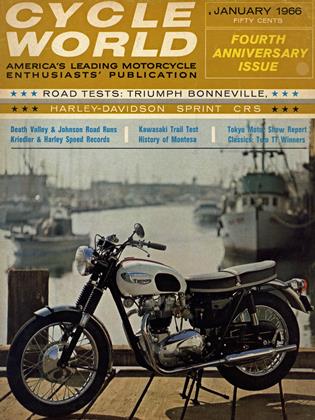
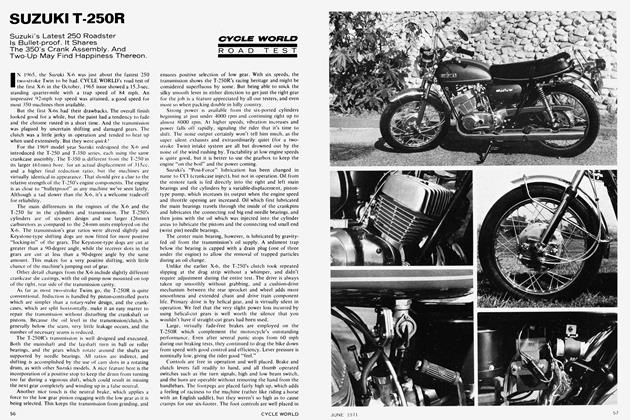
CYCLE WORLD'S first issue, published four years ago, featured a road test report about Triumph's Bonnevule. Forty-eight months and a hundred road tests later, we return to the Bonneville for our fourth anniversary issue. As one might expect, with the passing of so much time it has become a much better motorcycle, although there has been no major change and even though there is only a fractional increase in performance. The improve ment has been in handling, braking and reliability.
Taking first things first (handling), this aspect has been improved by the addition of an extra 2 1/2-degrees of rake, which places the 1966 Triumph's steering head angle at 29 1/2-degrees from the vertical. This is rather more rake than one usually finds in a touring machine, and in fact there is a distinctly heavy feel to the steering of the new Triumph. Interestingly, the increased rake is not coupled with any increase in wheelbase, so evidently the steering head was moved back slightly when the angle was changed. This is, however, the extent of the changes in the frame, compared to 1965. The design is much like the duplex-cradle frame of 1962, but the tubes leading down from the steering head to the crankcase cradle have been replaced with a single, large-diameter tube. This single tube is neither stronger nor weaker than the pair of tubes it replaces but it resists transverse-plane vibra tions better, and has the effect of making the entire motor cycle smoother.
Triumph claims that the "new" frame, with its added steering rake, was introduced to improve high-speed sta bility. Indisputably, it does what they claim - but there was nothing wrong with that aspect of the Triumph's handling in 1965. A much more likely reason for the change is found in the behavior of the big Triumph dirt pounders in years past. These have always suffered from a tendency to pitch their riders off in fast, rough-ground going. The cure, applied by all the experienced scrambles riders, has been to bend more rake into the steering head. Now, Triumph has adopted this speed-merchant's setup for all B-range models. A good thing, we think. Touring riders will very likely prefer the added steadiness they will get with the new frame, and the racing bunch will have had one major modification removed from their list of things to do.
The Bonneville's brakes are better than before mostly because the front brake is larger. Not larger in diameter, it still has an 8-inch drum; but the drum has been made wider. The previous full-width brake was laced into the wheel with straight spokes, an arrangement with advan tages in terms of strength but one that limits brake shoe width. The straight spokes require a row of holes around the mouth of the brakedrum, and the shoes must be set in deep enough to clear these holes. On the new brake, the spokes on the open side of the drum are laced to a flange. This makes room for wider shoes, and there has been a 44-percent increase in lining area. Also, the spoke flange around the mouth of the drum adds stiffness, so there is less tendency to fade during repeated hard stops from high speed.
No change has been made in the size of the rear brake, but there has been a big improvement made in the hub assembly. Last year, the big Triumphs had their rear sprocket as an integral part of the rear brake drum ; the teeth being machined right into a flange,cast as part of the drum. Now, the sprocket is a separate, bolt-on part, and changes in gearing can be made without adding a big, untidy "overlay" sprocket, or digging past the clutch to re place the countershaft sprocket. Actually, the overlay sprocket was not such a bad thing if you wanted to sub stantially increase the overall ratio; but there was no way to add, say, a half-dozen teeth to the rear sprocket.
Reliability has been improved in a variety of ways. In the engine, a change has been made from a ball-bearing to rollers on the drive-side main bearing, which is more of a change than one might think. Not long ago, Triumph Engineering was telling us how they had discovered that by pre-loading the ball-bearings, the engine would run much smoother. Unfortunately, there were also reports from owners that the pre-loading was shortening bearing life. The present combination of ball and roller main bearings is one long favored by Triumph-oriented tuners, and it impresses us as being an excellent arrangement.
Another small change with large implications is the provision of an oil feed direct to the exhaust tappets. Previously, both intake and exhaust camshafts relied on splash from the crank, but this lubrication was somewhat marginal for the exhaust cams. Due to the fact that the exhaust cams must push their valves open against a fairly considerable cylinder pressure, they are more heavily loaded and need the best possible lubrication.
Further improvements in overall lubrication have been added with a new, larger-capacity oil tank. The added capacity will reduce the oil’s running temperature, but we suspect that the main reason for this change is because oil for the rear drive-chain is now taken from the engine’s supply. Before, oil from the primary chain-case was sprinkled on the rear chain, but that system would sometimes empty the primary.
In addition to the things already mentioned, the Triumph 650cc engine also has a lightened flywheel (weight reduced 2.7 pounds) and new 9:1 pistons. And then there are “R” tappets and a “racing” inlet cam — used in combination with a “sports” exhaust camshaft. Pushrod-tube seals have been borrowed from the C-range engine, as these have proven better at keeping the oil inside the engine.
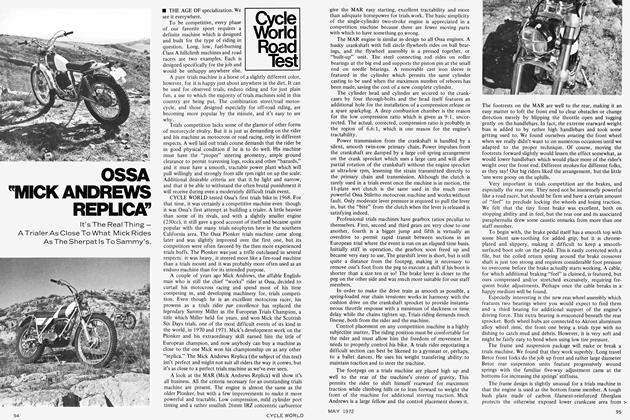
Having had no small amount of difficulty with the tachometer drive on our own Triumph Bonneville recordholder, we were much pleased to see that this item has been improved. In place of the cable emerging directly from the end of the camshaft, looping ’way out to the side before continuing on up the tachometer, the drive first goes into a right-angle drive box that reduces the cable drive to 1 /4 engine speed. With the old arrangement, cables would kink, and break, and sometimes the housing would snag on something and be torn away. The new drive-box aims the cable along a.straighter path, and tucks it in where it is less likely to have chance encounters with passing brush, etc.
The Bonneville’s electricals have not been ignored in the general upgrading. Everything is now operated on 12-volts, with current drawn from a pair of 6-volt batteries linked in series. The batteries are charged by the usual crankshaft-mounted alternator, which has a permanent-magnet rotor and fixed generating coils — all housed inside the primary case. The charging rate is controlled by a Zener diode, a “solid-state” device that progressively reduces output to the battery as it reaches full capacity. The Zener diode is a very superior output regulating device, and generally quite reliable. However, heat, vibration, voltage surges and sometimes even the phases of the moon can make them suddenly decide not to do whatever it is their little molecules are doing. A spare, tucked away with the spare spark plugs, would be a good thing for the Bonneville owner to have at hand. The Zener diode is a better device than any alternate means of voltage regulations, but when it packs up, it cannot be coaxed back into action.
At last, the Triumph factory has heeded the pleas of their American distributors and are sending a motorcycle with a fuel tank not cluttered by a parcel grid. The small carrying grid found on earlier Triumphs is doubtless a handy thing, but Americans have never cared much for it. We view its passing as a sign that the Triumph factory is beginning to care more for Americans.
Again, we will say that we very much like the Triumph Bonneville, and this latest model is the best yet. The stainless-steel fenders are a practical touch that present a fetching appearance, as does the new tank with its “racing-stripe.” Perhaps because of the lighter flywheel, or perhaps because the handlebars are rubbermounted, the bike seems even smoother than before. Triumphs have always had quite a good riding position and controls layout, and the new Bonneville is no exception. In all, the Triumph Bonneville for 1966 must still be considered the standard by which all medium-large displacement, high-performance touring bikes are judged. Others may be faster, or better handling, or even slightly more reliable. None offers quite the same combined package of performance, and reliability and handling.
TRIUMPH T120/R BONNEVILLE
$1309