Round Up
ROUND UP
OUR FOURTH ANNIVERSARY
JOE PARKHURST
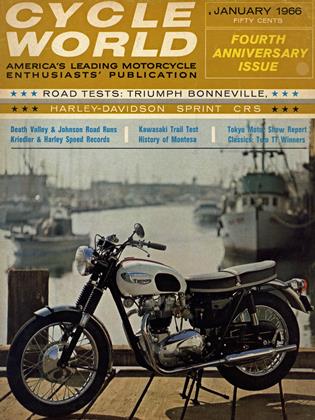
WELCOME TO THE PAGES of CYCLE WORLD'S fourth anniversary issue. Old friends of CW will find a return visit to the subject machine of our very first road test, the redoubtable Triumph Bonneville. They will find little else resembling that first 50-page issue. Changes have taken place I often cannot believe. The only thing that hasn't changed is our editorial policy, which has been strengthened in our four years. Volume 1, Number 1, con tained a first-hand description of riding a Honda four, a technical feature on disc brakes, a summary of West Coast track racing, Gordon Jennings' first technical article on intake and exhaust ram tuning, mini-bikes, a report on the farce called the U.S. Grand Prix at Rosamond (Willow Springs), and a Vespa motor scooter test. Not much reading by the standards of a 1965 volume, but the first issue was a giant step forward in motorcycle enthus iast publishing and it out-sold all the other competitive publications at the time. And it still does.
Among the advertisers in that first issue were Yamaha International, McHal protective headgear, the Matchless/Indian Co., Go-Cycle and Motorcycle Underwriters. With the exception of the poor unfortunate Matchless/Indian Co., they are still with us. The following month they were joined by American Honda and the Berliner Motor Corp., plus Webco, Ghost, Nicholson Mtrs., and we were on our way to advertising leadership, too, though it took a long time and was a hard struggle. Birthdays are a time to reminisce and be melancholy, even when you are only four!
Our goal of over 100,000 circulation is close; a 400% increase in four years means a great deal to us around CYCLE WORLD. As of this writing our offices are a shambles while we start our new office building. The editorial staff is busy assembling the 1966 Road Test Annual, a book on Intelligent Motorcycling, a Two-Stroke Tuning and Modifying Manual by Gordon Jennings, and another surprise we’ll spring shortly. Our entire staff is also up to their knees in work on the 1966 CYCLE WORLD INTERNATIONAL MOTORCYCLE SHOW, once more to be held at the magnificent Los Angeles Sports Arena in late April and early May, and we have a few surprises in store for this event, too. The show will again run in conjunction with the International Custom Car Show, and an added attraction will be the new "Teen 0-Rama." It's going to be quite an affair. Not only that, 1966 is going to be quite a year as well.
MOTORCYCLISTS AND THE U.S. FORESTRY SVC.
Recently I was invited to the first open meeting of the newly formed National Trail Riders Association, a group I have mentioned several times in this column. I was invited to say a few words to the group on the subject of riding on trails. Fellow speakers included two gentlemen from the United States Department of Agriculture Forest Service: Mr. William Hansen, Forest Supervisor in the Los Padres National Forest, and Mr. Wynne M. Maule of the Service. Los Padres is the huge National Forest that extends from Southern California clear up into the central area of the state and includes such areas as Santa Barbara, Ventura and Paso Robles, scene of the famous High-Mountain Enduro staged by the Cal-Poly Penguins Motorcycle Club.
N.T.R.A. chose Ventura as the site for their first meeting and used the occasion to introduce their program to the trail riders of the area. I was deeply ashamed of the small turnout the meeting produced. It was well publicized in advance, and the Association members were prepared to receive over 1,000 people. It was a classic example of the apathy I see among motorcycle riders, and the “let someone else do the work, I’ll just sit around and complain” school of thought that exists.
I learned one very important thing at the meeting, the direct result of a speech made by Mr. Hansen. Our Forest Service is on the side of the motorcyclist! Odd as this may sound, it is quite true. They are in fact, on the side of anyone wishing to use the forests, and this by all means includes many thousands of motorcycle riders. Use of Federal land by citizens is generally controlled by the desires of the people; the Forest Service acts on proposed restrictions or alterations to the rules using the expressed desires of the largest group of people’s requests (or, demands, if you will). As a motorcycle rider wanting his share of the rights to use this land, you need do only two or three things: join an association that is working for you, such as the N.T.R.A., or the American Motorized Sportsmen in Yakima, Washington; act as an individual as well and write the appropriate public figures, and appear at announced public hearings where such proposals as all motorized vehicles being completely forbidden from certain areas are being aired, and state your desires. The Government agencies are there to listen.
One excellent reason such groups as the Sierra Club are making headway in the war against motorcycles, jeeps, or anything else with an engine in it, is that they have about 30,000 members and almost every damn one of them either writes letters like crazy, or shows up at the open meetings and demands we be ruled out. Or both! The only reason we haven’t been pushed out of many areas yet is that the Forest Service knows we exist. They know we represent a large number of people (far more than the opposition could assemble in one hundred years, if the truth were known), and they cannot willingly act on the wishes of what is not an absolute majority. But this situation cannot last forever. Soon they will have to bow to the wishes of this very verbose group of nature lovers who feel the wilds should be left to the animals, and to them, of course. Our only salvation is to stand up and be heard. Write letters. Demand our rights. Join hands and fight for what is ours to use. What I’m saying is: MOTORCYCLE TRAIL RIDERS, ARISE!
I offer the following transcript of Mr. Hansen’s speech. Though it discusses only the Los Padres area, it applies all over the U.S. As you will see we are not yet doomed to ride only on public, paved roads. We have allies in the four-wheel associations whose problems are the same as ours. Mr. Hansen makes many important points, not the least of which is reference to the behavior of trail users, another subject we will deal with more closely once we maintain the rights and privileges we now have.
“We are pleased to be able to meet with you tonight and discuss the use of motorized vehicles on the Los Padres National Forest. As I understand it, your organization is relatively new and this is your first major meeting. We have not, therefore, had an opportunity to get acquainted and to work with you and your officers. We look forward very much to doing this. And I want to assure you before I go any further in this discussion, that we firmly believe that the use of trail vehicles and 4wheel drive vehicles is a valid recreation use of the National Forests. Also, that we are most anxious to work with you in developing sound policies that permit vehicle use without damage to the resource or danger to the users.
Let me tell you briefly about National Forest policy. In general, Forest Service roads and trails are open to the public under rules and regulations of the Secretary of Agriculture. These rules have to do with the protection, development, maintenance, and use of the roads and trails. On many roads on this Forest we do not have public rights-of-way across private land, and thus you find much of the access to the Forest blocked by locked gates. It is the Secretary’s policy now to secure full public rights-of-way for all new roads and to work on converting the limited rights-ofway now in existence. This is a slow procedure, but progress is being made.
In respect to the use of trails and crosscountry travel, we have tried to devise a policy which will permit maximum use of National Forest lands for recreational purposes, yet hold down damage to the resource. We believe that proper controls must be exercised over off-road use of motorized travel on National Forest land and trails. This is s'o because under some circumstances such travel can and has done serious damage to land, resources, and to people. However, we do not believe that the public should be denied the privilege of using off-road motorized transportation on certain portions of the National Forest where this can be done without damage to land and resources and without hazards to other users. Thus, the policy requires that Forest Supervisors consider use of each trail and each area on a case by case basis.
(Continued on page 8)
Trail restrictions were first put into effect on the Los Padres in 1961 on the Monterey District at the north end of the Forest. All but four trails were closed to vehicle travel. In 1964 — a year ago this month — an area comprising all of the National Forest land in Santa Barbara County and a portion in Ventura County became restricted. Ninety-three percent of the tra'ils in this area were closed to vehicle use. This sounds quite high, but many of these trails were closed because access to them was via private land without rights-of-way. Several years ago Santa Barbara County passed an ordinance prohibiting vehicles on trails on private land. The other trails were closed because they are too steep and easily eroded, unsafe (for example, a trail with precipitous ledges that makes an unsafe situation when a horse and vehicle meet) or because they are consistently heavily used by horsemen such as the ones in the front country adjacent to Santa Barbara, where an intolerable conflict of use would occur. Also, all trails within classified areas such as the San Rafael primitive area and the Sespe Wildlife are closed to motorized use. We know that you don’t agree with all of the closure action, but I’m sure you will agree that in some areas vehicles just do not belong. You must also remember that most of our trails were constructed during the C.C.C. days before trail vehicles were made, and these trails were designed for the foot and horse traveler.
Restrictions of any kind are always controversial. However, we have to face up to problems of this nature. We cannot pass on to anybody else our responsibility for the proper management of the National Forests. But it is also true that to help us meet this responsibility we must have an adequate expression from all interests, and I have to tell you frankly that interests opposite to yours have done a far better job of making themselves heard than you have. Do you know that we, the Forest Service, had to go the rounds with some strongly organized groups to prevent 100% closure on the entire 2,000,000 acres of the Los Padres National Forest? Certain strongly organized and extremely vocal groups completely rejected our closure action because it did not go far enough: It still left you 77 miles of trail out of 1050 miles within the restricted area and left some areas completely unrestricted. When we asked the Boards of Supervisors in the two counties to adopt local ordinances that would facilitate law enforcement, these groups appeared in strength and asked that the Boards not do this. They didn’t do this to help you out. They did this to try and make us go to the 100% restriction, and then they would ask the Boards to support us. Fortunately, both counties supported our proposal. If there was any opposition to the closure at all from your standpoint, it was minor. The battle for 100% closure of National Forest trails is by no means over — in fact, it is just beginning.
(Continued on page 10)
You have some powerful opponents who oppose 4-wheel drivers, trail scooter operators, and other motorized vehicle users. Your opponents argue that your off-road use creates noise, fire hazards, smelly exhaust fumes; they claim you frighten horses and wildlife; that you crowd others off narrow trails; that you damage trails, vegetation, and soils; that the roar of your motors shatters the natural serenity of their favorite haunts. These aren’t all of the complaints, but they are typical. Some people just don’t like to see a motor vehicle where they have always had to hike or ride a horse. These people have organ» izations similar to yours. They pass resolutions and send them to us and to anybody else from the President of the United States to network commentators. We hear a lot from people who oppose off-road use by motor equipment. One would suppose from what we read and hear that this is the majority opinion. We feel we need to recognize the opinion of the minority also. And we’re sure in many cases that it isn’t so much a matter of being in the minority as it is in just not being organized.
We are somewhat in a trial period with vehicle closures. Sometime next year after the local closure has gone through its second season, we will review it and ask for constructive suggestions from all user groups. In all probability we have some trails closed that may well be opened, and some are open that perhaps should be closed. We feel that your group, and all interested groups, should study what has been done, become familiar with the trails on the ground, and make your recommendations. We will meet with you anytime and anywhere to discuss the problem.
We also feel that through the exercising of good manners in the Forest you can do much to alleviate some of the criticism against you. We are sure you are aware of this and have already taken positive action to police your own ranks. The most prominent complaint we hear has to do with the loud noise some of the machines make, and it is true that the majority of campground users are annoyed when some of you roar through the camp at three o’clock in the morning. This actually happens. Giving the horseman the right-ofway on the trail by moving off and turning your motor completely off is another courtesy that will pay you dividends. The most serious damage to trails occurs by using them in wet weather, so this should be avoided. And of course there are items that are not peculiar to your type of use alone, but you need to make certain your groups are not the guilty ones if you are to improve your public acceptance. I’m talking about indiscriminate shooting of signs, out-houses, stoves, and all other improvements. This type of vandalism is one of the most disgusting and costly facing us today, and could well lead to further restrictions if it does not decrease. Hand in hand with this goes the problem of litterbugging. Pack your cans and bottles out with you — don’t toss them alongside the trail. And you should also, by all means, respect private property where you do have the privilege of access over it. These are some of the positive actions you can take to help yourselves. I have purposely not mentioned compliance with fire laws, since Fire Control Officer Carl Hickerson is going to specifically cover those in just a minute.
To summarize the current situation on the Los Padres:
1. All motor vehicle use is prohibited in wilderness and wilderness-type areas, which on this Forest are the San Rafael and Ventana primitive areas and the Sespe wildlife area.
2. Off-road and off-trail vehicle use is prohibited on designated areas within the Forest. You may obtain a map of these areas at any Ranger Station. The trails open to vehicle travel are designated and posted, so if you tear out a poster you automatically close the trail to your use.
3. All use of any kind, including foot and horse travel, is prohibited in areas closed because of the high fire hazard. Maps of these areas are also available from Ranger Stations.
In all of the National Forests in California, which comprise about 20 million acres, about 16.4 million acres or 80% are unrestricted to vehicle use. If any additional restrictions are made they will be based on good, sound reason open for everyone to review and comment upon. To prevent mass closure action, you will have to expand the self-education project to meet the criticism of the many opponents of off-road vehicle use. We will need your support and understanding when we have to make difficult decisions. Working cooperatively we can persuade the public to recognize off-road vehicle travel as a form of recreation which should be provided on National Forests.”
(Continued on page 12)
PRODUCT TESTING FIRM LAUNCHED
Two of my old friends in the motorcycle business, Dave Ekins and Jack Krizman, have given me the opportunity to make the first announcement concerning their newly formed firm, Product Testing, Research & Development, Box 3104, Granada Hills, California. Krizman is responsible for Research & Development, and Ekins for the testing and evaluation end of it. Both are certainly well qualified for their functions. Krizman is the designer of the famous Krizman American Sports Co. spark arrester, an item I have dwelt upon several times. Ekins is one of California’s leading motorcycle competitors on Triumphs, Hondas, Yamahas and Suzukis, and has been a member of two American International Six Days Trial teams. Dave was involved for five years in development activity on the Atlas and Thor propulsion systems and in the early design stages of the F-l propulsion system for the Saturn program.
Jack has made significant excursions into such fields as precision hydraulic controls in petroleum refinery installations, and development of a portable fresh-air environment helmet for industry. His spark arrester work gained him a contract with the U.S. Forest Service for the design of their spark arrester testing laboratory in San Dimas, Calif.
Purpose of the firm is to provide a professional approach to evaluation and development of new products for the manufacturer. The service includes field and laboratory testing with confidential technical reports, design engineering from conception through drafting, prototype building, production cost evaluation, marketing, owner and parts manuals, and complete installation drawings. They have at their disposal a technical staff of engineers and professional personnel that covers a wide range of fields in addition to motorcycling, such as automotive, agricultural, industrial, electronics, and civil engineering. I offer the new PT, R&D to any and all; we’ve already got them working on a project or two of our own.
PUZZLING SITUATION
We were very sorry to learn of Mike Duff’s dislocated hip as a result of a practice tumble at Suzuka, while training for the Japanese Grand Prix. This in itself is bad enough, for Mike has always been a credit to the sport. However, why was it necessary for the Yamaha factory to send to England for a replacement rider, when half the distance from Japan is a rider capable of filling the gap? The rider is, of course, Tony Murphy, who has had considerable experience on the RD-56s and is also employed by Yamaha. More than one expert observer feels that Murphy is as fast and much, much smoother than the rider the factory picked. Could the reason be that Yamaha is content with American sales, and prefers to develop sales in England? Certainly more Yamaha motorcycles are sold in the U.S. in any given month than will be sold in England throughout this entire year.
(Continued on page 14)
That is not likely to be the answer because when Americans adopt a hobby it is done with more enthusiasm than in any other country in the world, whether it is sports cars, boats, airplanes or motorcycles. Americans have the money to treat motorcycles as a hobby and not just a utility mode of transport. While it is true that motorcycles use less gasoline than cars, only a small percentage of people buy them for that reason. The people who do are a fickle lot and will soon abandon the motorcvcle as soon as they can afford a car. The true motorcyclist is the person who has one through choice not necessity. Hence the largest market in the history of motorcycling is developing in the U.S. We hope that some day soon the people who race factory teams, and are trying to sell motorcycles in this country, will see an advantage in hiring some of the talent we have around.
YOU MEET THE NICEST PEOPLE . . .
However, these little fellows are usually referred to as the “Fearsome Foursome” when playing defense for the Los Angeles Rams. We wonder how many of their opponents believe that “nicest people” slogan now. From left, Lamar Lundy, Rosey Grier, Merlin Olsen and David Jones on their Hondas.
“HONDO” ON A HONDA
Several National Basketball Association players are enjoying our sport and leading some of the more famous is star of the Boston Celtics, John “Hondo” Havlicek. Known as the “best sixth man,” John is shown aboard his new Honda Dream.
(Continued on page 16)
BENELLI EXPORTS
Shown in front of Philadelphia’s Independence Hall are Benelli Export Manager Dr. F. Pensele, from the Italian factory, Mr. E. Wise, President of Cosmopolitan Mtrs., Benelli Importers, and Mr. M. Benelli, General Manager of the plant. Rather stiffishly, they are shaking hands over the completion of a contract for 1966 in which Cosmo placed the largest single order for machines in the history of Benelli.
HONDA CHARITY
An ovation from 1,500 community leaders attending the fleet awards banquet of the Greater Los Angeles chapter of the National Safety Council, is being acknowledged in the photograph by K. Okumoto (left), Vice President and General Manager oT American Honda Motor Co., Inc., as J. T. Blalock, President of the group; displays a check for $25,000, contributed by Honda for the promotion of safety.
ROYAL DEDICATION
The Earl of Snowdon, very much a motorcycle enthusiast, took time out from his busy schedule while visiting the United States with Princess Margaret, to dedicate the site of the new Triumph-BSA distrubuting headquarters in Duarte, California. Most impressive was the fact that after the actual cornerstone chores were over, Lord Snowdon spent considerable time discussing motorcycling in the United States, showing a genuine interest in the sport.
At an enjoyable luncheon following the dedication ceremony, Wilbur Ceder, President of Johnson Motors, Harry Sturgeon and Eric Turner from the parent Company in England, addressed some 75 people, and expressed the need for this new 60,000 square foot building to keep pace with the tremendous growth in motorcycling in the 19 western states which it serves.
PRETTY MOTORCYCLE DEALER
Since dropping our “Around The Industry” column, the section of the original CYCLE WORLD that was written strictly for the motorcycle trade (replaced with our “New Models & Products” section), we continue to receive the normal flow of news releases from various distributors and dealers. Because CYCLE WORLD is published for the motorcycle enthusiast, not the “trade,” we use very few of these news releases, as we do not feel our readers really care who is the new store manager, district representative, or what have you. Not so for the release with the picture of the newest Berliner Mtr. Corp. products’ dealer in Ridgefield Park, New Jersey. Her name is Monique Schimmeyer; she is a partner in NBC Motorcycle Imports with Mr. Frank Krichmar, who handles the service and parts department. Monique handles sales. This is the kind of sales pitch few men could resist.
(Continued on page 18)
A 1000 WORD PICTURE
Pat McKenna of Bill’s Motorcycles in Torrington, Wyoming, sent me the photograph of what appears to be a man riding either a fur-covered motorcycle, or one with the largest seat I have ever seen. But I’ll let him tell the story:
“My father and I were successful in the elk hunting permit drawings, so we planned a motorcycle-mounted trip; we knew where the bikes could take us and figured it included a large area.
“Riding a Honda 50 and a Greeves Trials bike at the crack of dawn on opening day of the season, we crossed the mountainous boondocks of Laramie Peak, about 70 miles southeast of Casper, Wyoming. After passing two men in a Jeep, we were fairly confident we were the first to travel this neck of the woods this season. A game trail led us to a large draw; dismounting, we footed it for about ten yards, and were rewarded with the whistle sound of a bull elk. Splitting up, we headed up two sides of the draw, and soon I heard the report of my Dad’s rifle.
“Since the sound was not followed with shouts of jubilation, I moved on, assuming he had missed. A second later a large brown section of the forest moved and was transformed into a big spike elk. In awe, I stared at my first elk and proceeded to bag him with one shot to the spine, misjudged because of the short distance. We dressed the carcass, split it and draped it over the motorcycle lengthwise. I rode out on top of it. Every time we see the picture of the elk and me emerging victorious from the hunt I am reminded of the simplest hunting trip I ever made, and of how a good hunting motorcycle can be utilized.”
(Continued on page 20)
NEW '65 TT RECORDS
I’m happy to point out the advertisement in this issue, announcing the release of our 1965 Isle of Man TT long playing LPs. Stanley Schofield’s Sound Stories, truly the most remarkable productions in the world. Using the very latest E.M.I. location recording equipment, especially developed for this purpose, Schofield Productions have outdone themselves in these new volumes. Maybe I sound like a salesman (we are the distributors in the U.S. for Sound Stories), but I cannot suppress my excitement over the two new volumes.
During TT week I ran into Gordon Pitt, chief recording engineer for Schofield, and his staff, on almost every part of the over-37-mile course, flashing his microphones in the air. How truly fantastic the sound reproduction is can only be appreciated by those who have heard both the real thing, and the records. I can attest to the accuracy and fidelity; it is uncanny, and faithful to every bounce of a valve or clatter of a camshaft.
Each of the records run forty minutes; capsuling three solid days of racing into eighty minutes is no small task. E.M.I. loaned Schofield prototypes of their new machines for the TT. Pitt, plus Alan Haynes, Harold and Margaret Wood, recorded in thè field, while Gordon spent four months editing and mixing the final results.
England’s Murray Walker again conducted the interviews with the riders, as he has in last year’s and previous Sound Stories since the death of his father Graham Walker, and he has imparted an excitement that delivers the feeling that all of this is just for the individual listener’s benefit.
Enthusiasts of motorcycle sounds will be ecstatic over the sound the Honda six makes, quite unlike anything I have ever heard. From the 20,000 rpm sounds of Honda’s 125cc four, Suzuki’s 125 twin, Benelli and Suzuki fours, Yamaha and Jawa twins, up to the deep, almost leisurely Norton and Matchless singles and the enormous scream of the MV four. I think these new recordings are the absolute pinnacle of high fidelity, drama, excitement, and color of the greatest event in International motorcycle racing. They will even make motorcycle racing fans of the most jaded spectator sport follower.
(Continued on page 22)
NO WORLD CHAMPIONSHIP RACE FOR THE U.S. IN 1966
The FIM Autumn Congress has ruled that there will be no United States Grand Prix for world championship points in 1966. Officially, for the record book (and according to Tom Galan of USMC), MICUS requested that the race be reverted to its previous non-championship status. No reason has been given for this. However, it is strange that the request coincides with the letter of ultimatum to MICUS from the CSI (Commission Sportive Internationale, the portion of the FIM that rules on racing activities) after the Spring Congress, which stated that if the AMA and MICUS could not organize a world championship race jointly then there would be no such race. It is safe to assume that these two organizations did not get together and it looks like a case of “quit or get fired.”
The FIM and many competitors have voiced displeasure with race organization at the U.S. Grand Prix since its inception. The reasons are many, and although sometimes small, they all hurt motorcycle racing in the United States. One of our complaints was that the U.S.G.P. has never really been a Grand Prix. The name implies that this race should represent the best we have to offer in the way of equipment and riders, and in this respect the U.S.G.P. has been a farce. True, a handful of our better riders would be there, but then most chose to ride in “the other race” (AMA Daytona). The AMA pays over $20,000 in prize money at Daytona; we do not
know of a Grand Prix that pays anywhere near that amount. On the other hand, we do not know of any other country of consequence in the world of motorcycling that does not belong to the FIM and is therefore in a position to have champion ship races. Due to ill feelings between MICUS and the AMA, riders who attempt ed to compete in both races were threat ened with being banned from one organiza tion or the other - a situation that is pretty childish, viewed from any side. A similar situation exists in California where the AFM, primarily a Northern area club, published a calendar of events early in 1965, and later found the ACA holding races on the same dates in California.
We are sure that both the AMA and MICUS would welcome a face-saving way out of this one-way street. There is a simple solution. Any affiliate club could have the race at Willow Springs, Carlsbad or Riverside, because these venues happen to be in California where a law known as the Cartwright Act prohibits an organi zation from penalizing its members for belonging to, or competing with, another group or organization. CYCLE WORLD offered this suggestion to Riverside Race way officials several months ago, and it was presented to the FIM. According to the Autumn Congress report, the Riverside proposal was made too late. What is "too late?" We realize the FIM wants fewer Grands Prix, because many competing manufacturers are complaining about the tremendous traveling expenses involved to cover all the existing Grands Prix. We realize, too, that the United States has only one manufacturer building machines
for international class racing, but then several countries cannot claim one manufacturer and they hold world championship races. We feel that as long as the Riverside proposal was made before the Congress ended, an FIM official could have at least inspected the course for safety reasons and then made a decision. There is an FIM rule which states that an international race must be held on the course before it can be approved for a championship points race, but this has not always been followed to the letter in the past and although Riverside is not the safest course in the world, it is certainly not the most dangerous.
The person who has worked the hardest in recent years to join the AMA with the rest of the world is Count Johnny Lurani, President of the CSI until the last Autumn Congress, and a man of tremendous energies and foresight. We can only hope that a person of similar stature is replacing him. Piet Nortier is no longer President of the FIM, having been replaced by Rodil de Valle of Spain, and for the first time a Japanese member has been voted to the FIM, Mr. T. Tsugeno. As the leading participating country in the world, it is good to see Japan being represented.
A closing thought — more motorcycle racing takes place on a weekend in the United States than all year in Ireland, but they have a Grand Prix, and also a World Champion. They also have a single organization respresenting the sport and if they can avoid bickering and outright battle in Ireland, surely we in the United States can reach some sort of agreement between ourselves, and with the rest of the world ■