Tokyo Motor Show
TOKYO MOTOR SHOW
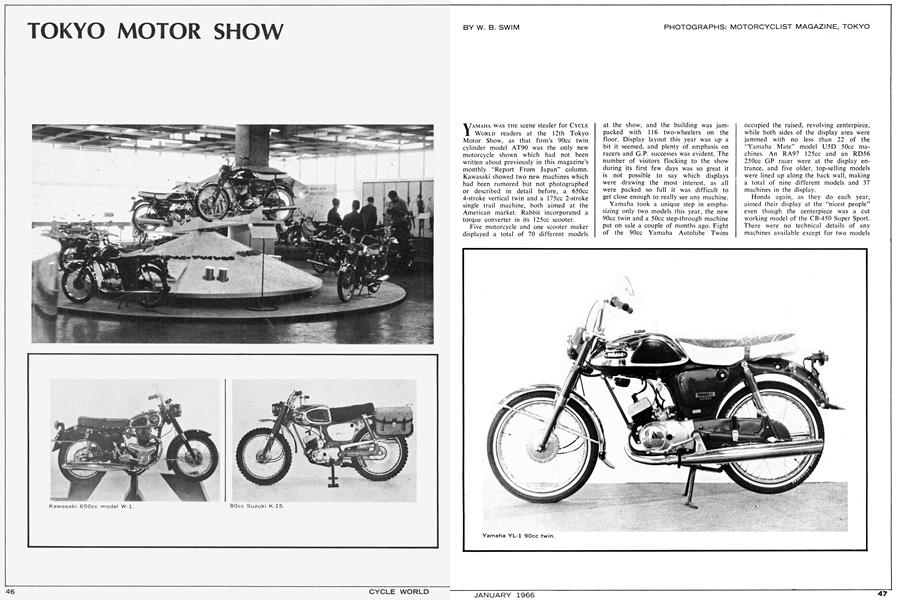
YAMAHA WAS THE scene stealer for CYCLE WORLD readers at the 12th Tokyo Motor Show, as that firm’s 90cc twin cylinder model AT90 was the only new motorcycle shown which had not been written about previously in this magazine’s monthly “Report From Japan” column. Kawasaki showed two new machines which had been rumored but not photographed or described in detail before, a 650cc 4-stroke vertical twin and a 175cc 2-stroke single trail machine, both aimed at the American market. Rabbit incorporated a torque converter in its 125cc scooter.
Five motorcycle and one scooter maker displayed a total of 70 different models
at the show, and the building was jampacked with 116 two-wheelers on the floor. Display layout this year was up a bit it seemed, and plenty of emphasis on racers and G.P. successes was evident. The number of visitors flocking to the show during its first few days was so great it is not possible to say which displays were drawing the most interest, as all were packed so full it was difficult to get close enough to really see any machine.
Yamaha took a unique step in emphasizing only two models this year, the new 90cc twin and a 50cc step-through machine put on sale a couple of months ago. Eight of the 90cc Yamaha Autolube Twins
occupied the raised, revolving centerpiece, while both sides of the display area were jammed with no less than 22 of the “Yamaha Mate” model U5D 50cc machines. An RA97 125cc and an RD56 250cc GP racer were at the display entrance, and five older, top-selling models were lined up along the back wall, making a total of nine different models and 37 machines in the display.
Honda again, as they do each year, aimed their display at the “nicest people” even though the centerpiece was a cut working model of the CB-450 Super Sport. There were no technical details of any machines available except for two models made by the Belgian factory and displayed in Japan for the first time. Seven machines topped by shapely models rolled smoothly around the center of the display, which was a huge moving illustration of how a double overhead camshaft engine works. At the rear of the area was a jungle scene with cute stuffed animals mounted on various Honda motorcycles and shaking their heads, moving their arms, etc., in time to a record. The two Belgian products, with bicycle pedals yet, were off to one side. Honda totals: 15 models and 19 machines.
Suzuki’s display of three water-cooled racers, a 50cc, 125cc and 250cc, up high on a platform, behind a huge curving case containing 38 trophies won in Grand Prix races, was the first thing to catch the visitor’s eye. Two 250cc model T-20 motorcycles (the model X-6 Hustler in the U.S.) were on revolving stands and another was in front of a movie screen synchronized with the throttle and gearbox, and featuring a huge lighted display to one side giving the rider instructions on which of the six gears he should shift to in order to stay up with the movie. The 118cc model BÍ00 was prominently shown on a revolving stand at the rear of the display, flanked by five other popular Suzuki motorcycles. To one side were four export models, fancied up with saddle bags, nifty seat covers, handlqgrip streamers, nice paint jobs, etc., but with no technical data given. These were the S32-2 150cc, Kll 80cc Sports, K15 80cc Trail and 50cc Ml2, bringing Suzuki’s total to 13 models and 17 machines on the floor.
Bridegstone’s emphasis was on the new 177cc Dual Twin, prominently displayed on a raised revolving stand in the center of their floor space. It was shown in two versions, the one for local sale labeled 180 and the chrome fendered overseas model called the 175. Out at the entrance was the tuned-up 90cc street machine which won its class at the 3rd Junior Road Race meeting, held in conjunction with the Japanese Grand Prix at Suzuka Circuit the weekend before the show opened. Just inside was the water-cooled 50cc twin GP racer which made its debut this year. To one side of the entrance was a 90cc Mountaineer and a 90cc Scrambler. Also shown were 6 models of the 90cc, 3 models of a 60cc and 3 models of a 50cc, giving Bridgestone 14 models displayed and 17 machines on the floor.
Kawasaki, as they did last year, again managed to hide their new motorcycles. They were lined up with older machines along the rear of the display area. Only the engine of the 650cc twin has been completed, and it was mounted in the 500cc K2 frame at the show. It will get its own pipe frame before going into production next spring. The 175cc features an automatic oil and gas mixing system, which is also available on the
85cc line of two-strokes. As reported earlier, the 175cc is designed for the
American market and a trail version will be the first one on sale. This was the
machine displayed at the show, and no standard touring or sports models were shown. Kawasaki had no less than six
versions of the popular 85cc model at the show, counting one scrambler which was flanked by 125cc and 150cc motocrossers. The company’s other models were scattered about the display, bringing the Kawasaki offering to 15 models and 17 machines.
Fuji Heavy Industries gave the biggest play to its 125cc Rabbit Superflow motorscooter which features a torque converter. Prominent at the rear of the display were two 150cc touring models, which recently completed a Tokyo-to-Madagascar trip, and 200cc and 90cc scooters were also shown. Total: 4 models and 9 machines.
The new Yamaha Autolube Twin 90cc, model AT90, claims 8.2 hp @ 8,000 rpm and a top speed of 62 mph through a 4-speed gearbox. Torque of 5.41 ft.-lb. @ 7,500 rpm is listed for the 36.5 x 43mm x 2 engine and weight is kept to 218 pounds. A Yamaha spokesman told CYCLE WORLD that this new machine can be expected on the American market any day now in a lOOcc version. The export model, dubbed YL1, has a bore and stroke of 38 x 43mm x 2 for a total of 97cc and claims 9.5 hp @ 8,500 rpm. Top speed is listed at 69 mph and torque at 5.92 ft-lb @ 8,000 rpm. Compression ratio is 7.1:1 on the kick-started model with flywheel magneto ignition and the Autolube fuel mixture system. Dimensions are 71.6-inch length, 24.8-inch width, 37.3-inch height and 45.1-inch wheelbase. Weight is 218 pounds.
Kawasaki’s 650cc model W1 engine claims 46 hp @ 6,500 rpm and 36.9 ft-lb torque @ 5,500 rpm. The kickstarted OHV engine has a bore and stroke of 74 x 72.6mm x 2 for 624cc and a compression ratio of 8.7:1. A four-speed separate gearbox driven by a primary chain is mounted. Top speed of 112 mph is listed and weight, dimensions, etc., are also displayed, but these will be changed when the engine gets its own frame.
The two-stroke Kawasaki model F1TR 175 Trail claims 16 hp @ 7,000 rpm and 13.26 ft-lb of torque @ 6,000 rpm. Bore and stroke are 62 x 56mm for a capacity of 169cc. The four-speed machine mounts 2.75-18 and 3.00-18 knobby tires and has dual sprockets using the same system as Kawasaki’s 85cc trailster. Both electric and kick-starters are fitted and the exhaust and muffler are raised just above the rear axle. A heavy duty carrier is standard equipment behind a semi-dual seat. The handlebar has a strengthening crossbar and the short chromed fender is mounted high over the front wheel. Top speed in road gear of the 264-pound machine is listed at 81 mph. Compression is 6.6:1 and the gas tank holds 2.6 gallons. Oil tank capacity was not listed. Dimensions are: length 78 inches, width 33 inches, height 40 inches, wheelbase 49.2 inches and ground clearance 6.3 inches. Climbing ability of 40 degrees and fuel consumption of 130 miles per gallon are claimed.
For the technical minded, and readers wanting to compare the various models, here is a listing of all street models at the show with their main specifications. All Hondas are four-stroke; Kawasaki is noted and all others two-stroke.
HONDA
CB-450, 444cc, 43 hp @ 8,500 rpm, 112 mph, 4 speeds.
CB-72, 247cc, 24 hp @ 9,000 rpm, 96 mph, 4 speeds.
CL-72, 247cc, 23hp @ 7,500 rpm, 86 mph, 4 speeds.
CB-125, 124cc, 15 hp @ 10,500 rpm, 80 mph, 4 speeds.
C-92, 124cc, 11.5 hp @ 9,500 rpm, 71 mph, 4 speeds.
S-90, 89.6cc, 8 hp @ 9,500 rpm, 62 mph, 4 speeds.
C-200, 86.7cc, 6.5 hp @ 8,000 rpm, 56 mph, 4 speeds.
CT-200, 86.7cc, 6 hp @ 7,000 rpm, 52 mph, 4 speeds.
S-65, 63cc, 6.22 hp @ 10,000 rpm, 56 mph, 4 speeds.
C-65, 63cc, 5.5 hp @ 9,000 rpm, 52 mph, 3 speeds.
S-50, 49cc, 5.2 hp @ 10,500 rpm, 53 mph, 4 speeds.
C-100, 49cc, 4.5 hp @ 9,500 rpm, 43 mph, 3 speeds.
C-310, 49cc, 1.8 hp DIN @ 3,000 rpm, 25 mph, 3 speeds.
C-320, 49cc, 1.8 hp DIN @ 4,700 rpm, 25 mph, 3 speeds.
CZ-101, 49cc. (Ed note: DIN Indicates net horsepower.)
YAMAHA
YM1, 305cc, 26 hp @ 7,000 rpm, 98 mph, 5 speeds.
YDS-3, 250cc, 24 hp @ 7,500 rpm, 92 mph, 5 speeds.
YDS-3C, 250cc, 27 hp @ 7,500 rpm, 84 mph, 5 speeds.
AT-90, 90cc, 8.2 hp @ 8,000 rpm, 63 mph, 4 speeds
(U.S. version YL1, 97cc, 9.5 hp @ 8,500 rpm, 69 mph, 4 speeds)
YGS-1, 80cc, 8 hp @ 7,500 rpm, 59 mph, 4 speeds.
YGS-1T, 80cc, 8 hp @ 7,500 rpm, 53 mph, 4 speeds.
U5D 50cc, 4.6 hp @ 6,500 rpm, 44 mph, 3 speeds.
SUZUKI
T20, 247cc, 25 hp @ 8,000 rpm, 94 mph, 6 speeds.
(U.S. version X-6, 247cc, 29 hp @ 7,500 rpm, 100 mph, 6 speeds).
S32-2, 149cc, 16 hp @ 8,000 rpm, 4 speeds.
S-10, 123cc, 10.5 hp @ 7,000 rpm, 69 mph, 4 speeds.
S30-2, 124cc, 9.5 hp @ 7,300 rpm, 63 mph, 4 speeds.
B100, 118cc, 8 hp @ 7,000 rpm, 63 mph, 4 speeds.
Kll, 79cc, 7.3 hp @ 7,000 rpm, 59 mph, 4 speeds.
K10, 79cc, 6.5 hp @ 6,000 rpm, 53 mph, 4 speeds.
K15, 79cc, 7.3 hp @ 7,000 rpm, 57 mph, 4 speeds.
M12, 50cc, 4.5 hp @ 8,000 rpm, 53 mph, 4 speeds.
M30 50cc, 4 hp @ 6,800 rpm, 44 mph, 3 speeds.
BRIDGESTONE
BS180, 177cc, 20 hp @ 8,000 rpm, 88 mph, 5 speeds.
(U.S. version BS175, same specifications).
90 Sport, 88cc, 8.8 hp @ 8,000 rpm, 66 mph, 4 speeds.
90 Touring, 88cc, 7.8 hp @ 7,000 rpm, 59 mph, 4 speeds.
BS 90, 88cc, 7.8 hp @ 7,000 rpm, 59 mph, 4 speeds.
90 Mountaineer, 88cc, 7.8 hp @ 7,000 rpm, 59 mph, 4 speeds.
60 Sport, 59cc, 6 hp @ 8,500 rpm, 56 mph, 4 speeds.
BS60, 59cc, 5.5 hp @ 8,500 rpm, 55 mph, 4 speeds.
Homer 60, 59cc, 5 hp @ 7,700 rpm, 47 mph, 3 speeds.
50 Touring, 50cc, 5.2 hp @ 8,500 rpm, 53 mph, 4 speeds.
BS50, 50cc, 5.2 hp @ 8,500 rpm, 53 mph, 4 speeds.
Homer 50, 50cc, 4.2 hp @ 7,500 rpm, 44 mph, 3 speeds.
KAWASAKI
Wl, 624cc, 46 hp @ 6,500 rpm, 112 mph, 4 speeds, 4-stroke.
K2P, 496cc, 36 hp @ 6,500 rpm, 103 mph, 4 speeds, 4-stroke.
SG, 248cc, 18 hp @ 7,000 rpm, 78 mph, 4 speeds, 4-stroke.
F1TR, 169cc, 16 hp @ 7,000 rpm, 81 mph, 4 speeds, 2-stroke.
BIT, 124cc, 12 hp @ 6,500 rpm, 72 mph, 4 speeds, 2-stroke.
B8, 124cc, 11 hp @ 6,000 rpm, 62 mph, 4 speeds, 2-stroke.
JIT, 81.5cc, 8 hp @ 7,000 rpm, 62 mph, 4 speeds, 2-stroke.
J1TR, 81.5cc, 8 hp @ 7,000 rpm, 59 mph, 4 speeds, 2-stroke.
J1TL, 81.5cc, 7.8 hp @ 6,800 rpm, 59 mph, 4 speeds, 2-stroke.
J1L, 81.5cc, 7.5 hp @ 6,800 rpm, 56 mph, 4 speeds, 2-stroke.
J1, 81.5cc, 7.5 hp @ 6,800 rpm, 56 mph, 4 speeds, 2-stroke.
M10, 50cc, 4.5 hp @ 7,500 rpm, 49 mph, 3 speeds, 2-stroke.
RABBIT SCOOTERS
S601, 199cc, 11 hp @ 5,500 rpm, 63 mph, torque converter.
S402BT, 148cc, 9.5 hp @ 6,200 rpm, 63 mph, 4 speeds.
S301, 123cc, 8 hp @ 6,000 rpm, 58 mph, torque converter.
S202A, 88cc, 5.5 hp @ 6,500 rpm, 53 mph, 3 speeds.