When Racing Was King
Roadracing fever swept Japan in the late ’80s and early ’90s, leading to these incredible Japanese-market production 250s revving to 19,000 rpm
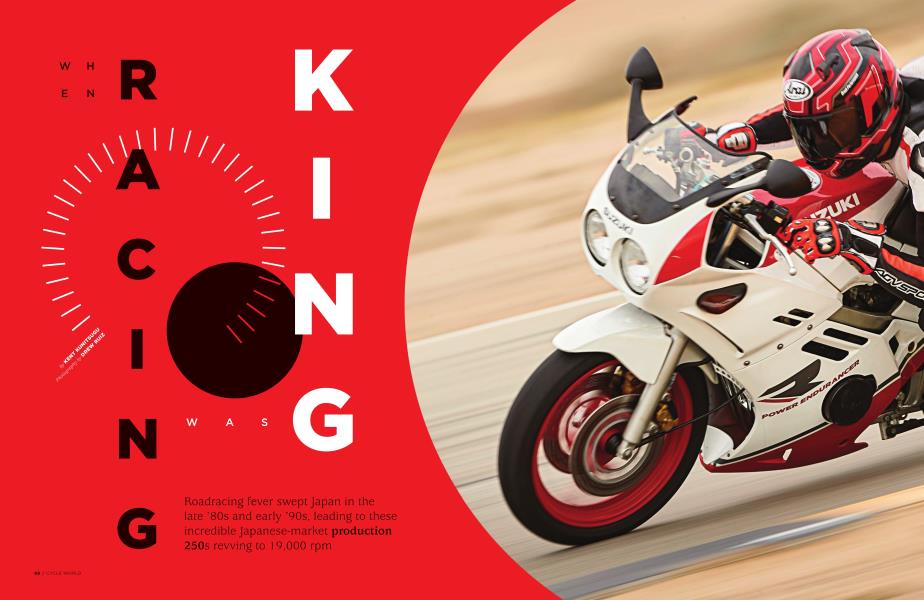
Roadracing fever swept Japan in the late ’80s and early ’90s, leading to these incredible Japanese-market production 250s revving to 19,000 rpm
WHEN RACING WAS KING
KENT KUNITSUGU
Roadracing fever swept Japan in the late ’80s and early ’90s, leading to these incredible Japanese-market production 250s revving to 19,000 rpm
Things were certainly different in Japan back in 1988. The country’s economy was shooting skyward much like the rev limits of these 250cc sportbikes. Motorcycles were still the primary form of personal transportation for the majority of the population. With the “golden era” of Grand Prix motorcycle racing in full swing, roadracing was soon reaching its zenith of popularity in Japan. The Japanese Grand Prix and Suzuka 8 Hours races drew massive crowds, and the MFJ All-Japan domestic racing series was bursting at the seams with entries.
Racing’s popularity meant that sportbikes were dominating motorcycles sales in Japan during that time, but the cost and difficulty of obtaining a license and registering a bike of more than 400cc meant that small-displacement bikes were the overwhelming choice of Japanese riders. The 250cc category from that era is not only a prime example racing’s Japanese-market influence, but also how motorcycle design and manufacturing technology had progressed.
The four models from that era we rode here—graciously provided by Iconic Motorbikes (iconicmotorbikes. com)—are up to 31 years old, yet their performance would easily equal or surpass any comparable 250cc bike available today. No simple single-cylinder or parallel-twin engines in this bunch; all four bikes utilize inline-four-cylinder, DOHC, four-valve-per-cylinder powerplants with redlines as high as 19,000 rpm. Anyone who remembers the heralded Honda RC162 four-cylinder 250cc Grand Prix racebike and its jewel-like internal components can understand just what an engineering and manufacturing feat these production motorcycles represent.
Think about that 19,000-rpm redline for a second. Back in 1991, that stratospheric rpm was basically unapproachable by any other four-stroke engine motor vehicle application. Even FI auto-racing engines didn’t approach that rev ceiling until 2002. Yet here were mass-production engines for sale to the public with warranty, that would start up with the push of a button, and idle at 1,200 rpm like a purring kitten, while screaming all day long if asked to. They are all plenty streetable below five-figure rpm; with such high rpm capability, gearing is low enough that the engines gain rpm quickly, and the acceleration is still brisk enough to holeshot most traffic. Yes, some deft clutch work is necessary if you want to leave the line with haste—but for average street life, these four bikes are the farthest thing from high-maintenance thoroughbreds imaginable.
Even a government-mandated 45-hp maximum for 250cc machines didn’t stop the manufacturers from pushing the limits of what a 250cc four-stroke motorcycle could do. The 1988 Suzuki GSX-R250 and 1989 Yamaha FZR250 are perfect early examples of this genre.
The GSX-R250’s tiny 49 mm bore coupled to a very short 33 mm stroke means sky-high rev capabilities, resulting in a 1 7,000-rpm redline from the 248cc engine. While the swingarm is box-section aluminum like the bigger GSX-R750, the rest of the cradle-type frame is steel. Wheels are 17-inchers—’88 was the same year the 750 went from its 18-inch front wheel down to the now-standard 17-inch diameter—but the rim widths are only wide enough to allow a 100/80 on the front, and a 130/70 on back.
As you’d expect from extracting 45 hp out of just 248cc, the little GSX-R needs lots of rpm. A hit of power comes on at 13,500 rpm, then the acceleration quickly tails off at 16,000 rpm, so you need to be quick with the shifter. Handling is a bit on the sluggish side, as the GSXR’s steering geometry is a very conservative 26-degree rake angle with 103 mm of trail, but a 53.9-inch wheelbase helps keep cornering tight.
Brakes were pretty wooden-feeling and high-effort, but nothing that a pad compound change wouldn’t cure. The non-adjustable suspension—save for spring preload—is definitely on the softer side of the spectrum, but with just 304 (dry) pounds to deal with, still plenty capable in the twisty bits.
The 1988 Yamaha FZR250 is a visual throwback to anyone who ever owned or raced an FZR600 in this country during the late ’80s. All the styling cues are the same, from the racy bodywork to the box-section steel-tube frame and swingarm. Like the FZR600, the FZR250 engine’s bore/stroke dimensions are less oversquare than the class norm, with a longer 34.5 mm stroke working smaller 48 mm pistons, yet the 249cc engine’s redline is identical to the GSX-R. The rim sizes are even narrower than the Suzuki’s, with the 2.75-inch rear wheel only allowing a 120/80 tire; add to this a 25.5-degree rake angle with just an 88 mm trail plus a 54.1-inch wheelbase, and you have a recipe for a very agile motorcycle.
And that’s basically what you get. The mere thought of initiating a turn on the FZR250 accomplishes the task, and the Yamaha’s scalpel-precise steering allows you to aim for any inch of tarmac in the turns. As you’d expect with the slightly longer stroke, the FZR starts its serious forward progress at the 13,000 mark, and signs off at 15,500 rpm, well short of its 1 7,000-rpm redline. Unfortunately, our time on the Yamaha was limited to a couple of sessions, as the rear tire developed a leak that prevented us from riding any more.
The 1991 Kawasaki ZXR250 shows just how quickly the market had progressed in three years. Boasting a twin-spar aluminum frame, inverted fork, dual 300 mm front discs, and larger 110/70-17 front and 140/60-18 rear size tires, the mini-Ninja’s more serious sporting intent is clear. The bore and stroke configuration is identical to the Suzuki, but with larger 30 mm carbs and more aggressive cams, the Kawasaki’s power is in a completely different league compared to the GSX-R250.
“Think about that 19,000~ rpm redline for a second. ”
1988
SUZUKI
GSX-R250
1988
YAMAHA
FZR250
1991
HONDA
CBR250RR
1991
KAWASAKI
ZXR250
FOUR-CYLINDER, FOUR-CYLINDER, FOUR-CYLINDER, FOUR-CYLINDER, Type INLINE, DOHC, FOUR INLINE, DOHC, FOUR INLINE, DOHC, FOUR INLINE, DOHC, FOUR VALVES/CYL. VALVES/CYL. VALVES/CYL. VALVES/CYL. Displacement 248CC 249CC 249CC 249CC Bore X Stroke 49.0 X 33MM 48.0 X 34.5MM 48.5 X 33.8MM 49.0 X 33.1MM Redline 17,000 RPM 17,000 RPM 19,000 RPM 18,000 RPM Front Tire 100/80-17 100/80-17 110/70-17 110/70-17 Rear Tire 130/70-17 120/80-17 140/60-17 140/60-18 Front Brakes DUAL 275MM DISCS, SINGLE 320MM DISC, DUAL 275MM DISCS, DUAL 300MM DISCS, TWO-PISTON CALIPERS TWO-PISTON CALIPER TWO-PISTON CALIPERS TWO-PISTON CALIPERS Rear Brakes SINGLE 210MM DISC, SINGLE 220MM DISC, SINGLE 220MM DISC, SINGLE 220MM DISC, SINGLE-PISTON CALIPER SINGLE-PISTON CALIPER SINGLE-PISTON CALIPER TWO-PISTON CALIPER Wheelbase 53.9 IN. 54.1 IN. 53.0 IN. 53.5 IN. Dry Weight 304 LB. 309 LB. 315 LB. 311 LB.
It absolutely screamed—which was what made a problem with the fuel petcock so disappointing. We had to park the Kawasaki after just a few laps, so we were barely able to scratch the surface of its undoubted performance potential, which was frustrating. Such is the struggle with now three-decade-old motorcycles.
The 1991 Honda CBR250RR was the real eye-opener of the quartet. As serious as the Kawasaki felt, it was no match for the high-revving menace of the little four-cylinder CBR. The frame is a beautiful twin-spar brushed aluminum unit with angled main spars that allow fresh-air intake runners—ram air technology hadn’t made it to production yet—a straight shot at the airbox intake. The curvaceous gullwing aluminum swingarm is identical to that of the NSR250 two-stroke—that’s a Japanese-market story for another time—and the 17-inch, six-spoke wheels are wider to fit 110/70 front and 140/60 rear tires.
With a 48.5 x 33.8 mm bore and stroke that strikes a middle ground between the Yamaha and Suzuki/Kawasaki engines, the Honda provided the most usable yet strongest power of the four bikes. Acceleration really comes alive at 14,000 rpm and continues on up to 18,000 rpm, where it flattens out onto the 19,000-rpm redline. The CBR can make surprisingly serious time on the racetrack, although some tap dancing on the shift lever is required; take the number of times you shift per lap on a 600 and multiply by two, almost three if you normally ride a 1,000, and you get the idea.
With a wailing soundtrack in your ears that isn’t that far off of the shrieking VI0 FI engines of a few years ago, the perception of speed on the CBR is intoxicating, and in the corners, you truly are hauling the mail. Throw any long straights into the equation, though, and you are reminded that you’re only harnessing 45 horses when bigger bikes come by with 5 to 10 mph in their pockets. Of course, your smile quickly returns as you come right back by them on the brakes, as the little Honda’s braking markers—if you even have any on some corners—are far deeper into the turns.
The CBR’s excellent handling traits allow these banzai-corner entries despite slightly soft suspension rates, with responsive steering and loads of feedback allowing you to ramp up corner speeds and use the Dunlop GPR 300 tires we had for the test to their maximum potential. Even the smallish 275 mm front discs and two-piston calipers were easily up to the task of braking hard, providing good power and feel.
Put it this way: Every rider that came off the Honda was spouting superlatives, and many said it would not be out of place at all in 2019.
Times have changed, though, and the Japanese domestic market not only doesn’t have any supersport models in any lineup, it is also a shell of its former self sales wise. Things are obviously just as different over here, and while smaller displacement machines are selling well, they’re not the same breed as the historic ones we sampled for this story. The enthusiasm and engineering passion is plain to see in these 30-year-old machines—we can only hope that somehow that racing spirit rises again sometime in the future. If not, it is better to have revved and lost than never to have revved at all.