Don Sakakura
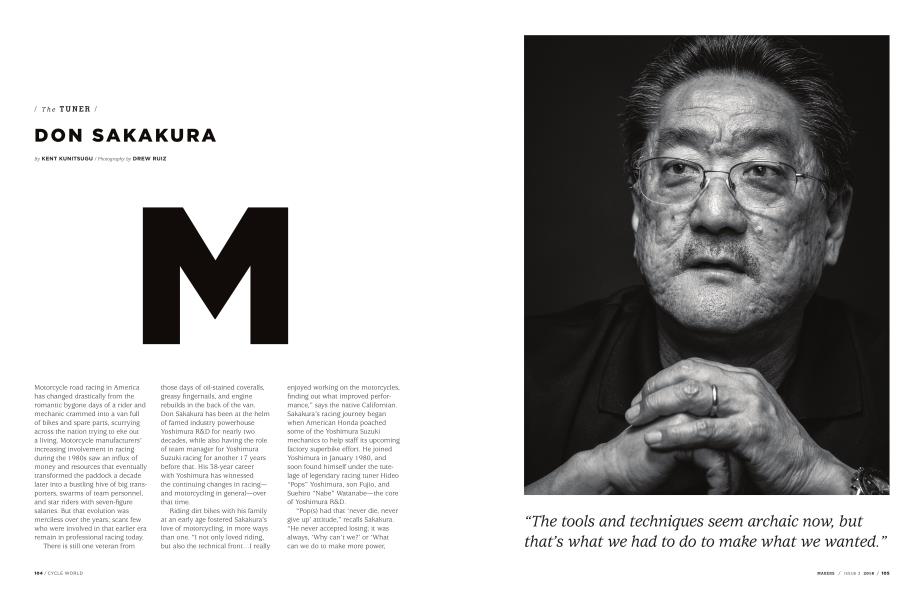
DON SAKAKURA
The TUNDER
KENT KUNITSUGU
Motorcycle road racing in America has changed drastically from the romantic bygone days of a rider and mechanic crammed into a van full of bikes and spare parts, scurrying across the nation trying to eke out a living. Motorcycle manufacturers’ increasing involvement in racing during the 1980s saw an influx of money and resources that eventually transformed the paddock a decade later into a bustling hive of big transporters, swarms of team personnel, and star riders with seven-figure salaries. But that evolution was merciless over the years; scant few who were involved in that earlier era remain in professional racing today.
There is still one veteran from those days of oil-stained coveralls, greasy fingernails, and engine rebuilds in the back of the van.
Don Sakakura has been at the helm of famed industry powerhouse Yoshimura R&D for nearly two decades, while also having the role of team manager for Yoshimura Suzuki racing for another 1 7 years before that. His 38-year career with Yoshimura has witnessed the continuing changes in racing— and motorcycling in general—over that time.
Riding dirt bikes with his family at an early age fostered Sakakura’s love of motorcycling, in more ways than one. “I not only loved riding, but also the technical front...I really enjoyed working on the motorcycles, finding out what improved performance,” says the native Californian. Sakakura’s racing journey began when American Honda poached some of the Yoshimura Suzuki mechanics to help staff its upcoming factory superbike effort. He joined Yoshimura in January 1980, and soon found himself under the tutelage of legendary racing tuner Hideo “Pops” Yoshimura, son Fujio, and Suehiro “Nabe” Watanabe—the core of Yoshimura R&D.
“Pop(s) had that ‘never die, never give up’ attitude,” recalls Sakakura. “He never accepted losing; it was always, ‘Why can’t we?’ or ‘What can we do to make more power, or go faster around the racetrack?’ He would work and work until he got what he wanted to achieve.” Of course, that work ethic was expected of everyone else, and those who didn’t follow suit wouldn’t last very long. “If you didn’t get a hammer or something thrown at you, along with the abuse and pounding he’d dish out, then you knew you were accepted as part of the team,” Sakakura says with a laugh.
“The tools and techniques seem archaic now, but that’s what we had to do to make what we wanted."
Yoshimura also taught him the value of old-school craftsmanship. “He actually would file camshaft profiles by hand,” reveals Sakakura. “Put [soft blank shafts] in the engine, check the degree wheel timing, turn the engine. He had an idea in his mind of how he would like to see the valve movement in relation to the bore and stroke of the engine. Then he would build a template off that for the cam grinder.” Because the early superbikes were basically converted streetbikes, manual fabrication and construction skills were a must. “The tools and techniques seem archaic now, but that’s what we had to do to make what we wanted. Like stuffing exhaust-pipe headers with sand and bending them by hand, working with metals in various ways to build what was needed.”
Sakakura progressed from mechanic for two-time AMA Superbike champion Wes Cooley (winning the title with him in 1980) to Yoshimura Suzuki race-team manager in 1993. The soft-spoken Japanese-American oversaw what would eventually be a racing dynasty; the Yoshimura and Suzuki partnership that began in 1978 has since racked up more than 35 national championships, including the motocross and offroad segment. This year marks the 40th anniversary of the partnership between the two companies, and Sakakura is well-aware of its significance. “We certainly wouldn’t be where we are now without the partnership and support we’ve received from Suzuki over the years.”
Yoshimura’s success on the racetrack translated to commercial success as well, but it wasn’t just a matter of “winning races and then waiting for the phone to ring back at the shop,” as Sakakura half-jokingly describes the early days. He eventually ended up supervising a rapidly growing staff to handle a thriving performance-product business, in addition to race-team management duties. Sakakura’s learning curve on the commercial side was steep, but the result is that the Yoshimura brand is now a household name in the motorcycle world.
The increasing demands of running both a major performanceproduct business and one of the pre-eminent professional race teams in the USA were beginning to force compromises that didn’t sit well with Sakakura, so now the commercial Yoshimura R&D of America part of the business has been turned over to Yusaku Yoshimura, Pops’ grandson. Sakakura still will be running the Yoshimura Suzuki racing team “until they decide to kick me out,” jokes the 59-year-old. That likely won’t be anytime soon, judging by his recent continued success in that arena (team rider Toni Elias is the current MotoAmerica Superbike champion). But regardless of where Sakakura goes from here, his influence on racing and motorcycling in this country won’t be forgotten.