The New American Bob-Jobs
THE NEW AMERICAN BOB-JOBS
CW COMPARISON
SADDLE UP FOR A NO-FRILLS CRUISE DOWN NOSTALGIA LANE
Paul Dean
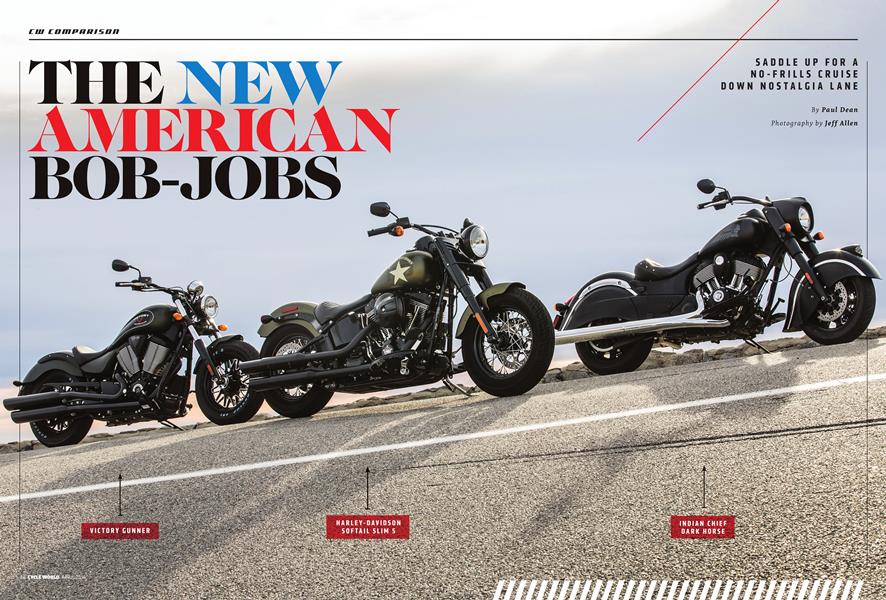
Unless you’ve been collecting Social Security longer than you care to admit, you have no personal recollection of the late 1940s. That, obviously, is because you either weren’t around back then or were way too young to remember. But images of that nostalgic era are precisely what the three American-made cruisers seen here are intended to project. They’re all dressed up—well, down, actually—in classic minimalist attire, a bare-bones style that quietly originated in the 1930s but grew more popular after World War II. They came to be called bob-jobs or bobbers, so named because their owners had cut them down to a minimum, often to emulate the flat-track racebikes of the era.
Due to current safety and emissions regulations, these modern-day production-line simulations—Harley-Davidson’s Softail Slim S, Indian’s Chief Dark Horse, and Victory’s Gunner—aren’t nearly as
stripped down as the bobbers hand-built during the Truman administration. They nonetheless do an effective job of harking back to the storied past rather than pointing to an uncertain future.
Besides being made in the USA, all three share numerous attributes. They’re powered by narrow-angle V-twin engines of near-identical capacity; ride on hiddenshock chassis fitted with low-slung solo saddles and raked-out forks, rolling on fat tires front and rear; and are painted in matte finishes complemented by black trim pieces galore.
Not surprisingly, considering the company that manufactures it, the ultra-low, compact Slim S manages the best impersonation of the original bobbed look.
The Chief Dark Horse—with its deeply valanced fenders, underseat bodywork, molded headlight shell, and illuminated warbonnet peering out atop the front fender—doesn’t scream “minimalist,” but it does radiate the iconic signature of the Indian marque that was a player in the early bob-job movement. And the Victory,
a brand lacking any history further back than its 1997 beginnings, still pulls off the just-the-basics look reasonably well.
Engine performance isn’t quite as uniform though. The Gunner’s io6ci vee—the only SOHC, eight-valve motor of the bunch—makes the most peak horsepower, plus the Vic weighs 29 pounds less than the Harley and is a whopping too pounds lighter than the Indian. So, as you might expect, it supplies the best zeroto-everything acceleration. The 111-inch Dark Horse, on the other hand, produces the least horsepower but hammers out the most torque over the widest range of rpm, allowing it to grind out low-end and midrange performance on par with that of the Victory and the 110-inch Harley. (The standard Softail Slim only rolls with H-D’s 103-inch engine; the S model’s 110-incher adds $3,567 to the MSRP.)
Despite any disparities in dynamometer, quarter-mile, and other power-related numbers, the engine performance you feel on these bikes is more similar than different. The Gunner delivers a slightly stronger rush at higher rpm, and the Slim S and Chief pull a little more smoothly and willingly at lower revs. But in the middle-rpm ranges where riders spend the most time, they all cruise beautifully, respond sharply, run smoothly, and shift
THEY CAME TO BE CALLED BOB-JOBS OR BOBBERS, SO NAMED BECAUSE THEIR OWNERS HAD CUT THEM DOWN TO A MINIMUM, OFTEN TO EMULATE THE FLAT-TRACK RACEBIKES OF THE ERA.
their six-speed gearboxes nicely. Given that these are not motorcycles competing for lap times and ETs, nothing about their respective power deliveries should be a deal-breaker.
Handling might be a different matter. All three are super stable in a straight line at speed over all kinds of road surfaces. And despite their considerable heft, long wheelbases, and kicked-out steering geometries, all are easy to lean into turns, a by-product of their low centers of gravity and wide handlebars. But with the Harley and Victory, a shortage of cornering clearance could be a no-go for some riders. At very mild lean angles, the Softail’s fold-up footboards start showering sparks like a portable machine shop, followed by the bashing of the sidestand and other hard parts off the tarmac. The Gunner’s folding footpegs (which it has instead of foot boards) poke out so far from the chassis that they, too, bang into the road surface at meager lean angles, along with the front cylinder’s muffler. No such theatrics with the Dark Horse, which has the best
cornering clearance of this threesome— enough so that fun but sensible rides along curvy back roads are not constantly punctuated with the graunch of metal on pavement.
In overall comfort, each of these latterday bob-jobs is suitable for a full day in the saddle provided that higher speeds are visited only occasionally and for short spurts. Aside from perhaps the headlight shroud on the Chief, there is not a hint of wind protection anywhere.
On all three, the feet-forward, seatto-footrest placement is comfortable— typical of what’s found on most modern cruisers. The seat-to-handgrip reach is close to ideal on the Slim S and Dark Horse, while the Gunner’s bars work best with the long arms of taller riders. The Indian’s seat is longer and softer than the Harley’s or Victory’s, not only making for a cushier perch but also allowing a smidgen more fore-aft movement during extended rides.
So, too, is the Indian’s suspension the most compliant. It allows the loooongwheelbase (3.9 inches longer than the H-D’s, 3.3 in excess of the Gunner’s) Dark Horse to comparatively glide over some road imperfections that would deliver
BIKE Dry weight Wheelbase Seat height Fuel capacity Fuel mileage 1/4 mile 0-60 mph Top gear, 40-60 mph Top gear, 60-80 mph Horsepower Torque Braking, 30-0 mph Braking, 60-0 mph
VICTORY GUNNER $13,499 654 lb. 65.1 in. 27.0 in. 4.5 gal. 38 mpg 12.49 sec. @ 104.78 mph 3.6 sec. 4.6 sec. 4.8 sec. 82.8 @ 4920 rpm 103.7 lb.-ft. @ 2820 rpm 37 ft. 146 ft.
H-D SOFTAIL SLIM S $18,499 683 lb. 64.5 in. 25.4 in. 5.0 gal. 39 mpg 12.68 sec. @104.51 mph 3.9 sec. 4.4 sec. 4.8 sec. 80.9 @ 4750 rpm 98.7 lb.-ft. @ 3800 rpm 29 ft. 126 ft.
INDIAN CHIEF DARK HORSE $17,499 754 lb. 68.4 in. 28.4 in. 5.5 gal. 36 mpg 13.30 sec. @ 99.08 mph 4.5 sec. 4.5 sec. 4.9 sec. 76.3 @ 4490 rpm 106.8 lb.-ft. @ 2670 rpm 32 ft. 131 ft.
a small but unmistakable thump at the rear of the H-D and Vic. There’s little difference in front-end suspension rates among the three, but at the rear, the Slim S is the stiffest and the Gunner marginally more taut than the Indian.
Braking is yet another area in which the Dark Horse excels with strong, consistent stopping power and excellent feel at the lever. Chalk it up mainly to its dual front discs, whereas the other two bikes have single front rotors. Harley’s front system was greatly improved for 2016, helping the Slim S post the best stopping distances during our controlled braking tests; but out on the road under all manner of stopping and slowing conditions, the Indian provided the best all-around braking. By comparison, the Victory’s
single-disc front has a wooden feel that contributed to the Gunner producing the longest stopping distances.
Okay, you ask, which of these three new-age bobbers takes home the gold? At the risk of sounding like a complete cop-out, the answer is, it depends.
Let’s start with the Victory Gunner. Although manufactured by Polaris, the same parent company that builds the Indian, the Gunner came up a bit short here. It’s a very solid, perfectly capable cruiser that performs well and does a decent job of looking the part. But aside from high-rpm engine performance, it didn’t excel in any area—though it does, admittedly, have the lowest MSRP, and that alone could justify its purchase by anyone with a tight budget.
If you’re in it for style and crave the closest thing to a classic bob-job that you don’t have to piece together yourself, the Softail Slim S is the clear choice. It’s not the fastest, the best-handling, the most comfortable, nor is it the cheapest (it goes for a thou more than the Indian and five grand above the Victory). But it works very well, feels good to ride, and it’s also the coolest and most authentic, a product of the same company that built the foundation for the lion’s share of the original bobbers. Harley-Davidson has been doing this a long time, and the results show it.
But if function plays a role in your program that’s just as important as appearance, if not more so, the Indian Chief Dark Horse belongs on the top step of the podium. And why not? It boasts the best suspension, the best ride, the best comfort quotient, the best handling, and the best braking. It even exudes a greater sense of refinement than the others. Yes, its looks can be polarizing, since not everyone is a fan of swoopy, enclosed bodywork that makes the bike look heavier than it already is. But the Chief is fun to ride, no matter if just putt-putting around town, cruising the open highway, or flowing along a remote mountain road. The reborn Indian brand is just a few years old, but what its new owners have accomplished is impressive.
The bottom line is simple: The Softail Slim S is the best bobber, but the Chief Dark Horse is the better motorcycle, cm
THE CHIEF IS FUN TO RIDE, NO MATTER IF jUST PUTTPUTTING AROUND TOWN, CRUISING THE OPEN HIGHWAY, OR FLOWING ALONG A REMOTE MOUNTAIN ROAD.
HARLEYDAVIDSON SOFTAIL SLIMS INDIAN CHIEF DARK HORSE VICTORY GUNNER
' Nails the bobber look ' Most compact, tidy feel ' Military graphics an appropriate touch ' Keyless remote-fob starting ' Most informative dash ' Pitch-perfect V-twin exhaust note ' Most affordable ’ Best WFO acceleration ' Fias the only automatic neutral finder
•To lean or not to lean? Not a question. • Good brakes, need more feel •Higher MSRP • Bodywork hides some maintenance items • Longerthan a Smart Car • Does it have to weigh 754 lb.? • Max lean angle too restrictive • No incremental fuel gauge • Used a quart of oil during test