The 5th Element
THE 5th ELEMENT
CW FIRST RIDE
1290 SUPER DUKE GT
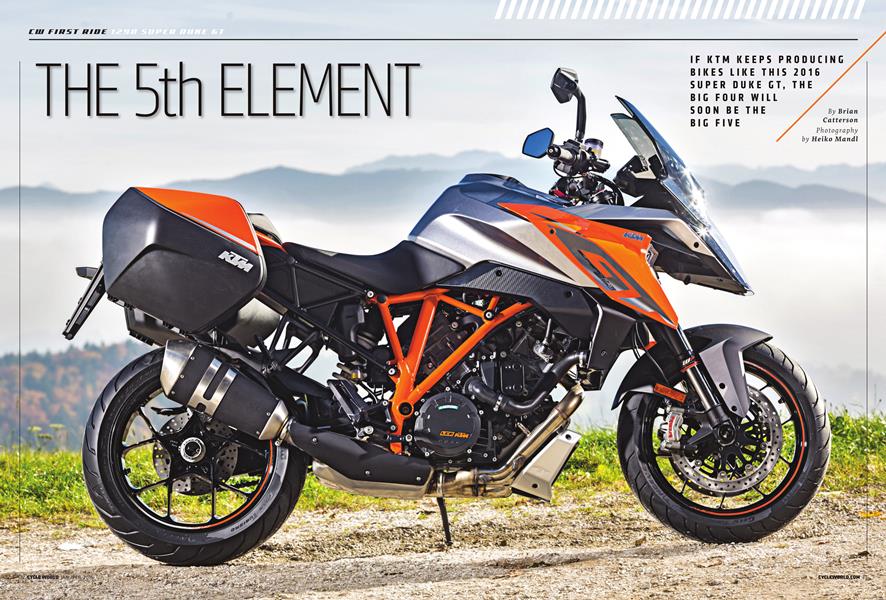
IF KTM KEEPS PRODUCING BIKES LIKE THIS 2016 SUPER DUKE GT, THE BIG FOUR WILL SOON BE THE BIG FIVE
Brian Catterson
KTM is on a roll and has been for some time.
In the past decade it has gone from a company whose only street offerings were relatively simple singles to one producing world-class V-twins bristling with the latest technology. It seems like eons since 1991, when CEO Stefan Pierer (see interview, page 36) intervened to rescue the Austrian dirt bike manufacturer from bankruptcy. It’s hard to fathom for Americans who think of KTM as the brand that Ryan Dungey races, but thanks to its partnership with Bajaj in India plus factories in Argentina, Brazil, Colombia, and Malaysia, KTM sells more streetbikes than dirt bikes nowadays.
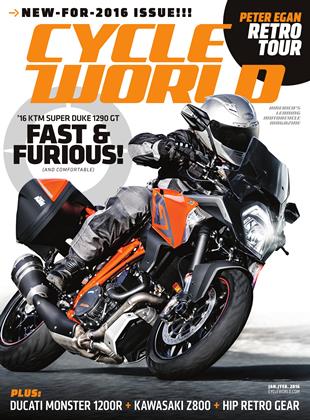
For 2016, there’s a new street model called the Super Duke GT. Based on the award-winning 1290 Super Duke R— a.k.a. “The Beast”—the GT is more touring oriented with a half fairing, a slightly larger passenger seat, and saddlebags as standard. That sounds like a simple upgrade—and to an experienced motorcycle manufacturer like KTM, it is—but there’s a whole lot more that goes into such a project, as I learned during a visit to the Austrian factory this past October.
All KTM—and now also Husqvarna— projects follow the same basic protocol. After an idea is conceived, KTM’s product development team turns over the project to their counterparts at Kiska, located not far from Mattighofen in Anif, a suburb of Salzburg. Led by founder Gerald Kiska, this design firm just celebrated its 25th anniversary, and with a collaboration going back 23 years KTM is one of its oldest clients. So intertwined are the two companies that KTM Technologies occupies the rear third of Kiska’s stylish new offices, though the former is slated to move back across the parking lot to the latter’s old offices in the near future.
I visited Kiska the day before my GT test ride and was shown around by Marketing Coordinator Rebecca Wideson. As she explained, all projects start with exhaustive research, conducted not in shotgun fashion but one on one, face to face, with real people. Showing us the storyboard for the KTM Duke lightweights as an example, her associate Verena Olschnögger explained that they actually stopped young people in
the street to ask them what they wanted in an entry-level motorcycle. Another time line detailing KTM’s acquisition of Husqvarna started with “Pierer’s phone call,” progressed through “BMW loses focus” and ended in the motto “The Pioneers of Motocross.” This sort of research helps influence the direction future products will take.
That process was pretty straightforward with the GT. The mission statement, according to Kiska Senior Designer Christof Taubl, was to “keep the Super Duke’s DNA while adding comfort.” So after a series of sketches, a mock-up was built atop a 1290 Super Duke R. Anew fairing stay and subframe were created using a 3-D printer, and then the fairing, fuel tank, bodywork, and seats were molded in clay. When the mock-up was completed, the team had an accurate representation of what the GT would look like.
One other design criterion was to use as few parts as possible, thus the fairing stay helps route air to the undertank airbox and the cornering lights are incorporated into the turn signals. The Kiska designers aren’t content to design simple parts when there is a possibility of making something more attractive. So where the space between the rider and passenger seat might ordinarily be filled by a nondescript plastic insert, Kiska spec’d a billet-aluminum piece with a KTM logo. Not every such part makes it into production, however: “Always we battle with the engineers because the best function is not always the best design,” Taubl says with a laugh. “I think that’s one of the big difference with KTM bikes: The designers work very closely with the engineers and try to inspire each other.”
With the GT scheduled to debut at the EICMA Show in Milan in mid-November and to hit US dealerships in May of 2016, specifications had yet to be finalized at the time of my visit. Mechanically, not much is changed from the Super Duke R, but it’s noteworthy that for 2016 all models must meet Euro 4 emissions standards, which require reduced mechanical noise and a California-style evaporative fuel canister. The GT also incorporates a few lessons learned during development of the 1290 Super Adventure, including reshaped combustion chambers that optimize charge swirl, narrower intake ports that smooth throttle response at low rpm, and new connecting rods with improved bearings. The clutch is also 10 percent stronger to allow extended highspeed running. A new straight-through muffler with an internal flapper valve helps boost low to midrange torque while still meeting noise standards.
Like the Super Duke R, the GT boasts all of the latest electronic rider aids, chief among which is Motorcycle Stability Control (MSC). Developed in cooperation with Bosch, this incorporates cornering ABS, traction control, wheelie and rear wheel lift mitigation, hill hold assist, and probably a few other functions I’m forgetting. “We decided to work exclusively with Bosch instead of also with Continental because they are both really big companies and KTM is comparatively small,” explains Gerald Matschl, KTM vice president of R&D in charge of street development. “A lot of know-how is developed on both sides, and because we work only with Bosch, they are much more open. Otherwise there is always the fear to transfer some know-how from one to another.”
BASED ON THE AWARD-WINNING 1290 SUPER DUKE R-A.K.A. “THE BEAST”-THE GT IS MORE TOURING ORIENTED WITH A HALF FAIRING, A SLIGHTLY LARGER PASSENGER SEAT, AND SADDLEBAGS AS STANDARD.
The GT’s MSC is similar to that employed on the Ducati Multistrada, with some subtle differences. Mainly, when you select one of the three ride modes (Rain, Street, Sport), the engine power, traction control, and the damping in the WP semi-active suspension all change simultaneously. Should you desire Street ride mode with Sport suspension, for example, you must first select the former and then the latter. “We were thinking to be able to change the levels up and down, but we found it much easier for the customers to give them the three different modes,” Matschl explains. “Many of them get lost if you give them too many things to work around.”
Both the traction control and the ABS can be turned off (but only at a standstill), while the ABS can also be turned halfway off, as there is a Supermoto setting that disables the rear. If you don’t know why that is, this is probably not the bike for you; at the very least, it’s not the setting for you. The WP semi-active suspension also improves upon that of other manufacturers by having four preload settings instead of just three (again only adjustable at a standstill).
THE BEAST GOES EAST...AND WEST...AND EVERYWHERE ELSE. US MODELS WILL COME WITH COLOR-MATCHED SADDLEBAGS, BUT THE ONLY COLOR SCHEME SO FAR IS SILVER AND ORANGE. HEATED HANDGRIPS ARE STANDARD, WHILE HEATED SEATS ARE OPTIONAL. REMOVING THE BAGS DOES NOT REVEAL ANY UNSIGHTLY MOUNTING HARDWARE.
There’s also something called a Motor Slip Regulator (MSR), which as Matschl explains is “basically the reverse of traction control.” While the GT has a mechanical slipper clutch that counteracts back torque during downshifts, that only works when the road surface has a high coefficient of friction. (Humorously, the engineers refer to this as “MU,” so they sound like a herd of cows when discussing it.) On a slippery surface, where back torque would threaten to break rear-wheel traction, the MSR raises rpm just enough to prevent loss of stability.
So, yes, the engine is accelerating slightly while you’re decelerating. While no KTM is yet fitted with auto-blip downshift assist as on the latest Ducati and BMW superbikes, that is envisioned for 2017.
Another new development is an electronic quickshifter that varies its cutout duration according to rpm and throttle position and is actuated by not one but two internal sensors—one on the shift shaft and another on the drum. This prevents premature actuation when the rider is simply toeing the lever in preparation to shift. (“Shift request,” the engineers call that.)
I experienced déjà vu during my GT test ride because in 20041 rode the original Super Duke prototype on many of these same roads. A circuitous route over western Austria’s rolling green hills to lunch (but sadly no laps) at the famed Salzburgring race circuit gave me adequate time to gain an impression of the GT. The verdict? It is what you would expect it to be: a Super Duke R with better wind protection and someplace to carry your stuff. It’s much more than the sum of its parts, however, as nothing about it feels tacked on. If you didn’t know better, you’d suspect that this was an all-new model developed from the ground up.
Aside from those new creature comforts, the GT feels every inch a Super Duke R. It’s still crazy-fast, lofting wheelies whenever you whack open the throttle or crest a rise. And it still handles superbly, changing direction with ease despite the added weight of the fairing and bags. The revised engine spec really does make a difference in terms of flexibility, as you can negotiate switchbacks in third (or even fourth) gear with no chugging. In fact, my only criticisms had to do with a slight surge between 4,500 and 5,500 rpm and the occasional hiccup from the quickshifter—though the latter may have been partly my doing. Both of these faults will likely be rectified before production commences.
On the strength of class-leading streetbikes like the Super Duke R, Super Adventure, and now this GT, KTM is poised for even greater success in the future. Already the largest European manufacturer in terms of market share and unit sales, KTM has Suzuki in its gunsights (and Kawasaki is not too far ahead). How long will it be until we are forced to refer to the “Big Four” as the “Big Five”?