Buell Wins!
Buell Wins!
RACE WATCH
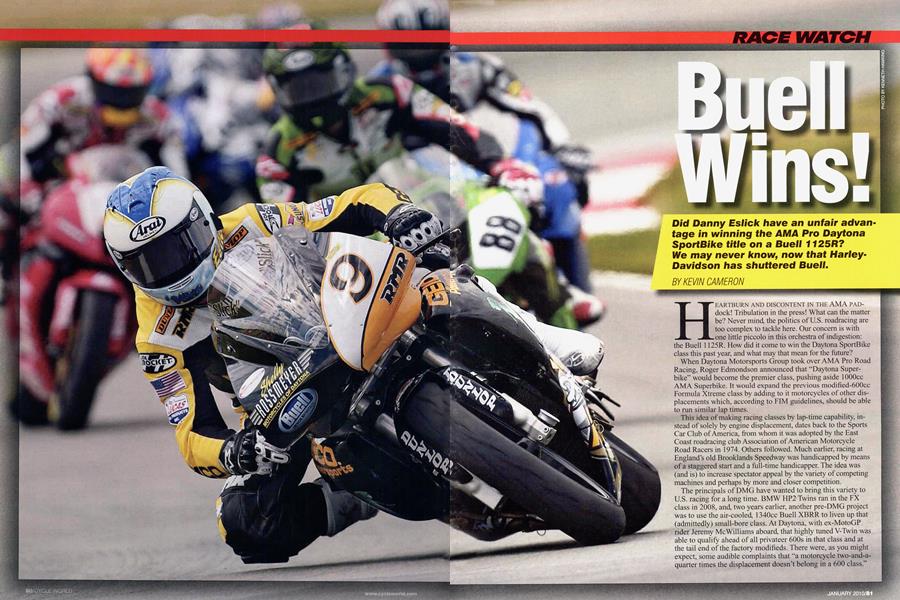
Did Danny Eslick have an unfair advantage in winning the AMA Pro Daytona SportBike title on a Buell 1125R? We may never know, now that HarleyDavidson has shuttered Buell-
KEVIN CAMERON
HEAR TBURN AND DISCONTENT IN THE AMA PAD-dock! Tribulation in the press! What can the matter be? Never mind, the politics of U.S. roadracing are too complex to tackle here. Our concern is with one little piccolo in this orchestra of indigestion: the Buell 1125R. How did it come to win the Daytona SportBike class this past year, and what may that mean for the future?
When Daytona Motorsports Group took over AMA Pro Road Racing, Roger Edmondson announced that “Daytona Superbike” would become the premier class, pushing aside lOOOcc AMA Superbike. It would expand the previous modified-600cc Formula Xtreme class by adding to it motorcycles of other displacements which, according to FIM guidelines, should be able to run similar lap times.
This idea of making racing classes by lap-time capability, instead of solely by engine displacement, dates back to the Sports Car Club of America, from whom it was adopted by the East Coast roadracing club Association of American Motorcycle Road Racers in 1974. Others followed. Much earlier, racing at England’s old Brooklands Speedway was handicapped by means of a staggered start and a full-time handicapper. The idea was (and is) to increase spectator appeal by the variety of competing machines and perhaps by more and closer competition.
The principals of DMG have wanted to bring this variety to U.S. racing for a long time. BMW HP2 Twins ran in the FX class in 2008, and, two years earlier, another pre-DMG project was to use the air-cooled, 1340cc Buell XBRR to liven up that (admittedly) small-bore class. At Daytona, with ex-MotoGP rider Jeremy McWilliams aboard, that highly tuned V-Twin was able to qualify ahead of all privateer 600s in that class and at the tail end of the factory modifieds. There were, as you might expect, some audible complaints that “a motorcycle two-and-aquarter times the displacement doesn’t belong in a 600 class.”
Erik Buell, for years manufacturing sport-oriented motorcycles powered by Harley-Davidson engines (of which the aforementioned 1340 was one), finally got corner-office permission to build a sportbike powered by an overhead-cam, liquid-cooled Rotax V-Twin. This is the Buell 1125R whose “Helicon” 72-degree engine has the dimensions of 103.0 x 67.5mm bore and stroke, making a claimed 146 horsepower at 9800 rpm.
At Daytona this past March, one of the Buells ran well until one of its side radiators began to fall off. Then-whammo ¡-Danny Eslick won three out of the next four races and was leading the series. Instantly, objectors were in full cry. DMG’s response was to weigh and dyno 10 bikes from the DSB field and add 5 pounds to the Buell’s minimum weight. The implication was that this was “fine-tuning” of class power-toweight ratios, but the paddock knew no Buell was on the 385-pound minimum (though Buell literature claims a 375pound dry weight).
The shouting died down as quickly as it had begun. Martin Cardenas dominated May and June on a Team M4 Suzuki GSX-R600. Cardenas led the champi-. onship from Kawasaki’s Jamie Hacking, 255 points to 204, with Eslick trailing at 199. At Sonoma, the track that gives riders no rest, Eslick got a fifth and a 12th. It was either feast or famine for him. Phew, crisis over.
Development is an integral part of racing, and for Mid-Ohio, Eslick’s team found him new confidence in the front end. Up to then, everyone had said, “That Buell’s a slug in the corners but a rocket on acceleration.” That comforting explanation was exploded as Eslick suddenly had more corner speed. That turned more tracks into “Buell tracks.” Eslick won both races in Ohio, putting him just 10 points off of Cardenas.
We know the rest. At Topeka, it became even-Steven, Cardenas vs. Eslick, and at Virginia in August, Cardenas fell, breaking a bone in his right hand. Eslick then rode conservatively to win the title.
What’s wrong with that? To me, it reads like any regular season of racing, with its usual ups and downs for everyone. The 600s had speed, maneuverability and braking. The Buell had acceleration and a horsepower advantage. So what?
Many in racing see issues everywhere. Here’s one: “What happens when an established top rider gets on a Buell?” People ask this question because Eslick has up to now been seen as only moderately talented. Did he 1 ) for years lack focus but suddenly acquire title-winning talent? Or 2) did possibly improper advantages of his motorcycle make the difference? The official message from Buell was that this machine suited Eslick’s dirt-track style, so the right answer is 1. But if the latter is correct, then Eslick might not be the only rider whose hopes could be revitalized by a Buell ride. If that were so, as long as parts are available for a bike that is no longer manufactured, we might see a phalanx of Buells up front, every bit as “boring and processional” (the usual criticisms of pre-DMG racing) as the old phalanx of expertly prepared and ridden Japanese “commodity Fours.” That would be back to square one or, in new-speak, “destabilizing.”
Honda has withdrawn from DMG racing for 2010. What if others do the same? What might surplus factory riders do then? Ben Spies neatly fit World Superbike’s promotional planning, but there’s no evidence that Mr. Flammini’s series could absorb more U.S. riders.
We don’t know what rear-wheel horsepower and weight figures DMG discovered in its post-race measurements of 10 bikes early in the season, but we can come up with numbers of our own. We know that when prepared for Supersport racing, recently designed four-cylinder sportbike engines generate stroke-averaged net combustion pressures (bmep) of around 190 psi. If we combine this with reasonable racing rpm for 600s (14,000) and the Buell (10,500), we get 123 crankshaft hp for the 600 and 172 hp for the 1125. If we knock off 12 percent for driveline and accessory loss, that becomes 108 at the rear wheel for the 600s and 152 for the 1125. A horsepower advantage of 40 percent is a point to ponder.
Club racing isn’t the only place where engine displacements have been staggered in the interest of good competition. In the early years of World Superbike, Twins were given lOOOcc while Fours got 750cc. This had a solid basis in engineering, for the displacement difference made up for the fact that Twins can’t rev as high as Fours. That gave the Twins a 33 percent displacement advantage. Eater, WSB rules changed to lOOOcc Fours vs. 1200cc Twins-a reduced 20 percent displacement advantage for Twins. Some would ask what extra disadvantage the Buell has versus the 600 Fours that calls for, not a 20 percent or a 33 percent advantage, but an 88 percent displacement advantage.
At Road Atlanta this past season, someone observed that the Buells “didn’t look like much fun through the esses.” And Eslick noted “a couple of issues on the brakes there...” At another point, Eslick also was quoted as saying, “The hardest thing is changing direction and a little bit under braking.”
Okay, as a first theory, one can propose that Buells needed that 88 percent displacement advantage and notional 40 percent horsepower advantage because they are heavy, unmaneuverable and have marginal brakes. Are Buells 88 percent heavier than typical 600s? Are they 40 percent heavier? The numbers say their weights are close.
As to maneuverability, following the final AMA national at New Jersey Motorsports Park, at Buell’s request, Cycle World sent Associate Editor Mark Cernicky to ride an 1125RR. He said, “Changing direction wasn’t a wrestling match, just a snap to get the Buell to transition from side-to-side in fast esses.”
During my own visit to Buell last spring, I was shown the impressive mass-properties lab, which contained instruments for measuring center-ofgravity location in three axes, plus a whole-bike polar-moment rig (which measures a bike’s resistance to being accelerated into rotation around various axes) and, significantly, a wheel polarmoment rig. Conversation with Buell engineers made it clear that they had worked in the most scientific ways to reduce the 1125’s resistance to the rider’s efforts to maneuver it. In public utterances, the company essentially said, “This is the world’s best-handling motorcycle.” Such confidence could arise from having used the mass-properties machines to measure and compare the polar moments of other makers’ machines, then designing their own to surpass them all in some unstated overall figure of merit.
Cernicky was riding the $40,000 turn-key 1125RR Superbike, not the simple “R” model raced by Eslick. Differences? Some lighter parts, such as magnesium wheels, and a heavier front brake disc-no 88 percent or 40 percent differences there.
After weight and maneuverability, we have the braking issue. The Buell carries a single 375mm iron disc with a special 8-piston caliper that grips it from the inside. All the 600s have the usual sportbike twin discs. Of the Buell’s brakes, Cernicky said they would “build heat and decelerate more drastically with even lever pressure. Plus, brake drag would linger after the lever was released.”
This sounds like brakes that may run hotter than average but not like terrible brakes. One Buell engineer told me last spring, “We’re not a racing company. Our brake is designed to deliver real advantages to street riders.” Yes, you can see that much effort has been devoted to making the single disc work in racing, but Erik Buell was adamant that it is a good brake. No 88 percent or 40 percent differences here, either.
All of the above still leaves open the question of what disadvantages the Buell had that justified its substantial displacement and power advantage on the field. Rightly or wrongly, many in the paddock still want to know.
Just before Road America, DMG announced that Buell would provide a tractor-trailer combination carrying three “safety bikes” as a replacement for the ill-starred and ingeniously named “safety car” used previously. To the untutored onlooker, this had the appearance of a cozy deal. A conversation with DMG folk revealed that all manufacturers were propositioned for this arrangement, and that “Buell was the only one to step up.” Okay, but the damage was done-there was the appearance of a cozy deal.
Others discussing these subjects ask how long DMG can remain a favorable environment for Buell. If the underlying policy is to randomize finish orders and put non-Big Four bikes into the mix, which smaller manufacturer might be DMG’s next “project?” BMW, Triumph and Ducati are not active in Daytona SportBike. Presumably, they are not because such racing would require too much R&D investment to make winners of the appropriate models. On the other hand, something attractive like generous horsepower or displacement advantages could make such an R&D task look both more practicable and affordable. Who knows what the future may bring?
Buell had planned to shift its racing focus to American Superbike in 2010, even though this is not DMG’s idea of a premier class. The 1125RR was created as a “turn-key Superbike,” and we are told that DMG favored the turn-key bike over a kit concept because that would make it easier for a team to enter the class. But that brought its own controversy, as many claimed the RR is not a street-legal machine as required by American Superbike rules.
Please, no paddock lawyering here. Sanctioning bodies will make whatever rules they think will bring the results they want. But what if other entrantsYoshimura Suzuki, for example-want “RR” models of their own, with special parts like those of the Buell? Will they be approved routinely under existing rules? Or would such approvals be individually “subject to policy?” And if RR models proliferate, doesn’t that take us straight back to the specialized racers of yesteryear? The politics of parts approval could be complex. If rules are not the same for all, does not that give at least the appearance of improper dealings between teams so favored and the sanctioning body?
When you talk with paddock regulars, you find that ill feeling arises from “the appearance of arbitrary rules making and enforcement.” That may not be the intention, but after-the-fact press releases haven’t made this okay. Appearances matter.
So which is it, a regular season of racing? Or issues everywhere? It may not matter. The well-to-do people or companies who spend money sponsoring racing are in general not doing so because roadracing is the only tool that reaches their target audience. They go racing because they like it, can afford it and want to be part of it. If it also works as advertising, so much the better. But if paddock-management relations feel adversarial, or if the teams perceive that rules weather-vane arbitrarily, they may be tempted to move their fun to a more stable and welcoming environment-like golf. Wouldn’t we rather have them in motorcycle racing?