Service
SERVICE
PAUL DEAN
The unfiltered truth
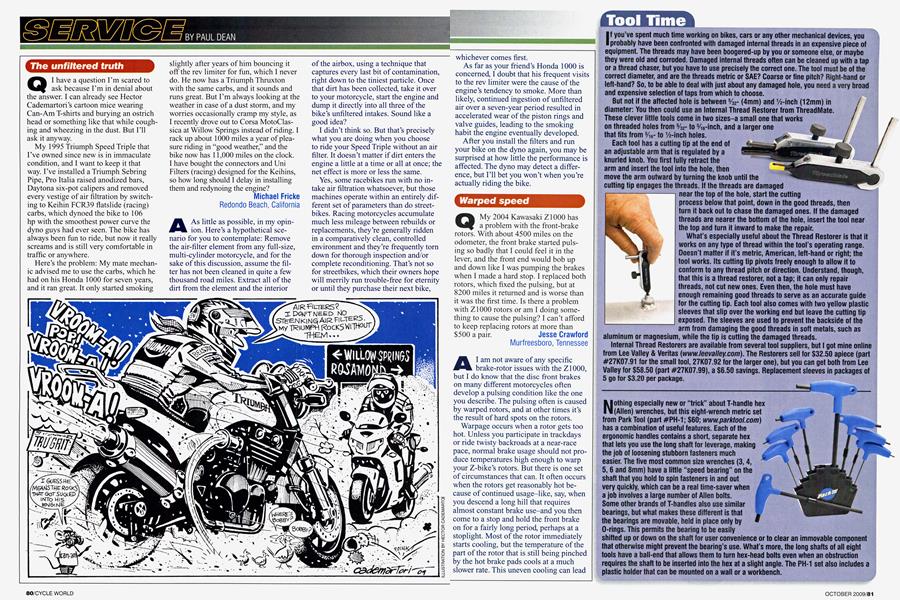
Q I have a question I’m scared to ask because I’m in denial about the answer. I can already see Hector Cademartori’s cartoon mice wearing Can-Am T-shirts and burying an ostrich head or something like that while coughing and wheezing in the dust. But I’ll ask it anyway.
My 1995 Triumph Speed Triple that I've owned since new is in immaculate condition, and I want to keep it that way. I've installed a Triumph Sebring Pipe, Pro Italia raised anodized bars, Daytona six-pot calipers and removed every vestige of air filtration by switch ing to Keihin FCR39 fiatslide (racing) carbs, which dynoed the bike to 106 hp with the smoothest power curve the dyno guys had ever seen. The bike has always been fun to ride, but now it really screams and is still very comfortable in traffic or anywhere. - -
Here’s the problem: My mate mechanic advised me to use the carbs, which he had on his Honda 1000 for seven years, and it ran great. It only started smoking
slightly after years of him bouncing it off the rev limiter for fun, which I never do. He now has a Triumph Thruxton with the same carbs, and it sounds and runs great. But I’m always looking at the weather in case of a dust storm, and my worries occasionally cramp my style, as I recently drove out to Corsa MotoClassica at Willow Springs instead of riding. I rack up about 1000 miles a year of pleasure riding in “good weather,” and the bike now has 11,000 miles on the clock.
I have bought the connectors and Uni Filters (racing) designed for the Keihins, so how long should I delay in installing them and redynoing the engine?
Michael Fricke
Redondo Beach, California
A As little as possible, in my opinion. Here’s a hypothetical scenario for you to contemplate: Remove the air-filter element from any full-size, multi-cylinder motorcycle, and for the sake of this discussion, assume the filter has not been cleaned in quite a few thousand road miles. Extract all of the dirt from the element and the interior
of the airbox, using a technique that captures every last bit of contamination, right down to the tiniest particle. Once that dirt has been collected, take it over to your motorcycle, start the engine and dump it directly into all three of the bike’s unfiltered intakes. Sound like a good idea?
I didn’t think so. But that’s precisely what you are doing when you choose to ride your Speed Triple without an air filter. It doesn’t matter if dirt enters the engine a little at a time or all at once; the net effect is more or less the same.
Yes, some racebikes run with no intake air filtration whatsoever, but those machines operate within an entirely different set of parameters than do streetbikes. Racing motorcycles accumulate much less mileage between rebuilds or replacements, they’re generally ridden in a comparatively clean, controlled environment and they’re frequently torn down for thorough inspection and/or complete reconditioning. That’s not so for streetbikes, which their owners hope will merrily run trouble-free for eternity or until they purchase their next bike, whichever comes first.
As far as your friend’s Honda 1000 is concerned, I doubt that his frequent visits to the rev limiter were the cause of the engine’s tendency to smoke. More than likely, continued ingestion of unfiltered air over a seven-year period resulted in accelerated wear of the piston rings and valve guides, leading to the smoking habit the engine eventually developed.
After you install the filters and run your bike on the dyno again, you may be surprised at how little the performance is affected. The dyno may detect a difference, but I’ll bet you won’t when you’re actually riding the bike.
Warped speed
QMy 2004 Kawasaki Z1000 has a problem with the front-brake rotors. With about 4500 miles on the odometer, the front brake started pulsing so badly that I could feel it in the lever, and the front end would bob up and down like I was pumping the brakes when I made a hard stop. I replaced both rotors, which fixed the pulsing, but at 8200 miles it returned and is worse than it was the first time. Is there a problem with Z1000 rotors or am I doing something to cause the pulsing? I can’t afford to keep replacing rotors at more than $500 a pair. Jesse Crawford
Murfreesboro, Tennessee
AI am not aware of any specific
brake-rotor issues with the Z1000, but I do know that the disc front brakes on many different motorcycles often develop a pulsing condition like the one you describe. The pulsing often is caused by warped rotors, and at other times it’s the result of hard spots on the rotors.
Warpage occurs when a rotor gets too hot. Unless you participate in trackdays or ride twisty backroads at a near-race pace, normal brake usage should not produce temperatures high enough to warp your Z-bike’s rotors. But there is one set of circumstances that can. It often occurs when the rotors get reasonably hot because of continued usage-like, say, when you descend a long hill that requires almost constant brake use-and you then come to a stop and hold the front brake on for a fairly long period, perhaps at a stoplight. Most of the rotor immediately starts cooling, but the temperature of the part of the rotor that is still being pinched by the hot brake pads cools at a much slower rate. This uneven cooling can lead to rotor warpage, even though you never actually overheated the brakes.
These same conditions can also cause excess brake-pad material to be deposited on the rotor. Every time you use the brakes, a tiny amount of pad material is transferred to the rotor; much of it is scraped away during the next revolution of the rotor and turned to dust, only to be replaced by a little more material, most of which is scraped away on the next revolution, and so on. But when the brakes are applied and held tightly on a hot, stationary rotor, more pad material than usual is transferred to the rotor, and not all of it necessarily gets wiped away during subsequent revolutions. This can ultimately lead to a difference in the coefficient of friction at that one spot on the rotor, causing the brakes to pulse.
Same thing can happen when grease or oil get on the rotor. The heat of normal braking can bake the lubricant into the surface of the rotor, leaving that area with a glaze that has a different coefficient of friction than exists on the rest of the disc.
Quite often, rotors that are glazed or have accumulated some pad material can be repaired by thoroughly sanding both sides of the rotors with 100or 200-grit sandpaper, and by cleaning the pads with solvent and sanding them, as well. But if the rotors are warped, replacement is the only alternative.
Leaping to contusions
QI have a 1981 Honda CB750 Custom that has just 12,000 miles on it. I acquired the bike 10 years ago but have only put 5000 miles on it because I hate riding it. When I start the engine for the first time at the beginning of each ride and put the transmission in gear, the bike leaps forward as though I never disengaged the clutch. The engine stalls when this happens and I’m almost thrown off the bike.
After that initial start, the bike goes into gear perfectly every time for the rest of the day, but the next time I ride it, the same problem occurs on the first start. I’ve played with the clutch adjustment but had no luck whatsoever.
I asked a couple of mechanics about this problem and they had no answer. Any advice you could provide would be greatly appreciated. John Agugliaro
Sanborn, New York
A You’re not alone here, John; I get quite a few inquiries from readers who are having the very same problem with their bikes. The brands, models and years of the affected machines vary all over the map, but they all have one thing in common: wet clutches.
Your CB750 lunges forward when you first put it in gear after it sits overnight or longer because all the plates in its multiplate wet clutch are stuck together. When you squeeze the lever, the clutch linkage pushes the pressure plate outward, away from the rest of the 14-plate clutch pack. Normally, this relieves the force of the springs pressing against the plates and you can then shift into or out of gear without problem. But there’s a thin film of oil between the fiber clutch plates and the steel plates, and it acts sort of like a vacuum seal, causing the entire pack to stick together. So, when you put the transmission in gear, the clutch momentarily indeed does act like you have not disengaged it, causing the bike to lunge forward. That sudden shock is forceful enough to separate the plates, though, and the clutch then operates normally once again until the bike sits unused for a while.
Several things can cause a clutch to behave this way. Sometimes, it results from the use of automotive oils that contain additives that are not ideal for use in motorcycles with wet clutches. Sometimes, it is caused simply by dirty, worn-out oil. And in your case, it could very likely be the result of either or both of those factors combined with your CB’s age and long periods of non-use. The bike is 28 years old but only has 12,000 miles on it; and during its first 18 years, it was ridden fewer than 400 miles annually, and it has only averaged 500 miles a year since you bought it. Obviously, it has sat unused for long periods, giving oil plenty of time to soak into the fiber clutch plates. Regular clutch use tends to keep the faces of the fiber plates relatively clean and unsaturated with oil, but that doesn’t happen with a bike that is parked most of the time.
I suggest you start by changing the oil and filter. Use a motorcycle-specific lubricant, such as one of Pro-Honda’s four-stroke oils, which have additives that help prevent the clutch plates from sticking together. If the problem persists after you have ridden a couple of hundred miles with that oil, you will need to install new clutch plates. You could try removing the old plates, cleaning the fiber ones with a good solvent, roughing up the surfaces of all the plates with 80-grit sandpaper and reinstalling everything; but at that point, you will already have the clutch apart, so it would be worthwhile to spend the ap> proximately $100-125 for new plates to ensure that the clutch will function properly after reassembly.
American idle
QI have a 1980 Yamaha XS1100.
After I ride it for an hour or so, the idle goes way up, and I don’t know why. Normal idle is about 1000-1100 rpm, but when the engine gets warm, it can go up to 2500 rpm or even higher. The bike has K&N air filters and a Kerker 4-into-l exhaust but is otherwise stock. Any ideas how I can get this fastidle problem to stop? Tim Dalton
Posted on America Online
A Usually, a dramatic increase in idle rpm once an engine warms is the result of a lean fuel mixture at idle. Such leanness can be caused by a number of factors, including intake-manifold leaks, worn carburetor slides and plugged idle jets. Intake leaks and worn slides introduce too much air into the mixture; plugged idle jets deprive the mixture of sufficient fuel. On a bike as old as your XS1100, any or all oí these conditions could be the cause.
Diagnosing an intake leak involves a fairly quick and easy procedure. With the engine warm and running at its high idle speed, spray some WD-40 around all of the carb-to-rubber-manifold and manifold-to-cylinder-head joints. If you immediately see smoke coming out of the mufflers, that is a clear indication of an air leak in the intake manifold. Use the little straw that comes with every can of WD-40 to direct the spray, targeting only one carb/manifold combo at a time so you’ll know which cylinder is the culprit if smoke starts exiting the exhaust. Each intake manifold also has a brass carburetor-synchronization fitting that’s covered with a rubber plug, so check those to determine if one of the plugs is either cracked or missing altogether.
Unless your bike has close to 100,000 miles on it or has been run for many years without an air-filter element (see “The unfiltered truth” letter at the beginning of this Service), I doubt that worn carb slides are the problem; XS11 slides are chromeplated, which not only gives them superb long-range wear characteristics, but their ultra-smooth surfaces also inhibit wear of the pot-metal slide bore in the carb bodies. Still, if you have doubts, remove the airbox, start the engine, let it warm until the idle speeds up, then poke your fingers into the inlets of the carbs and push the slides forward against the front of their bores. If the idle slows down close to the normal
rpm, the slides and/or slide bores are worn and the affected components will need to be replaced.
Then there’s the matter of plugged idle jets. If this were the case, the engine would either idle poorly or not at all once the cold-start enricheners were turned off. But you indicated that the idle speed remains in the proper range until the engine warms, so plugged jets obviously are not the problem. In the end, I think that can of WD-40 will prove to be your best friend in your quest for a normal warm-engine idle. □
Got a mechanical or technical problem with your beloved ride? Can't seem to find workable solutions in your area? Or are you eager to learn about a certain aspect of motorcycle de sign and technology? Maybe we can help. If you think we can, either: 1) Mail a written in quiry, along with your full name, address and phone number, to Cycle World Service, 1499 Monrovia Ave., Newport Beach, CA 92663; 2) fax it to Paul Dean at 949/631-0651; 3) e-mail it to CWlOean@aoLcom; or 4) log onto
www.cycleworld.com click on the "Contact Us" button, select "CW Service" and enter your question. Don't write a 10-page essay, but if you're looking for help in solving a prob lem, do include enough information to permit a reasonable diagnosis. And please understand that due to the enormous volume of inquiries we receive, we cannot guarantee a reply to every question.