Honda Cbr600f4i
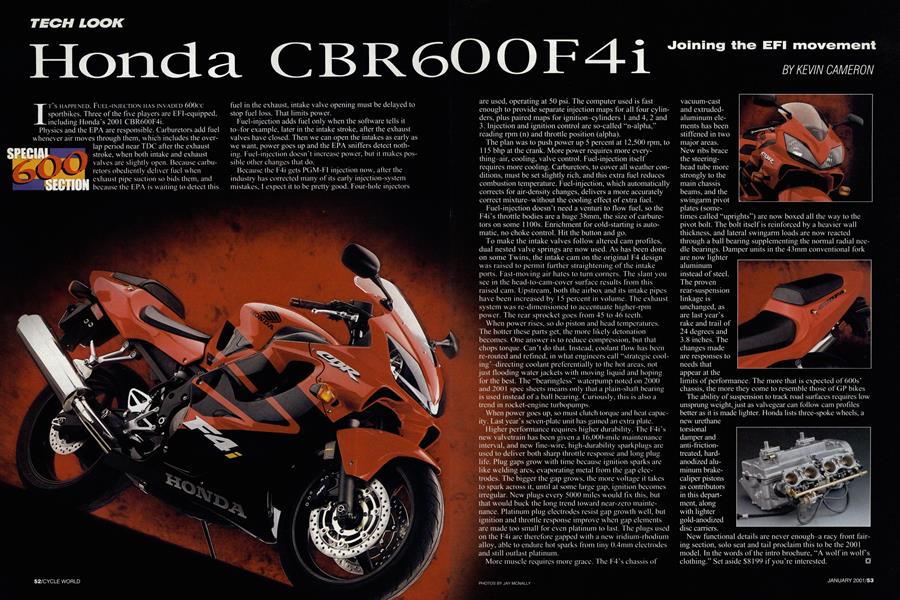
Honda CBR600F4i
SPECIAL 600 SECTION
TECH LOOK
IT’S HAPPENED. FUEL-INJECTION HAS INVADED 600CC sportbikes. Three of the tlve players are EFl-equipped, including Flonda’s2001 CBR600F4Í.
Physics and the EPA are responsible. Carburetors add fuel whenever air moves through them, which includes the overlap period near TDC after the exhaust stroke, when both intake and exhaust valves are slightly open. Because carburetors obediently deliver fuel when exhaust pipe suction so bids them, and because the EPA is waiting to detect this fuel in the exhaust, intake valve opening must be delayed to stop fuel loss. That limits power.
Fuel-injection adds fuel only when the software tells it to-for example, later in the intake stroke, after the exhaust valves have closed. Then we can open the intakes as early as we want, power goes up and the EPA sniffers detect nothing. Fuel-injection doesn’t increase power, but it makes possible other changes that do.
Because the F4i gets PGM-F1 injection now, after the industry has corrected many of its early injection-system mistakes, I expect it to be pretty good. Four-hole injectors are used, operating at 50 psi. The computer used is fast enough to provide separate injection maps for all four cylinders, plus paired maps for ignition-cylinders I and 4, 2 and 3. Injection and ignition control are so-called “n-alpha,” reading rpm (n) and throttle position (alpha).
Joining the EFI movement
KEVIN CAMERON
The plan was to push power up 5 percent at 12,500 rpm, to 115 blip at the crank. More power requires more everything-air, cooling, valve control. Fuel-injection itself requires more cooling. Carburetors, to cover all weather conditions, must be set slightly rich, and this extra fuel reduces combustion temperature. Fuel-injection, which automatically corrects for air-density changes, delivers a more accurately correct mixture-without the cooling effect of extra fuel.
Fuel-injection doesn’t need a venturi to How fuel, so the F4i’s throttle bodies are a huge 38mm, the size of carburetors on some 1100s. Enrichment for cold-starting is automatic, no choke control. Hit the button and go.
To make the intake valves follow altered cam profiles, dual nested valve springs are now used. As has been done on some Twins, the intake cam on the original F4 design was raised to permit further straightening of the intake ports. Fast-moving air hates to turn corners. The slant you see in the head-to-cam-cover surface results from this raised cam. Upstream, both the airbox and its intake pipes have been increased by 15 percent in volume. The exhaust system was re-dimensioned to accentuate higher-rpm power. The rear sprocket goes from 45 to 46 teeth.
When power rises, so do piston and head temperatures. The hotter these parts get, the more likely detonation becomes. One answer is to reduce compression, but that chops torque. Can’t do that. Instead, coolant flow has been re-routed and refined, in what engineers call “strategic cooling’-directing coolant preferentially to the hot areas, not just flooding water jackets w ith moving liquid and hoping for the best. The “bearingless” waterpump noted on 2000 and 2001 spec sheets means only that a plain-shaft bearing is used instead of a ball bearing. Curiously, this is also a trend in rocket-engine turbopumps.
When power goes up, so must clutch torque and heat capacity. Last year's seven-plate unit has gained an extra plate.
Higher performance requires higher durability. The F4i’s new valvetrain has been given a 16,000-mile maintenance interval, and new fine-wire, high-durability sparkplugs are used to deliver both sharp throttle response and long plug life. Plug gaps grow with time because ignition sparks are like welding arcs, evaporating metal from the gap electrodes. The bigger the gap grows, the more voltage it takes to spark across it, until at some large gap, ignition becomes irregular. New plugs every 5000 miles would fix this, but that would buck the long trend toward near-zero maintenance. Platinum plug electrodes resist gap growth well, but ignition and throttle response improve when gap elements are made too small for even platinum to last. The plugs used on the F4i are therefore gapped with a new iridium-rhodium alloy, able to endure hot sparks from tiny 0.4mm electrodes and still outlast platinum.
More muscle requires more grace. The F4's chassis of
vacuum-cast and extrudedaluminum elements has been stiffened in two major areas.
New ribs brace the steeringhead tube more strongly to the main chassis beams, and the swingarm pivot plates (sometimes called “uprights”) are now boxed all the way to the pivot bolt. The bolt itself is reinforced by a heavier wall thickness, and lateral swingarm loads are now reacted through a ball bearing supplementing the normal radial needle bearings. Damper units in the 43mm conventional fork are now lighter aluminum instead of steel.
The proven rear-suspension linkage is unchanged, as arc last year’s rake and trail of 24 degrees and 3.8 inches. The changes made are responses to needs that appear at the
limits of performance. The more that is expected of 600s’ chassis, the more they come to resemble those of GP bikes
The ability of suspension to track road surfaces requires low unsprung weight, just as valvegear can follow cam profiles better as it is made lighter. Honda lists three-spoke wheels, a new urethane torsional damper and anti-frictiontreated, hardanodized aluminum brakecaliper pistons as contributors in this department, along with lighter gold-anodized disc carriers.
New functional details are never enough-a racy front fairing section, solo seat and tail proclaim this to be the 2001 model. In the words of the intro brochure, “A wolf in wolfs clothing.” Set aside $8199 if you’re interested.