2001 Suzuki Gsx-R600
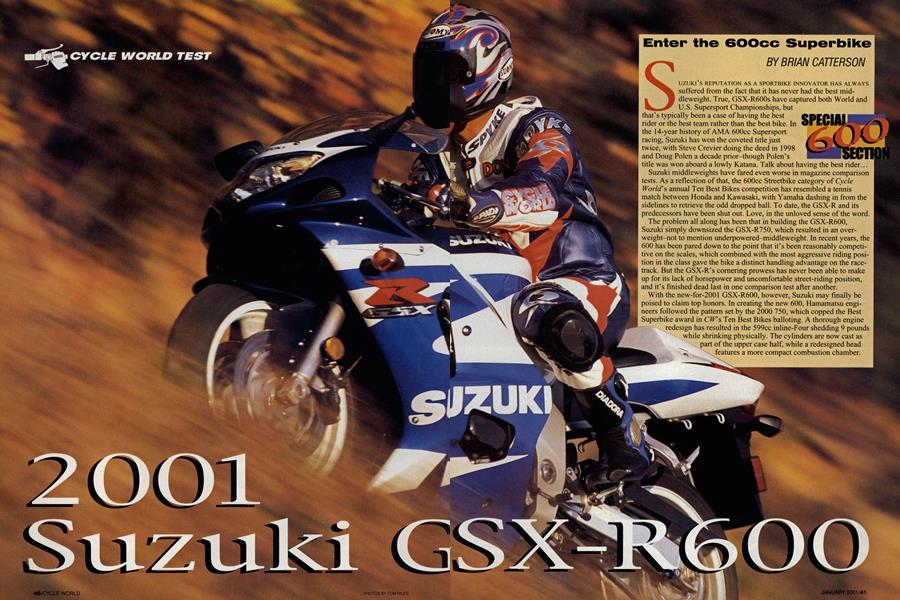
2001 Suzuki GSX-R600
CYCLE WORLD TEST
Enter the 600cc Superbike
BRIAN CATTERSON
SUZUKI'S REPUTATION AS A SPORTBIKE INNOVATOR HAS ALWAYS suffered from the fact that it has never had the best middleweight. True, GSX-R600s have captured both World and U.S: Supersport Championships, but that's typically been a case of having the best rider or the best team rather than the best bike. In the 14-year history of AMA 600cc Supersport racing, Suzuki has won the coveted title just twice, with Steve Crevier doing the deed in 1998 and Doug Polen a decade prior-though Polen's title was Won aboard a lowly Katana. Talk about having the best rider...
Suzuki middleweights have fared even worse in magazine comparison tests. As a reflection of that, the 600cc Streetbike category of Cycle World's annual Ten Best Bikes competition has resembled a tennis match between Honda and Kawasaki, with Yamaha dashing in from the sidelines to retrieve the odd dropped ball. To date, the GSX-R and its predecessors have been shut out. Love, in the unloved sense of the word.
The problem all along has been that in building the GSX-R600,
Suzuki simply downsized the GSX-R750, which resulted in an overweight-not to mention underpowered-middleweight. In recent years, the 600 has been pared down to the point that it’s been reasonably competitive on the scales, which combined with the most aggressive riding position in the class gave the bike a distinct handling advantage on the racetrack. But the GSX-R’s cornering prowess has never been able to make up for its lack of horsepower and uncomfortable street-riding position, and it’s finished dead last in one comparison test after another.
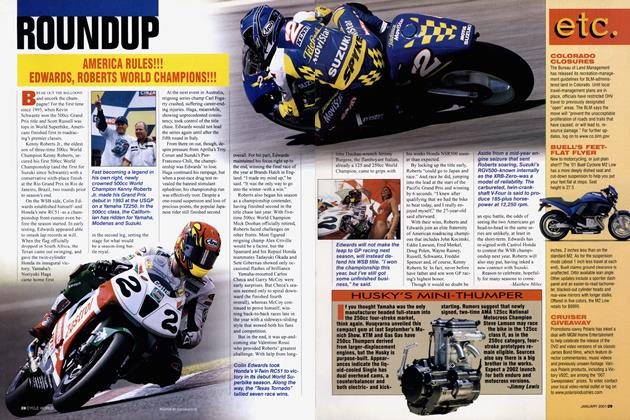
With the new-for-2001 GSX-R600, however, Suzuki may finally be poised to claim top honors. In creating the new 600, Hamamatsu engineers followed the pattern set by the 2000 750, which copped the Best Superbike award in CW's Ten Best Bikes balloting. A thorough engine redesign has resulted in the 599cc inline-Four shedding 9 pounds while shrinking physically. The cylinders are now cast as part of the upper case half, while a redesigned head ^ \ features a more compact combustion chamber.
But the most significant improvement is the adoption of an all-new engine-management system, which controls fuelinjection and ignition timing with the aid of more 3-D maps than the War Room at the Pentagon.
The chassis wasn’t neglected, either. Drawing from lessons learned on the RGV500 Grand Prix racer, the GSXR’s engine was moved forward and its swingarm lengthened, resulting in a greater front-end weight bias and a slightly longer wheelbase. Chassis flex was optimized, and the Showa suspension was changed subtly, with a longerstroke right-side-up fork and a shorter, lighter shock that delivers the same amount of wheel travel as before. The twin Tokico four-piston front brakes also were redrawn, with a new caliper shape, aluminum (rather than steel) pistons and grooved discs to further reduce weight. The engineers even shaved a few ounces by changing the shape of the wheel spokes.
To show how well the new GSXR600 works, Suzuki invited the motorcycling press to Georgia’s Road Atlanta Raceway for a test ride, and to help celebrate the 15th anniversary of the Suzuki Cup Finals. Where, illustrating the lack of interest, there were just 12 entries in the GSX-R600 class, seven fewer than in the brand-new SV65Ü category, and less than half as many as in the GSXR750 ranks. For the record, up-and-comer Lee Aeree was the big winner, sweeping three of the four classes, the exception being veteran Tray Batey’s victory in the new TL 1000 category.
Road Atlanta is one of America’s premier roadrace circuits, with a challenging layout that utilizes the area’s undulating terrain to dramatic-and occasionally heartstopping-effect. And now that the track has come under the ownership of pharmaceutical entrepreneur Don Panoz (the Irishman who invented the gel cap and the nicotine patch), it’s even better, with more runoff everywhere and a much safer left/right chicane replacing the potentially lethal, wide-open “Gravity Cavity” of years past. Local folklore holds that the former owners purchased the track in order to land drug-smuggling planes on the long backstraight, so it’s encouraging to see the facility under new, enthusiastic ownership.
Like an increasing number of semi-Pro roadracing series, the Suzuki Cup Finals arc now run under strict horsepower and weight guidelines, enforced via dynamometer and scales. And seeing as how there was one of each at the tech inspection area, it seemed a waste not to roll our GSX-R600 testbike on over.
The results were flabbergasting. With the fuel tank topped off, the new Suzuki weighed just 416 pounds. Subtracting the weight of the 4.8 gallons of gas equates to a dry weight of just 387 pounds, 32 pounds lighter than the old version and 17 lighter than the previous class flyweight, the Yamaha YZF-R6. And on the dyno, the GSX-R pumped out 103.5 rear-wheel horsepower, an incredible 14 ponies more than the last GSX-R600 we tested and 8 more than the next-strongest 600, the R6. Clearly, this bike means business.
Riding the new GSX-R around the racetrack showed just how far it has come. Pushing the starter button gave an immediate indication of the improvements wrought by the fuel-injection system. Previous Suzuki middleweights have required lengthy warm-up periods, but the new 600 fired right up and idled smoothly, even without the aid of the barmounted “choke” (actually a fast-idle) lever. The transmission snicked easily into first gear, and working the throttle against the relatively narrow clutch engagement afforded by the new coil-type clutch springs (which replaced the diaphragm springs used previously) saw the bike accelerate smoothly down pit road.
The riding position is radical by 600cc roadbike standards, but compared to past GSX-Rs-especially the torturous late `80s/early-'90s models-~it's a vast improvement. Though the clip-on bars are low-set, the reach from the seat isn't too far, and the rearset pegs bend your knees just enough to remind you of the bike's sporting intentions. The seat is surprisingly cushy, the suspension firm yet supple, and the cockpit. while cluttered by unsightly brackets and wires, boasts easy-to-read instrumentation.
Among Road Atlanta's many interesting features are the infamous Esses, where you snap the bike back and forth as you plunge downhill, then baek uphill, pulling maximum g’s in the valley between. And here you could really feel the weight savings, as the GSX-R offered little in the way of turning resistance. Slowing for subsequent second-gear Turn 5 revealed that the new brakes possess both excellent stopping power and feel, particularly while trail-braking, though by day’s end our testbike’s rotors had developed hot spots that caused some slight pulsing at the lever. Cornering clearance is more than ample. Despite shagging two sets of Dunlop D207s, we only ever touched down the footpeg feelers.
Like many repli-racers, the GSX-R can sometimes be a tad nervous. Gassing it hard over the small rises exiting Turns 5 and 7 caused the bike to wag its head unless you sat back, tugged on the bars and mono-wheeled down the hill. Like Scott Russell once said at Daytona, “It won’t headshake if you’re wheelyin’.” But the bike felt stable everywhere else, even with the digital speedometer indicating 166 mph at the end of the backstraight-in fifth gear!
We’d like to be able to tell you how fast the GSX-R goes in the top of sixth, but given north Georgia’s rolling topography, dense roadside woods, freely roaming deer and lack of long, straight roads, we thought it prudent to pencil an “na” in the data panel for now and wait ’til we can get a testbike back in California. But we’re confident that the GSX-R will prove to be the fastest middleweight ever. Even with the usual speedometer optimism, could this be the first 160-mph 600?
We can tell you how fast the bike went in the quartermile, however, because we stayed over a couple of days following the press intro to do performance testing and log some street miles.
At Atlanta Dragway, the GSX-R affirmed its status as the
new 600cc horsepower king with a time of 10.76 seconds at 127.95 mph, quicker than any of the current breed of sporting middleweights and a hundredth of a second quicker than the previous class record-holder, the 1997 Kawasaki ZX-6R. And while the Suzuki’s top-gear roll-on numbers are lackluster, it was impressive how cleanly the engine pulled from below 40 mph in sixth gear. The only protestations came from the chain slapping on the swingarm.
As remarkable as the GSX-R was on the racetrack, it was even more so on the street. To be honest, the hour-long freeway stint leaving Atlanta wasn’t much fun, owing to the racy riding position and a fair amount of engine vibration tingling the bars. But once past the tourist trap that is the town of Helen and into the North Georgia Mountains, it was pure pleasure. You forget how much fun it is to ride a lightweight machine until you spend a day flogging one down twisty roads. You never have to muscle the GSX-R, you just move it back and forth between your knees, tightening your line at will. It’s reminiscent of a 250cc GP bike.
The only really negative comment we'll make about the GSXR is that it doesn’t produce much lowto midrange torque. This is particularly noticeable while accelerating out of one of those hairpin turns that’s too fast for first gear, yet too slow for second. But even then, the GSX-R doesn’t complain, it just lazily motivates out of the comer, patiently waiting until the tachometer needle sweeps past 6000 rpm before accelerating in earnest.
So, is the new GSX-R the best 600? Well, if it’s true, as racer Aaron Yates claimed at Road Atlanta, that the 2001 GSX-R600 is as strong in stock trim as his fully developed 2000 Yoshimura Supersport bike, then everyone else will be racing for second place. And there will be a lot more GSXR600s at next year’s Suzuki Cup Finals.
SUZUKI GSX-R600
$7999