The Forever Racer
SPEED IN AMERICA
The Forever Racer
Don Vesco, hot-rodder, road racer, land-speed record holder, doesn't know when to quit-thank goodness
JOE SOALZO
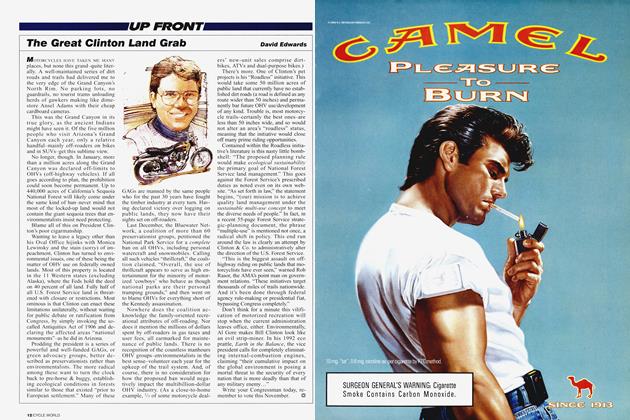
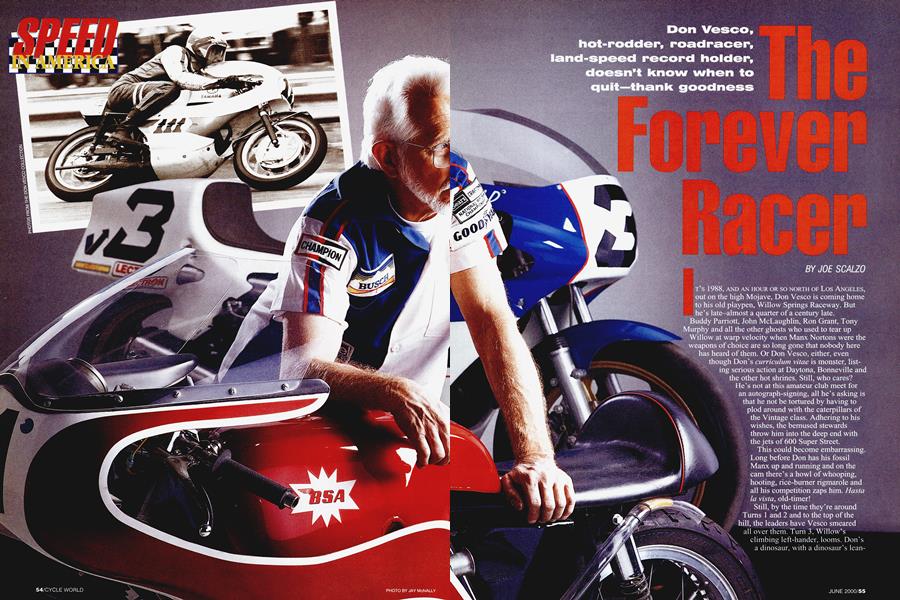
IT’s 1988, AND AN HOUR OR SO NORTH OF LOS ANGELES, out on the high Mojave, Don Vesco is coming home to his old playpen, Willow Springs Raceway. But he’s late-almost a quarter of a century late.
Buddy Parriott, John MCLaughlin, Ron Grant, Tony Murphy and all the other ghosts who used to tear up Willow at warp velocity when Manx Nortons were the weapons of choice are so long gone that nobody here has heard of them. Or Don Vesco, either, even though Don’s curriculum vitae is monster, listing serious action at Daytona, Bonneville and the other hot shrines. Still, who cares? He’s not at this amateur club meet for an autograph-signing, all he’s asking is that he not be tortured by having to \ plod around with the caterpillars of the Vintage class. Adhering to his B wishes, the bemused stewards m, : throw him into the deep end with ■L the jets of 600 Super Street.
lB|; This could become embarrassing. M; Long before Don has his fossil I |p Manx up and running and on the Mr . cam there’s a howl of whooping, hooting, rice-burner rigmarole and all his competition zaps him. Hasta la vista, old-timer!
Still, by the time they’re around Turns 1 and 2 and to the top of the ^ hill, the leaders have Vesco smeared all over them. Turn 3, Willow’s climbing left-hander, looms. Don’s a dinosaur, with a dinosaur’s lcan-
ing-instead-of-hanging-off style-when it comes to all that knee-dragging and torso-heaving abracadabra, he’s clueless. Quite a handicap, but Vesco knows how to play dirty.
He lets the young bucks lure him in deep and ultra-close. And then he royally jams them up the inside by remaining ultra-close. It’s beautiful, because the young bucks have no space for the usual monkey-fomicating-a-football contortions and can’t turn. Grabbing the lead, the old man prepares to split.
Reality returns when everybody nails him on the run into 9. Extra-tricky Turn 9, Willow’s intimidating sweeper, has been busting butts ever since it was invented, and it’s what Don’s been waiting for-he was careening around 9 before most of the young bucks were even bom. He gets them out of his hair by acing it.
But the fastest of the young bucks, aboard some kind of killer Honda, camps out behind him long enough to measure Vesco’s Turn 9 line.
No scaredy cat, he next comes past on the outside. So Don
has to raise still another full head of steam and catch the Honda in the draft, right at the checkered, by a Manxlength.
But afterward there’s going to be hostility in the pits. Don looks up, and, Oh, God, here comes the buck he beat, a twentysomething hot-dog. He looks pissed, and maybe has the right, because he’d never lost at Willow previously. Checking out the duo of phantom codgers that did him in, the buck first confronts Don-white-haired, white-bearded, almost half a century ancient and (let’s be candid) winded. Then he turns to the equally thrashed Manx bleeding lubricant out its valve-spring hairpins.
He’s suspicious. “This thing’s not oversized, is it?”
“No,” Don replies, playing it congenial. “Just a 500. It’s a Norton Manx.”
The young buck’s suspicion deepens. “What’s a Norton Manx?”
It’s 1949, and just down the coast from L.A. in San Diego, Don’s hometown, all the family Vesco-Dad, Mom, Don and his two brothers-are at Balboa Stadium for the midgetcar races. Don is 10 years old. His father, the namesake of John Vesco Auto Body, has been mad for automobile racing ever since he was young and poor and used to ride the freight-train rails to Indianapolis to see the 500-mile race. Since then, it’s been his pleasure and gusto to gas
Terraplane Hudsons around the dry lakes at Muroc as well as tool salt rods across Bonneville.
His sons have caught his madness-Don especially.
Certain that automobile racing will be his life’s calling, he’s honing his skills. Only a third-grader, he can already take any model airplane engine, tear apart its insides, reassemble them and make everything faster.
On this Balboa Stadium eve, as ever, Don’s parked on the first-turn fence, digging the din and heavy charisma of “OT
Ironsides,” a famous red and ragamuffin midget raced by Billy Vukovich, the sensational Balkan badman who is Don’s god. Ol’ Ironsides is almost as much motorcycle as racecar. Its crude-butinspired Drake powerplant consists of the bottom half of a Harley 74 bolted to a pair of water-cooled barrels-the whole wicked brew violently jacked up to a compression ratio of 15:1. Vukovich in coming years will buy the farm trying to become the only race driver to win three consecutive Indy 500s-Don will hear the radio broadcast and take a long time to get over being devastated. But what he won’t forget, ever, is being a 10-year-old
at Balboa getting blasted by Ol’ Ironsides’ din and clobbered by Vookie’s flying dirt.
It’s 1958 in the San Diego outback at Paradise Mesa, a makeshift roadracing track ringing a dragstrip. Raging away in a dead heat for first are a Gold Star BSA and a 500 Triumph. Don’s the one on the Turnip.
What’s he doing racing a velocipede instead of a fourwheeler?
Well, at a moment in history when race cars are pricey but you can acquire a decent scooter for a fast couple of bills, you gladly settle for two wheels. Then you can ride it to high school, cowtrail it, drag race it, even roadrace it. Besides, ’Dago has this fantastic motorcycle situation going on. The town’s jumping with major players including (among many) the first Clark Gable lookalike to win three Grand National No. l’s (Joe Leonard); the first teenager to be No. 1 (Brad Andres); a family dynasty of Daytona champions past and future (Floyd and Don Emde); an amazing jack-of-all trades capable of winning anywhere from Daytona to the Springfield Mile to the Ascot TT steeplechase (Ralph White); and even a 17-year-old blueprint-shagger on a Beezer who’s Don’s best bud and at this very moment right on Vesco’s elbow at Paradise-said 17-year-old blueprint-shagger (Cal Raybom) who will later lift Harley-Davidson dirt-track master Carroll Resweber’s dangerous plow-the-front-wheel cornering trick, graft it to blacktop and go on to be dazzle Daytona and all roadracing.
Paradise is a snaking ribbon of narrow pavement hooking into a hairpin followed by a right-left chicane marked by three tires bolted together and painted white. Grabbing great and greedy handfuls exiting the hairpin, Don and Cal find themselves running out of room as they hurtle handlebar-to-handlebar toward yonder chicane.
They bat on to the point of no return. Then trespass it. Don goes up over the tires and out the other side, then hangs a quick U and swerves back into the race. Cal does ditto.
Moral: If you think of the consequences, you can’t be brave.
It’s 1961 on the wide-open runways of Goleta Airport near the resort town of Santa Barbara on the tony California Pacific. These weekend matches for the swells and rich guys of sports-car racing are hosts to caterwauling Ferrari V-12s and droning Maserati Birdcages. Splendiferous sounds, but you can forget them. American Honda Motor Company, looking for publicity as it kicks off its big sales campaign, has imported straight from the Grand Prix world tournament a four-pipe RC 161 whose aria will soon shatter the seacoast and put all the sporty cars on their trailers. On the RC’s throttle ready to make it wail like a banshee is Don Vesco.
His journey from Paradise Mesa to the saddle of the loudest and most exotic rocketship in motorcycledom has itself been rocket-like.
All those early Willow Springs pilgrimages of Don’s started it. He’d gone to Willow to take on the Manx Norton tribe and gotten fed up with leading one lap, max, before Buddy, John, Ron and Tony annihilated him and his wobbly Triumph. A Manx, then, was what he had to have, too. But when one finally came up for sale, Don couldn’t pony up the scratch. So he borrowed it from a sweet and loyal girlfriend, Norma, shortly to become his wife (the first of three failed Vesco marriages; wedlock is a volatile undertaking for the lifelong racer). With this thing nobody will be able to beat me, Don had decided, and he wasn’t so far wrong, which was why when someone was needed to seriously exercise its RC161, American Honda picked him.
To persuade all of the country’s automobile Babbitts to park their sleds and take up motorcycling, Honda’s advertising slogan is, “You meet the nicest people on a Honda.” But Don is not exactly a “nice” person in the sense Honda means. A “nice” person, upon being entrusted with so rare and irreplaceable a piece as an RC161 might say, Jeez, I’d
better be careful. A not-so-nice person (a maddog racer like Don, for instance) would say four cylinders, six speeds, instant horsepower, endless revs—get outta my way!
On Saturday’s Santa Barbara run-and-bump he has the throttle cracked wide-open, and when all four carbs light at once he’s off so fast that everybody else is still pushing. He and the RC161 win huge.
On Sunday, his start is as bad as Saturday’s was perfect. The little fire engine won’t flame. When it finally does, Don
is utterly last. He doesn’t care; he’s down on the paint ripping into traffic and through a pack of maybe 35 bikes in a swoop. He wins huge again. But back at Santa Barbara a couple of months later, Don’s catching top gear-can’t wait to get this little mother singing its song in sixth!-just as the front end washes out. Slamming the ground, he and the RC 161 are precipitated in the direction of an offcourse fireplug, which Don misses but the RC161 takes straight in the fuel tank.
Though damaged goods himself, Vesco limps over to shut off the spurting gasoline before rescue medics can drag him off in an ambulance.
All pretty fair entertainment value for American Honda, which had secured Don’s services for the price of a motel room. Afterward-certainly helped by Don’s acrobatic derring-do and the RC’s sound show-some 30 or so swells come out of the Santa Barbara crowd to enlist in Honda’s burgeoning dealer network. The Honda story, which becomes the monster motorcycle story of the last half of the 20th century, is launched. In later decades, Don will examine where he is, and where Honda is, and ponder whether or not he should have asked for something more than a motel room.
It’s 1966 at Carlsbad, another of SoCal’s worthy race pads, and Vesco has just zoomed up and over a blind hill and is going for avoidance control, trying to miss a stalled 250 Harley sitting on the track. He eats it-eats it big. The back of his TD1C Yamaha steps out and he’s pitched onto his melon and knocked dingy. Nothing is broken, but upon awakening he’s angry that he’s done it to himself again.
Race hard, occasionally crash hard, the racer’s lament. By now, Don’s done the walking-wounded number everywhere from Santa Barbara to Bonneville to Daytona. A couple of seasons prior there had occurred his worst get-off ever. He’d gone over the handlebars and through the windscreen and smashed up a collarbone so thoroughly that a stainless-steel pin had gone inside for three months. Sleep was impossible except for 10 minutes at a stretch-the pain was like a razor-but the worst part of the recuperation was when the boss of the used-car lot where Don was employed as a shadetree mechanic called and said, “You sure miss a lot of work on account of your racing. Maybe ■Ä you should race less and work here more.”
‘TT1 come right over and get my toolbox,” IHMBPI Don had replied, then had to add, “As soon as I’m strong enough to pick it up.”
Gigs where you can eam a steady paycheck and still get to race being rare, Don found losing this one extra-tough. It forced him to do something he really hadn’t wanted to.
Ever since 1963 when he took a works RD56 Yamaha to Daytona and won the U.S. Grand Prix-Yamaha’s first big American racing success, just like Santa Barbara had been Honda ’s-the coiporation had been pitching him to become a Yamaha dealer and open a shop. Naturally, he’d said no. Too much responsibility, not to mention it’d get in the way of his racing. But following the loss of his mechanic’s job, he had no choice but to give Yamaha a half-hearted yes. Don Vesco Yamaha subsequently opened in the blue-collar village of El Cajon. It became a success. Unfortunately, though, the other shoe quickly dropped. “We’d prefer you not to race anymore,” Yamaha informed Don.
Well, forget that. Even after the corporation subsequently quit giving him gratis Yamahas and thought it had him in drydock, Don retaliated by hocking a beloved G50 Matchless and purchasing TDICs of his own-
including the one he’d just thrown away at Carlsbad.
It’s 1970 at Bonneville-September the 17th, actually-and Don, aboard a multi-engine Yamaha streamliner he designed himself, goes 251.66 mph, making him the planet’s fastest man on two wheels. Those who know Vesco best will volunteer that, devoted as Don is to his roadracing, he’s even more so to the Salt Flats; that if he were absolutely forced to give up one of the two activities, roadracing would go. This strange salt infatuation dates to 1957 when he and his faithful 500 Triumph made their first-ever run at a whopping 109 mph.
Don’s hold on the Land Speed Record is tenuous indeed. The beertown shaker people, too, hunger for LSR glory, and on October 16th an orange-and-black Harley-Davidson streamliner duly materializes. At the controls, Don’s old nemesis from Paradise Mesa, Cal Rayborn. Calvin cuts a mighty 265.46 mph, and Don’s reign is over in less than a month.
It’s 1976 at Riverside International Raceway, and the Don Vesco Racing team is here for a round of the Camel Pro Series. Having reluctantly removed himself from the saddle going on roughly six seasons now, Don is, mostly, confined to bike prep and conducting strategy from the pits. It’s not as dreary as it sounds, because he’s been able to employ and hang with many of the sport’s livewires-Z.e. Kel Carruthers,
Dick Mann, even his own all-time best bud, rival and hero, Rayborn. At Riverside, Don’s gun is the former No. 1, former Daytona winner and allaround famous character, Gene Romero.
Riverside is Vesco’s old stomping ground; when he used to race here, RIR felt as user-friendly as Willow Springs. Coincidentally, as a preliminary to its Sunday national, the place is holding a kind of fun race for celebrity geezers like Don. But just one alarming lap of Saturday practice on Romero’s bazooka monoshock OW demonstrates to Don just how much racing has changed in six years. This thing is really fast, he thinks to himself, and suddenly gets trapped in the middle of the great-grandmother of all tank-slappers. “I’m too old for this,” he tells himself. “I’m never riding one of these things again. Never, ever, no.” When he arrives on Sunday morning he’s purposely left his leathers and crash lid back at the motel.
Hearing that his employer plans to be a no-show,
Romero is shocked. After all, Don’s various adventures have by now earned him a unique sort of pedigree as arguably racing’s most stone-cold brave hombre. There was the time, for instance, in 1961 when Don buzzed Willow for 100 mad miles with a visibly bent chassis, and finally got blackflagged on the last lap because he was frightening hell out of the officials. Or in aforementioned 1970 when he was first to take a Tiner beyond 250 mph, and 1975 when he hit 300.
“You have to ride,” Gene tells him, reminding Vesco that his risk-it-all style has been working pretty good so far.
“No,” Don replies in earnest. “That was the worst tankslapper of my life.”
“Oh, that” Romero says dismissively. “You’rejust not used to racing on slicks. When it starts to shake like that, just turn the throttle wide-open. That makes it drive right around the comer.”
Don still looks unconvinced. “Do it,” Romero implores.
“I don’t have my leathers and helmet,” Vesco counters.
“Take mine,” offers Romero.
Still pulling the leathers on over his Levi’s and buckling up the helmet as he walks to the starting line, Don, when the big moment comes, gasses it the way Romero instructed. He wins the geezer race. Later, he’ll take the OW out to the lakes and ride it to 200 at Muroc.
It’s 1985, and Vesco is back at Bonneville. But on four wheels instead of two. The reason for this heresy is simple. Having in 1978 made himself supremo of the salt by raising the motorcycle LSR ante to 318.598 on his twin-turbomotored Kawasaki Lightning Bolt, he’s been waiting seven long years for someone to take the bait and come after his record.
Nobody has. So from now on he’s going to work on the automobile record. What would suit him just fine is a run in excess of 500 mph.
It’s 1996 at the Manzanita Speedway in Phoenix,
Arizona, and Don is watching a sprint-car race from the grandstands. It could be debated that at times his racing has seemed like a long and drawn-out case history of battered muscles and bones, so it’s high time that he watch instead of race anymore. Just in the past five years or so, he’s dinged up vertebrae and a leg when his Sky Tracker 1 streamliner car went endo for three-quarters of a mile; and he was lucky to walk away from wrapping a turbocharged Indycar around a pole at a vintage car meet. All this at his age.
So here he is, safe and sane in the Manzy grandstands, being pelted by dirt just like he had while watching Vookie all those years ago. And a clod flies up off the track and puts out his eye!
The optic nerve is dead, period. One orb forever missing. So what’s he going to do, go cry? Not a chance. Instead,
Don accepts the invitation to get his equilibrium back by competing at velocities of up to 150 mph in the BMW Legends Series with Gary Nixon and Yvon Duhamel and other old combat comrades.
It’s January 1, 2000, in rural San Diego County on the five wind-blown acres of Don Vesco Racing. Having already worked straight through Christmas on an emergency job for one of DVR’s midget-car customers, Don has no misgivings whatsoever about setting out on a New Year’s Day flog for a desert-racing client. That’s the business, and Don Vesco Racing is one of auto sport’s hot addresses.
Vesco’s five acres contain speed toys fit for all tastes,
everything from a cherry old Ford F100 pickup to a Ferrari 308 GTS to circle-track race wagons of all vintages and configurations. Also-in different states of dress and undress-a vast fleet of bikes led by a matching pair of Manx Nortons. For nostalgia, there’s the original Vesco 500 Triumph.
But the greatest eye-grabber of the Team Vesco collection is “Turbinator,” a 31-foot-long land-speed projectile powered by a Lycoming direct-drive gas turbine. Designed by Don and his brother Rick, the car’s mission in 2000 is to obliterate the 427.832-mph wheel-driven car record of the incumbent speed holder, the Turbinator itself. As a 60th birthday present to himself, Don ran up those big numbers at Bonneville last October.
Asked what else might be in the old pipeline for the new century, Don rattles off some possibilities that are pure Vescoesque. “I still want to go 500 mph. And I’d like to set the car and motorcycle LSRs on the same day-I’ve still got my Lightning Bolt ’liner, and even though Dave Campos broke my old record in 1990, it was only by 4 mph-I know I can get it back. I’d like to try racing a TQ midget. Maybe get a 200mph lap around Indianapolis...”
Almost all of the remaining but fading members of his generation seem to have gone and gotten prematurely old and fat. They’ve shed their vigor and gusto and resigned themselves to settling down to the straight life to learn how to become dull. Whereas racing, to Don-who discounts all its getting-spit-over-the-high-side penalties-still is the fountain of youth.
“I’d race every day if I could,” Vesco says. □