Primetime
PRIMETIME
Supercross hits the jackpot
RACE WATCH
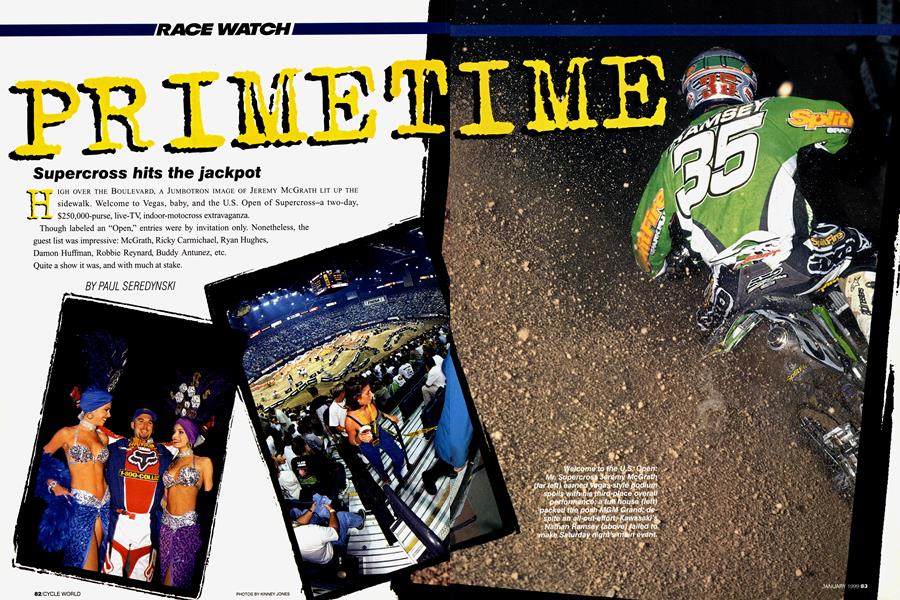
HIGH OVER THE BOULEVARD, A JUMBOTRON IMAGE OF JEREMY MCGRATH LIT UP THE sidewalk. Welcome to Vegas, baby, and the U.S. Open of Supercross-a two-day, $250,000-purse, live-TV, indoor-motocross extravaganza.
Though labeled an "Open," entries were by invitation only. Nonetheless, the guest list was impressive: McGrath, Ricky Carmichael, Ryan Hughes, Damon Huffman, Robbie Reynard, Buddy Antunez, etc. Quite a show it was, and with much at stake.
PAUL SEREDYNSKI
Compared to the acres of pristine flooring in the world’s largest hotel, the MGM Grand’s dirt-filled arena was an odd sight. The earthy aroma was wildly out of place in the climatecontrolled, citrus-scented air.
When practice started, the 10,000seat venue erupted with the snapping baritone of 250cc two-strokes. The wealth of invited off-road talent floated over triple-jumps carved into the earthen floor, and sailed past sponsor banners. Largest of these belonged to Fox Racing, the aftermarket clothing supplier. Fox ponied up most of the cash required of the event’s title sponsor and funded the unprecedented $100,000 winner’s check. But mixed among the Mazda Trucks, Maxxis Tires and Cometic Gasket banners ringing the arena were a few new names, including > Microsoft and Revlon Professional.
If you’re wondering what software or makeup have to do with dirtbikes, ask yourself what cereal and cheeseburgers have to do with NASCAR. On the same weekend, Ford-driving Dale Jarret took home $1 million at the Winston 500. References to that ultra-saleable form of motorsports were rampant throughout the weekend. The U.S. Open proved as much a debutante ball for marketers as a well-deserved payday for the sport’s top riders.
The event was organized by Eric Peronard and Mike DeStefano. Peronard said the idea came together after he saw Honda cart tons of dirt into the MGM for a dealer intro.
“I’ve been involved with Bercy, Geneva, all those races for over 10 years,” Peronard said of Europe’s “All-Star” invitationals. “All these guys go to Europe and they say, ‘Why don’t we have this in the States?’ I’ve had this idea for many years, but you need a prestigious venue.”
The MGM Grand was rather “intimate” for a Supercross event, which meant scaling down the track layout. The folks at PACE Motor Sports, who have spent the last few years promoting AMA Supercross, were not pleased.
“They’re comparing it to Bercy, and to some of the other events in Europe,” said PACE CEO Gary Becker. “They do not meet the definition of Supercross. They are doing an Arenacross event, and they are using the Supercross name to give them credibility.” Worried that the event would lend a false impression of an AMA Supercross, a product PACE has put serious effort into growing, company officials tried to prevent the Open from going off as billed. But a judge denied the injunction. The legal wrangling is just another sign of a sport with growing pains.
“In 1996, we averaged 26,000 people a race,” Becker said. “Last year, we averaged 42,000 people a race. It’s getting the media attention because the property is being promoted, something we have to do if we’re going to compete with NASCAR, baseball, football, basketball and the other forms of entertainment-not sporting activities, but entertainment.”
Entertainment is Peronard’s goal. “We’re not out here to do a series,” he explained. “We want to have this jewel at the MGM, with the biggest purse ever. We’ve been attracting sponsors that have never been in this kind of event, such as Revlon and Microsoft, though I don’t think Bill Gates is here.” >
Bill wasn’t in the house, but other Microsoft folks were. Their mission? To demonstrate the company’s new video game, “Motocross Madness.” Peter Parsons, Microsoft’s racing games product manager, found the partisan crowd to be exactly what he was looking for: “A bunch of smart, intelligent and fun people who love the sport. We went in feeling this would be a great crowd to show our product to, and it was true. As resources allow, we’d love to get involved in more events.”
The Revlon crew was no less enthusiastic. They were drawn to the ultrahip Supercross scenesters as a new market for Revlon’s cosmetics. “It’s kind of like going to a boxing matchthe audience is as interesting as what’s going on in the ring,” said Jan Arnold president of Revlon’s Creative Nail Design division. “The crowd was very handsome, very stylish, young, hip. I would say it was as much a social scene as it was a sporting event.”
“It does bode well,” added Mazda’s Jack Stavana. As title sponsor for the AMA outdoor series, Mazda also came in as the official truck of the Open. “If those consumer-product companies feel confident that the exposure they’re going to get is worth the advertising dollars, it’s an endorsement of where we’re at.”
Peronard said he hopes these nonindustry companies are just the beginning. “If we can find more sponsors, we’ll increase the purse,” he said. “We are here to share the wealth with the riders.”
It was hard for most riders not to focus on the purse, with the win worth 20 times that of an AMA Supercross. “It’s kind of like a prize fight,” said Yamaha rider Jimmy Button. “It’s live on TV, there’s a lot of hype, there’s a ton of money up for grabs-it’s probably got everybody nervous.
“That’s what we’ve always had a hard time doing, getting big, corporate, outside sponsors,” he continued. “We need McDonald’s. We need Coca-Cola. We need Gatorade and DieHard batteries and Craftsman tools. We need big companies like that to come into our sport. And events like this are the ones that are going to propel us to that next level.” Getting sponsors means providing exposure, something AMA Supercross has been able to do more of in the last few years, as attendance has increased and TV has come into the picture. Produced by PACE, ABC’s broadcast of the Dallas Supercross was hugely successful. Plans call for two more broadcasts in 1999. “The reason 1-800-Collect is sponsoring McGrath is not because he’s running 10 outdoor AMA Nationals,” Becker said. “It’s because he’s in front of 750,000 people, and he’s on TV”
The U.S. Open’s two-night format was carried live on Speedvision and Fox Sports, with mixed reviews. Blame the track. To fit within the “prestigious” venue, the tight track presented few passing opportunities, thus holeshots were critical.
“People who are screaming about getting it on live television are forgetting about the restrictions that come with that medium,” explained Davey Coombs, ESPN2 race commentator and publisher of Racer X Illustrated. “They shortened the race > to get it on TV. Is that not the tail wagging the dog? I think what we have to worry about first is attracting more outside sponsors and getting more money for the riders before we start talking about becoming ‘Saturday Night Live.’”
Purists may argue the point, but it’s clear that the path to mass acceptance as a primetime American sport is being blazed by Supercross, and not traditional outdoor motocross. The future is in stadiums, not scenery.
“The attendance has probably been the same at the outdoors for the last eight to 10 years,” said Team Chaparral owner, Dave Damron. “It’s the same 12,000-15,000 people. They don’t care if they’ve got flush toilets. They don’t care if it’s snowing, raining. We’re looking at corporate sponsors, trying to bring people in from outside. It would be an embarrassment to try and take them to an outdoor. ‘C’mon out, and bring your wife with you.’ Yeah, she steps out of the truck and trips on a rock. We aren’t NASCAR. (But) we need to learn to be.”
As for the racing itself, Kawasaki’s Damon Huffman, who got great holeshots and finished second both nights, walked away with the big check. “I’ll probably buy a house with it,” said the elated Californian. Teammate Ryan Hughes scored a pair of thirds to finish second overall.
His take? Thirty-five-thousand dollars. As for McGrath, the sport’s most popular rider stormed back from a disappointing first-night seventh-place showing to win the second main event and $17,500.
The U.S. Open was a display of growth. Supercross is on its way to becoming the most popular form of motorcycle competition.
“All you had to do for a sign of that was look in the grandstands,” notes Coombs. “When was the last time you had that many VIPs sitting there? Those people were there because they wanted a glimpse of the future.” U