Honda Vfr800
HONDA VFR800
CYCLE WORLD TEST
Return of the Interceptor
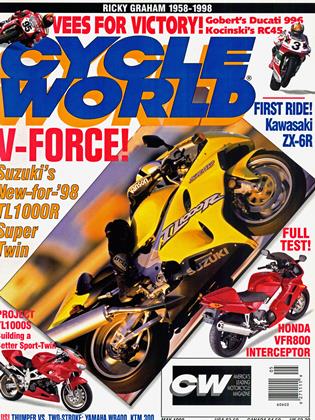
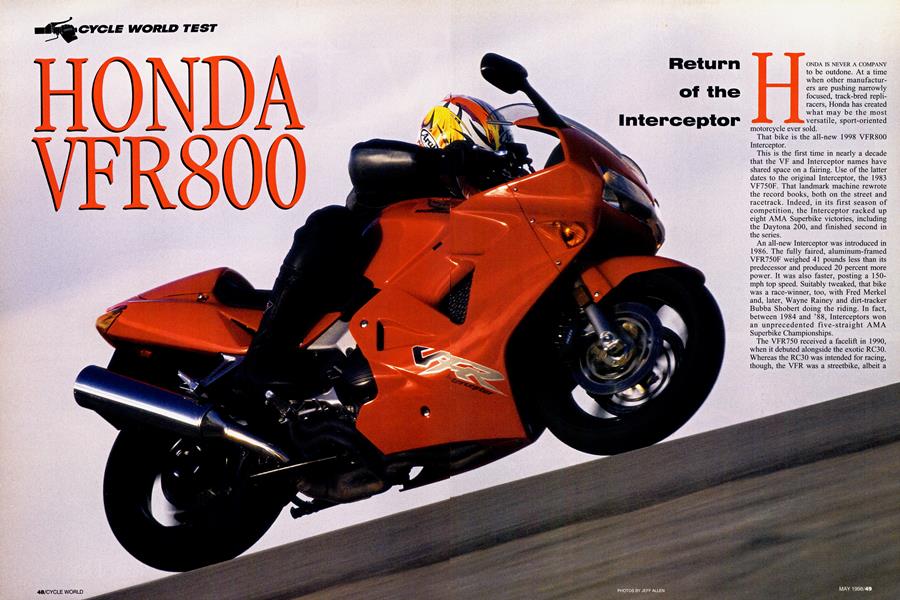
HONDA IS NEVER A COMPANY to be outdone. At a time when other manufacturers are pushing narrowly focused, track-bred repliracers, Honda has created what may be the most versatile, sport-oriented motorcycle ever sold.
That bike is the all-new 1998 VFR800 Interceptor.
This is the first time in nearly a decade that the VF and Interceptor names have shared space on a fairing. Use of the latter dates to the original Interceptor, the 1983 VF750F. That landmark machine rewrote the record books, both on the street and racetrack. Indeed, in its first season of competition, the Interceptor racked up eight AMA Superbike victories, including the Daytona 200, and finished second in the series.
An all-new Interceptor was introduced in 1986. The fully faired, aluminum-framed VFR750F weighed 41 pounds less than its predecessor and produced 20 percent more power. It was also faster, posting a 150mph top speed. Suitably tweaked, that bike was a race-winner, too, with Fred Merkel and, later, Wayne Rainey and dirt-tracker Bubba Shobert doing the riding. In fact, between 1984 and ’88, Interceptors won an unprecedented five-straight AMA Superbike Championships.
The VFR750 received a facelift in 1990, when it debuted alongside the exotic RC30. Whereas the RC30 was intended for racing, though, the VFR was a streetbike, albeit a highly competent one. Taking aim at the same territory staked out by Suzuki’s broad-based Katana 750, the sexy, blood-red VFR combined all-around versatility with sporting performance. Unfortunately, it wasn’t a sales success in the U.S. The bike’s high price was blamed, as was the fact that some 600cc sportbikes offered superior acceleration and handling. Similar shortcomings plagued the updated ’94 model, despite improved performance, a 19-pound weight loss and NR750-inspired styling.
With the 1998 Interceptor, Honda hopes to change that. To broaden the bike’s appeal, particularly among hardcore sport riders, the VFR800 is now quicker and faster, and boasts sharper, more responsive handling.
This, in addition to retaining the relaxed ergonomics, versatility and wind protection so integral to past examples.
At first glance, the new bike looks a lot like last year’s VFR, with its full fairing, aluminum frame, single-sided swingarm and black U-spoke wheels.
It is only upon closer inspection that you realize the frill scope of the changes.
Consider the pivotless frame: It’s aluminum, like that of the VTR1000 sportTwin, but instead of the VTR’s rectangular upper spars and lower trellis sections, the VFR has triplebox-section beams anchoring the steering head to the engine.
Compared to the old frame, it is 7 percent stiffer torsionally, 52 percent less stiff laterally. The frame also provides a top mount for the rear shock, and, like the VTR, uses variable-stiffness motor mounts. The Elf-licensed Pro Arm swingarm pivots in the engine cases, a la Ducati, and is almost 19 percent stiffer torsionally than the ’97 VFR’s similar single-sided affair.
The redrawn, liquid-cooled V-Four shares its basic architecture, right-side gear-cam drive, composite cylinder sleeves and narrow, 26-degree included valve angle with the championship-winning RC45. That’s where the similarities end, though. Displacement is 782cc (courtesy of a 2mm bump in stroke), new pistons provide slightly higher compression and there’s still a 180-degree crankshaft, as opposed to the RC45’s 360-degree crank, for better midrange punch and VFR-like “feel.”
Like the sophisticated RC45, the VFR is fuelinjected, but its all-new system (which also incorporates ignition timing) is simpler, more compact and nearly 2 pounds lighter. At its core is an eightbit control unit, which is charged with digitally mapping each cylinder for ultra-precise fuel and spark delivery. Spent gases exit through a 4-into-2into-1 exhaust capped with a huge, 6.4-liter stainless-steel muffler.
Honda claims only moderate increases in horsepower and torque compared to last year’s VFR750,
but the engine certainly feels more powerful. Throttle response is instantaneous, and the Vee-motor revs with unexpected immediacy, despite identical flywheel inertia. In terms of outright acceleration, a CBR600F3 will leave the VFR trailing in its wake, but the 800 posts better top-gear roll-ons, a truer measure of real-world usability. Plus, with its flat torque curve and smooth power delivery, it’s easier to ride on an unfamiliar backroad. Truly, this is a bike that can be left in one gear all day. Combine those facts with the best sounds this side of an Indy car, and you’ve got an engine that absolutely pegs the thrill meter.
The VFR handles well, too. Side-mounted radiators allowed the wheelbase to be shortened and permitted the engine to be shifted closer to the front wheel for improved weight bias. Those changes, along with more aggressive steering geometry, have endowed the bike with light, neutral steering. What’s more, the design of the front Dunlop radial is such that the bike is not inclined to “stand up” and run wide if the brakes are suddenly applied mid-comer.
Those brakes incorporate Honda’s third-generation Linked Brake System. In the past, LBS has come under fire from expert riders for lack of feel and imprecise actuation. For lessskilled pilots, though, such systems offer clear advantages over conventional stoppers, especially in pedal-only braking.
The decision to equip the VFR with LBS came down to availability of an updated, more proficient design that would suit the VFR’s sporting mission. The essentials are these: There are three floating, single-action calipers, two up front and one at the rear, each with three pistons. When the front brake lever is applied, the outer two pistons in the front calipers are activated, as is, via a secondary master cylinder and three-stage proportioning valve, the center piston in the rear caliper. The rear brake pedal operates the outer pistons in the rear caliper and the center pistons in front. A pressure-sensitive delay valve ensures smooth engagement of the front brakes, staving off unexpected lock-up on slippery surfaces.
On a bike with conventional independent brakes, aggressive use of the front binders will cause the front end to dive, unweighting the rear and rendering the back brake all but useless. Hammer the brakes on the VFR, though, and the bike just hunkers down and stops right now. No muss, no fuss. The system works so well, in fact, that locking either wheel is difficult.
This civility extends to the VFR’s ride, which was compromised only slightly for better handling in the twisties. The conventional spring preload-adjustable fork has updated internals, and the 41mm tubes are half an inch farther apart for increased torsional rigidity. Out back, a new springpreload and rebound-damping-adjustable shock offers 4.7 inches of wheel travel. Even when pushed hard, the bike follows undulations in the pavement with unflappable precision. Tires stick like glue. Or the vulcanized equivalent.
Ergonomics are virtually unchanged, the exceptions being slightly taller handlebars and a reshaped seat. Brake and clutch levers are adjustable for reach, and there’s an all-new instrument cluster. Analog dials relay road and engine speeds, and there is an LCD for time, fuel level, ambient air and coolant temperatures, twin tripmeters and odometer. The only thing missing is GPS.
Settle into the saddle, and knees slip comfortably into cutouts in the tank. The reach to the bars is reasonable-not so distant as to cause discomfort on a long ride, and wide enough to provide plenty of leverage. The gas tank is narrower than on a CBR900RR, but not as skinny as on a VTR. Footpegs are high enough so as not to impede ground clearance, yet knees don’t feel bound up. The taller windscreen provides improved wind protection with minimal buffeting. There are decent passenger accommodations under the solo tailpiece, and molded-nylon grabrails bolt on in seconds.
In case you haven’t noticed, we like this bike. A lot. We get all giddy just talking about it. But that’s always been the case with VFRs and us. If you include the ’83 VF750F, VFRs have won Best 750cc Streetbike in our annual Ten Best balloting an unprecedented 10 times. But thanks to its
No streetbike provides a more fort, handling and performance.
displacement increase, the VFR800 is no longer eligible for that category. Best OpenClass Streetbike, anyone?
Like its predecessors, the 1998 Interceptor is motorcycling’s jack of all trades, an exceptional commuter, sportbike and two-up sport-tourer, ideal union of character, comThere is nothing like it. U
EDITORS' NOTES
AT THE VFR800’S U.S. PRESS INTROduction, Honda wheeled out several earlier Interceptors, including my alltime personal favorite: Bubba Shobert’s 1988 AMA Superbike Championshipwinner. Next to the newest VFR, the HRC-kitted racer looked so small, even perched atop its custom-fabbed rear stand. Elegant, too, with its beautifully drawn fairing, and narrow gas tank nestled within aluminum frame spars. As for the exotic fork, hand-milled triple-clamps and titanium exhaust system, don’t even get me started.
Shod with decade-old slicks, though, Shobert’s Superbike is best-suited to static display. Not so this latest VFR. In fact, I have never ridden a motorcycle that is so capable and so versatile, and at the same time, so forgiving. And so red. Previous VFRs were very, very good. This bike belongs in the Motorcycle Hall of Fame. If you must own only one bike, this is the one. -Matthew Miles, Managing Editor
DAMN! I COULD FEEL NINE LARGE SLIPping out of my bank account before the 800’s engine was barely warm. I want one of these, I said to myself. Now, I already own a VFR, a cherry 1990 that still makes me smile every time I swing a leg over it; and until now, none of the “new and improved” models have made me want to trade up. The ’92-’93 VFRs had mild suspension upgrades but were the wrong colors-as God and every sane person knows, motorcycles are supposed to be knock-your-eye-out, fire-engine red. The ’94-’97 versions were slightly better in every aspect of performance, but their scoop-happy styling left me cold. This 800 is a different story, though: Honda has magically created a machine that does a cut-and-thrust number through the comers like one of today’s better repli-racers, yet retains all the comfort, character and charm that have endeared so many people-including me-to the VFR concept. You know, I think a rational man needs to own two VFRs... -Paul Dean, Editorial Director
HAS HONDA COME UP WITH THE PERFECT motorcycle in this Interceptor 800? No. Here’s why: 1) The mirrors need about an inch more stalk length. As is, the rear view is somewhat compromised. 2) Someone muffed it on the front-brake lever. The whole assembly can only be rotated so far on the bar until it comes in contact with the handlebar riser, leaving the lever a few degrees too high for comfort. Minute but annoying. 3) Applause for the pivotless frame, but why are we treated to an unlovely piece of tin in place of the pivot on the right side? 4) And why, Honda, wasn’t someone assigned to develop a quality set of detachable hard luggage for the 800? It chafes me that one of the world’s best sporttourers has to be loaded down like Jed Clampett’s old Model T for any kind of road trip. Fit some heated handgrips while you’re at it.
That said, we’d be willing to keep our testbike and work out some of these minor glitches-shouldn’t take longer than a couple of years, maybe three. Don’t call us, we’ll call you. -David Edwards, Editor-in-Chief
HONDA
VFR800
$9499