Zx-9r
SPORTBIKES KAWASAKI '98
ZX-9R
Not a new makeover, a whole new bike
DON CANET
IT'S HARD TO BELIEVE THAT SIX YEARS HAVE ELAPSED SINCE the introduction of Honda's CBR900RR, a landmark sportbike that rewrote the definition of "lightweight" and "powerful" in Open-class terms. Perhaps even more unbelievable is that until now, no other major manufacturer has invaded the CBR's domain. Sure, there have been a few challengers, but nothing has been able to match the Double-R's outstanding power-to-weight-to-price ratio.
That may change shortly, however, as the sporthike wars are heating up considerably for the 1998 model year. An all-new Kawasaki ZX-9R leads the charge, with further assaults to fol low from Yamaha's YZF-Rl and SLizuki's TLI000R. But a moving target is difficult to hit, and Honda has been hard at work shoring up its defenses with several updates to the CBR900.
The 1997 ZX-9R was a powerhouse, and a fine road bike, but was no featherweight. Thus, having grown weary of making excuses for its portly stature, Kawa saki's engineers focused on giving the 9er a class leading power-to-weight ratio and responsive, 600-like handling, while retaining the previous model's comfortable seating position and rock-solid stabili ty. No stone was left unturned in their quest for ZX enlight enment, either: Witness the `98 ZX-9R's magnesium engine covers and all-titanium exhaust canister, and you, too, begin to "see the light." Look deeper, and you'll see they've redesigned every component of the machine with compact ness and reduced weight in mind.
At the ZX-9R's press launch held in Southern France, rumors of 10-second-flat quarter-mile times and 170-mphplus top speeds were abuzz. While verification of those claims was not possible at the launch, we did gain an appre ciation for the bike during laps around the Circuit Paul Ricard, and on a road ride in the neighboring countryside.
Displacing 899cc, the revised ZX-9R gets an entirely new liquid-cooled inline-Four that's substantially lighter, and smaller, and which delivers improved power and respon siveness. A 2mm bore increase has made the `98 ZX's cylinders even more oversquare (75 x 50.9mm), reducing piston speed and allowing 1mm larger intake and exhaust valves. A narrower included valve angle was also made pos sible, yielding a flatter, more efficient combustion chamber with a relatively high 11.5:1 compression ratio. Lean and mean, the new engine features a far more compact cambox with direct shim-under-bucket valve actuation replacing the rocker-arm valvetrain of the old ZX-9R. The intake ports are straighter as well, offering improved flow.
In the quest for quicker engine response and increased power output, efforts were made to reduce internal frictional losses. This is most evident in the use of a generator mounted on the left end of the crankshaft, in place of the chain-driven unit found on earlier ZXs. The crankshaft is significantly lighter than before, and the use of strong, rare-earth magnets has kept the size and weight of the generator extreme ly low. Serious knee-draggers will be pleased to know that the 9R's cornering clearance has not been compromised.
Additional reciprocating mass was pared by adopting a lighter, more compact ZX-6R clutch, which carries an additional pair of clutch plates to handle the extra load. The back-torque eliminator present on earlier ZX-9Rs has also been eliminat ed in the mass-trimming program. Closer shaft spacing-identical to that of the new ZX-6R-has substantial ly shortened the new 9R's engine cases. Crankshaft-to-input shaft distance measures 14mm less than before, with 12mm less space between the input shaft and countershaft. The transmission gears have been widened to handle higher loads, and the ratios within the 9R's six-speed box are more closely spaced than before.
If it's techno-wizardry that draws you to performance bikes, the ZX-9R delivers the goods. Start with its Twin Ram Air Induction system that feeds a quartet of 40mm Keihin carburetors now equipped with a throttle-position sensor. The TPS, for those keen on acronyms, is part of a system called K-TRIC (Kawasaki Throttle Responsive Ignition Control). The twist to the new 9's mapped ignition is that it monitors not only engine rpm and throttle position, but also the rate at which the throttle is opened. What this means to the rider is improved response and acceleration under varying loads, elimination of detonation (engine knock) when whacking it open at low rpm and improved fuel efficiency at all revs. Plug-mounted stick coils-like those first seen on the Suzuki GSX-R600-are also included in the ZX's bag of trickery.
Both good and bad news awaits California buyers. The bad news is that in place of the exotic titanium exhaust silencer, Cali-bikes will be fitted with a catalytic converter housed within a stainless-steel muffler. While the system is said to add about 6 pounds, Kawasaki claims it only costs a single horsepower. The truly good news for West Coast canyon-carvers and roadracers is that all other engine speci fications are the same as a 49-state model. Fit an aftermarket pipe and you're set. Hip, hip, hooray!
The ZX's shortened, lightened and more responsive chas sis deserves equal applause. The new frame does away with the front downtubes of its predecessor, using the engine as a stressed member. Adhering to current engineering trends, Kawasaki employed tuned chassis flex on the ZX-9R. Switching to a less-rigid 46mm conventional fork from the previous 41mm upside-down unit has allowed for a compa rable reduction in frame stiffness, equating to further weight savings. Suspension remains fully adjustable both front and rear, and while offering a good range of adjustment, the shock could benefit from more aggressive rebound damp ing.
On public roads, the ZX's ride feels firm and controlled. Steering effort is light, with excellent feel and neutrality. Engine vibration is always present but never intrusive, seep ing through the bars with subtle variation in intensity throughout the rev range. The ZX is fearsomely quick, accelerating from one corner to the next like a wildcat with its tail on fire. Thankfully, its brakes are powerful and con sistent, and its Bridgestone Battlax BT56 radials are well up to the task of street riding.
Rigorous racetrack abuse of the pilot-production ZX-9s over the course of a four-day press intro, however, reveals some weaknesses. Clutchiess upshifts result in third gear sometimes being missed, the front brake rotors are prone to warping and the stock, street-compound Bridgestone tires draw complaints for their lack of grip. It isn't until a set of SS Type-3 race compound Bridgestones are fitted that the ZX-9R really begins to show its racetrack prowess.
Circuit Paul Ricard, located along the French Riviera near Marseille, is famous for its mile-long Mistral Straight. Although the full 3.6-mile road course wasn't used for the ZX-9R's press launch, the short course utilizes a good two thirds of the Mistral, providing enough room to see the top of fifth gear and an indicated 168 mph on the speedo.
Rider tucked in with chin on tank, the ZX's low-cut wind screen offers just enough wind protection to eliminate buffeting at high speed. While less than crystal-clear, the optics of the plexiglass bubble provide a good view of the Mistral and the rapidly approaching brake marker.
As the braking point flashes past and you pop up from behind the bubble, a violent windblast rocks you, causing a moment of blurred vision as you apply a firm, two-finger squeeze on the front brake lever. It takes but a few pounding heartbeats to shed the unwanted speed before bending the bike into the triple-digit right-hander that follows. Having backshifted to third gear while braking, you see the tach register 9500 rpm as you roll back into the throttle through the apex.
True to form, the 9R feels steady at all times. Its exhaust canister is tucked in tightly enough to remain clear of the tarmac at all times. Full-tilt lean angles at such high speeds saw only the pegs touch down, a testimony to the bike's out standing cornering clearance.
Blitz down a short straight and you're back on the brakes, along with another downshift, slowing for a long, decreas ing-radius right. Here, too, the ZX scores high marks for its willingness to bend into turns while you apply light to mod erate front brake. Getting hard on the throttle as you exit the turn has the rear end stepping out in a smooth, controllable manner. Great fun!
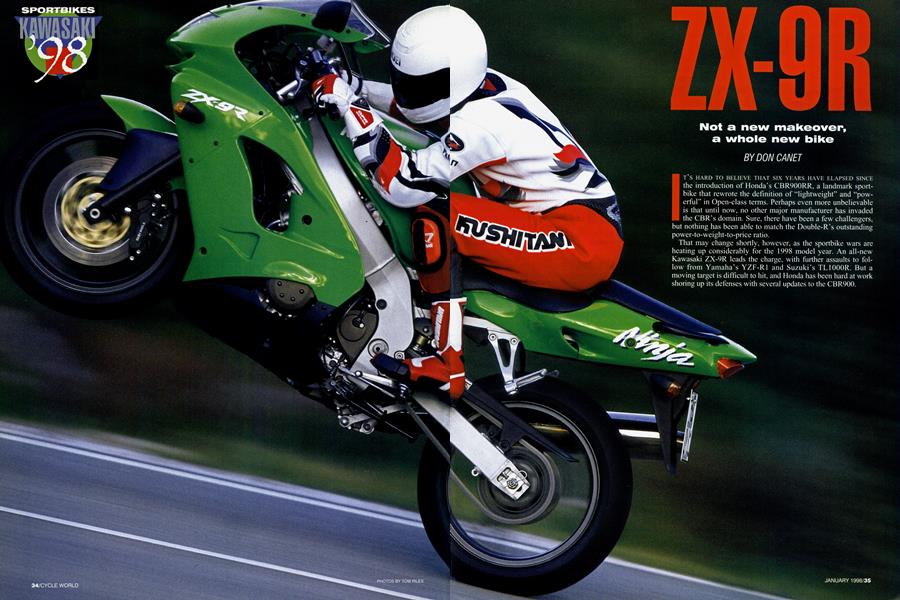
If it's wheelies you're looking for, first gear is a snap at any rpm, with no clutch work required. Even second gear gets it up with a well-timed tug on the bars as the tach nee dle sweeps past 8500 rpm.
While we won't know for certain whether Honda's CBR900RR has been unseated until we ride one, it cer tainly appears that the 1998 Kawasaki ZX-9R won't be taken lightly.