Crystal-Ball Classics
Crystal-ball classics
UP FRONT
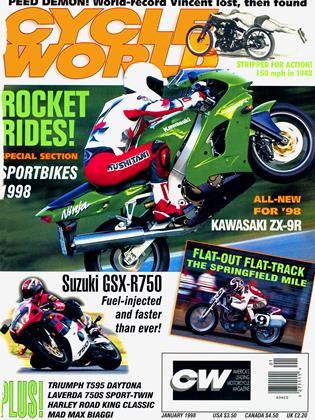
THE SCENE IS A MOJAVE DESERT DRY lake bed, looking much the same as when the primordial oceans rolled back a half-million years ago. On its caked surface sits the world's most famous Vincent V-Twin, Rollie Free's Black Lightning, a.k.a. The Bathing Suit Bike. A half-century earlier, this same bike: roared across a similar lake bed, a tune up run in preparation for its worldrecord, nearly nude, 150-mph blast:at the Bonneville Salt Flats.
You can read about the Vincent in "Re turn of a Warhorse," beginning on page 54, and see how this most collectible of. motorcycles was very nearly lost to the mists of time. Its story got me wondering about bikes from the past quarter-century or so that might be worth saving.
Now, you don't have to have the Psy chic Friends Network cued up on the speed-dialer to forecast that models like a sand-cast 1969 Honda CB750 Four or a Jubilee-edition Triumph Bonneville will one day be highly sought-after collectibles. But what about the next strata of future classics, the ones that may be sitting unwanted and unloved in the back of someone's garage? In no particular order of im portance, here are five to think about:
Bultaco Metralla: A collector I know owns something like 200 motor cycles, mostly Italian, many of them classics. In making the rounds of his various barns, garages and cubby holes one day, I asked which bike was his fa vorite. "This way," he said, making a beeline for a banged-up Bultaco Metral la. "That's the best bike I've ever rid den, no question."
For whatever reason, Spanish marques have yet to catch on with the concours crowd. Founded in 1958 by Francisco Bulto-who 13 years earlier co-founded Montesa-Bultaco is best know for its world-championship trials bikes, devel oped by feet-up maestro Sammy Miller. The firm's motocrossers were big news, too, one of them powering Jim Pomeroy to America's first MX GP win.
The Metralla streetbike took the 250 Pursang motocrosser's basic piston-port motor and surrounded it with stone-ax simple running gear, the result being a 270-pound street slinger good enough to go 1-2-3 in the 1967 Isle of Man 250cc Production class. Almost a sure bet as a future blue-chipper. Yamaha TX750: The tuning-fork folks were in a bind as the Seventies began. Honda had its electrifying CB750, Kawasaki had just let loose with its powerhouse Z-1. To go up against the Fours, Yamaha had only its XS650 Twin, a charismatic little beast ie, but certainly no blockbuster.
Enter the TX750. "It's finally here," CW said in 1973. "A big, fast Twin with four-cylinder smoothness." Vi bration was nullified by a chain-driven bobweight arrangement Yamaha dubbed the "Omni-Phase Balancer."
Only problem was the system went out of phase at an alarming rate, stretched chains being the guilty party. By the time the problem was rectified, the TX name was mud in the market place, and the model was quietly toetagged in 1974. Too bad, because the 750 was a handsome machine, classi cally good-looking in the Norton Com mando vein. Today, a clean example is a rare sight, but worth the search.
Yankee Z: If a good pedigree counts for something, then the Yankee Z, built from 1972-75 in Schenectady, New York, had a lot going for it. Brainchild of OSSA/Bultaco importer John Taylor, the dual-purpose Yankee was powered by a pair of OSSA 244cc cylinders mounted atop a common crankcase, the pistons arranged to rise and fall together in "Twingle" configuration. AMA champ Dick Mann drew up and devel oped the Z's frame, notable for its mod ern large-section, thin-wall design.
David Edwards
Gun-maker Smith & Wesson cast the aluminum triple-clamps, which pinched ahead-of-their-time, big-tube fork stan chions. CW's own Joe Parkhurst got in on the act, designing the company's stylized Stars-and-Stripes logo.
Unfortunately, the Z was tardy in getting to market and plagued by lack of develop ment. Then, tragically, Taylor's son was killed testing a flat-track version of the bike. Production was halted at 750 units, and Yankee withered away, one of the most obscure of American bike-makers.
Harley-Davidson Bobcat: Amaze and mystify your Hog-riding buddies, because this may be the most unheardof Harley ever. Its two-stroke Single was lifted from the Hummer series of paperboy bikes, bored out to 175cc and rigged for all of 10 horsepower. What sets the Bobcat apart from other runabouts of its era (mid 1960s), though, is a single-shock framewith the damper hung beneath the motor as sort of an early blueprint for Erik Buell. More bric-a-brac than benchmark bike, the Bobcat may be the perfect gift for the Harley collector who thought he had everything.
CB750 Chopper: Yes, long bikes are back! Hidden on back porches and under tarps for 20 years, choppers are being resurrected-like platform shoes, belibottoms, the Bee Gees and other icons of the 1970s. Be bold here; don't go for the expect ed Harley-motored contraption. Too easy, too ordinary. Instead, opt for a Honda 750-powered rig. The springer fork should stretch at least to the next postal zone, the sissybar should be a real cloud-scratcher and the pipes should be short and slash-cut. Bonus points if the metalfiake paint looks as if it's been applied with a trowel.
So, a short list of future collectibles, af fordable quasi-classics ready for the rid ing (okay, I admit, the Bobcat is a long shot). Good news is that if you pay more than $1500 for good, running examples of these five, you've paid too much-pos sible exception being the Metralla, which might fetch $500 to $1000 more. And, if you're looking for payback on your in vestment, remember that the Rollie Free Vincent, now worth well into six figures, once traded hands for a measly 25 clams. As always, your results may vary.