T595 Daytona
T595 DAYTONA
SPORTBIKES TRIUMPH '98
A squeaky wheel gets oiled
BRIAN CATTERSON
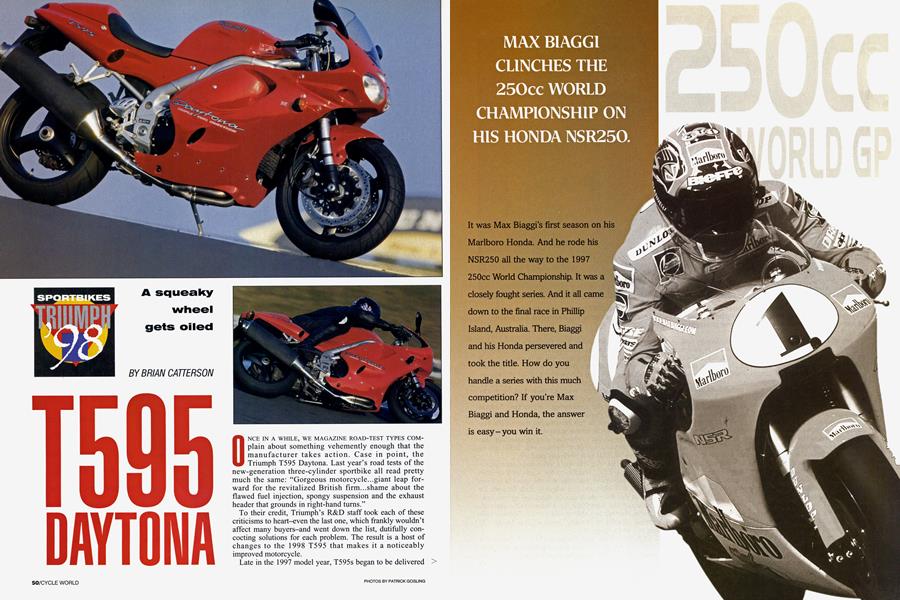
ONCE IN A WHILE, WE MAGAZINE ROAD-TEST TYPES COMplain about something vehemently enough that the manufacturer takes action. Case in point, the Triumph T595 Daytona. Last year's road tests of the new-generation three-cylinder sportbike all read pretty much the same: "Gorgeous motorcycle...giant leap forward for the revitalized British firm...shame about the flawed fuel injection, spongy suspension and the exhaust header that grounds in right-hand turns."
To their credit, Triumph's R&D staff took each of these criticisms to heart-even the last one, which frankly wouldn't affect many buyers-and went down the list, dutifully con cocting solutions for each problem. The result is a host of changes to the 1998 T595 that makes it a noticeably improved motorcycle.
Late in the 1997 model year, T595s began to be delivered with revised mapping in their French-made Sagem fuelinjection systems. Known as #9822, this state of tune is meant to rectify the midrange flat spot and surging, and can be downloaded to any T595 by dealers, at no cost under warranty, using a Triumph Datatool. Furthermore, tighter production tolerances in the throttle bodies have eliminated a step just past each butterfly that was found to be creating excessive turbulence in the intake tracts.
As for the suspension, a stiffer 14-kg shock spring was fitted, replacing the too-soft 13-kg unit used previously. And the exhaust-header dilemma was rectified simply by rotating the collector, thus tucking the pipes in tighter and netting an approximate .4-inch increase in cornering clear ance at maximum lean.
Triumph extended an exclusive invitation to Cycle World to sample the reworked `98 T595 on the company's home turf at Donington Park. Home of the British Grand Prix, the fast, undulating circuit proved an ideal venue to assess the new bike's performance, and to thoroughly test the limits of its cornering clearance.
The verdict? Much, much better. Gone are any concerns about crashing due to running out of cornering clearance. Even frantic, trail-braking entrances to right-hand Redgate, and ham-fisted flicks into uphill McLeans saw only the fair ing's bottom edge touch the tarmac; the exhaust header never contacted terra firma.
The remapped EFI worked equally well at Donington, the 955cc Triple responding to the slightest twist of the wrist as its throaty exhaust note echoed off England's rolling green hills. But we expected as much-previous T595s exhibited no injection glitches at high rpm, where an engine spends the majority of its time at a racetrack. Instead, the problem resided farther down in the powerband, in the region between 4500 and 5500 rpm.
So, in order to discern whether there had been any improvement there, we made repeated runs down Donington's pit straight, accelerating from walking speed in each of the first four gears. The result: There's still a notice able flat spot, but it's far less pronounced than on the two different Daytonas CW tested previously. Moreover, our efforts to reproduce the steady-state surging condition that plagued our previous testbikes' freeway ride failed miser ably. Triumph's efforts have obviously paid off.
Not content to sit idle, Triumph's technicians are continu ing to refine the T595. Already in the works is a re-engi neered rear suspension that relocates the shock's bottom mount. This will allow the rear wheel to slide forward far enough that the drive chain can be shortened by one link, thus reducing the wheelbase by a comparable amount. Admittedly, this will be implemented in what Triumph calls a "running production change," meaning that not all `98 models will be so equipped.
Oh yeah, there's one more change to the T595 Daytona: It now comes in not-quite-Ducati red, in addition to the famil iar black and yellow. Attractive, but I'm holding out for British Racing Green.