Return of A Warhorse
Return of a Warhorse
IT WAS EARLY ONE SUMMER'S DAY 50 years ago, and Roland Free was slow. With sunlight reflecting up from the Bonneville Salt Flats harshly enough to toast the skin inside one's nostrils, Free was stuck at 148 miles per hour.
Free figured his Vincent, owned by a writer/enthusiast named John Edgar, could do 150. Free wanted that number, wanted it badly. But several two-way runs through the traps on Bonneville's three-mile course could net no better than 148 and change.
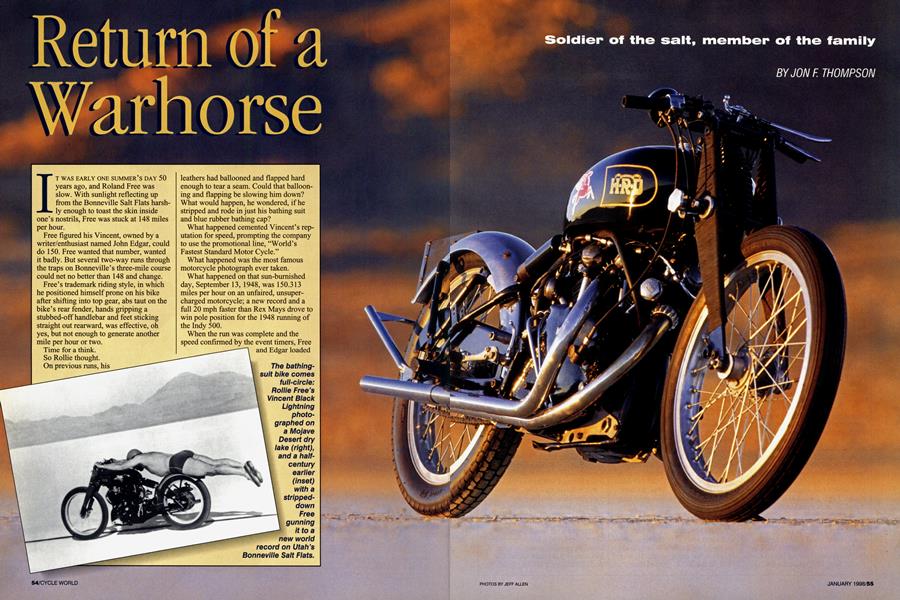
Free's trademark riding style, in which he positioned himself prone on his bike after shifting into top gear, abs taut on the bike's rear fender, hands gripping a stubbed-off handlebar and feet sticking straight out rearward, was effective, oh yes, but not enough to generate another mile per hour or two.
Time for a think. So Rollie thought. On previous runs, is. leathers had ballooned and flapped hard enough to tear a seam. Could that balloon ing and flapping be slowing him down? What would happen, he wondered, if he stripped and rode in just his bathing suit and blue rubber bathing cap?
What happened cemented Vincent's rep utation for speed, prompting the company to use the promotional line, "World's Fastest Standard Motor Cycle."
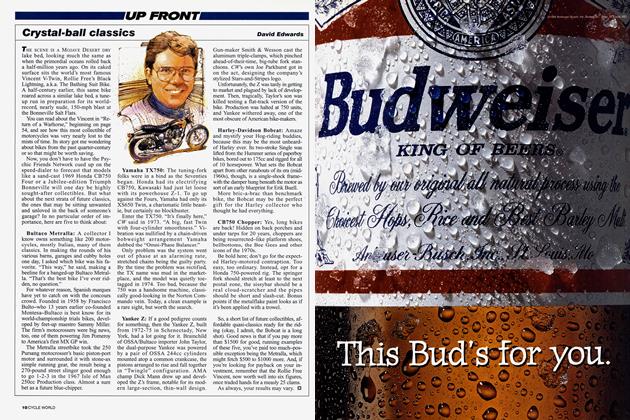
What happened was the most famous motorcycle photograph ever taken.
What happened on that sun-burnished day, September 13, 1948, was 150.3 13 miles per hour on an unfaired, unsuper charged motorcycle; a new record and a full 20 mph faster than Rex Mays drove to win pole position for the 1948 running of the Indy 500.
When the run was complete and the speed confirmed by the event timers, Free and Edgar loaded up, drove back to Los Angeles and went about their lives. Edgar raced cars, employing top drivers like Carroll Shelby. Free ran his gas sta tion, returning to Utah numerous times to defend his record on other Vincents. That first Vincent Bonneville bike, though, never saw the salt again. After being flogged around Southern California for a few years as both a roadracer and a streetbike, it disappeared from motorcy cling's public consciousness.
Soldier of the salt, member of the family
JON F.THOMPSON
Now, 50 years after Free's record run, it's back, very little changed from when Rollie Free stripped down and cranked off that 150.313-mph pass. Respectfully retired by Herb Harris, its latest owner, it is a rolling celebration of speed, and of the skill and courage of its pilot.
That the bike exists as it does in almost completely original form, and with the evidence of Vincent engi neering genius Phil Irving's laying-on of hands still clear on the hard parts inside its crankcases, is almost an accident. But the story begins prior to the bike's accidental salvation. It begins at a dinner meeting in May of 1948, with Edgar, Vincent boss Philip Vincent and Los Angeles dealer V.L. Martin. Edgar wanted to set a speed record. What he didn't have was a motorcycle.
As Edgar, Vincent and Martin hatched their plan, the motorcycle speed record stood at 136.183 miles per hour. It was put there in 1937 by Joe Petrali (see "Unsung Hero," Cycle World, July, 1993) aboard a Harley
on the hardpack sands of Daytona Beach. Edgar wanted to beat that speed.
No problem, Martin told him, any standard Vincent Black Shadow was good for 120 miles per hour. For an extra 50 pounds sterling over the Black Shadow's price, Vincent would build Edgar a machine capable of demolishing Petrali's record. Then, he added, the machine could be returned to street trim for more mundane usage.
The deal was done. Martin lined up Free as the record-attempt pilot, and Vincent wrote chief engineer Phil Irving and told him what Edgar want ed. Irving and test rider/engineer George Brown pulled a standard Series B Black Shadow from the assembly line, set aside a place for it in the factory's experimental shop, and went to work. They completed the bike in such a hurry that there was no time to design and cast intake manifolds for the bike's two 32mm Amal TT carburetors, which were set up to burn methanol. So Irving made some special float-bowl fittings and bolted the flange-mount carbs, instead of the usual spigot-mount items, straight to the heads, mounting them sideways. When the pair was done, Brown did a short test run on an aban doned runway. He recorded 143 miles per hour. On July 28, 1948, the bike was logged out of the factory, crated and shipped.
On August 27, the Vincent was delivered to Free. He pulled off the bike's fenders, saddle, front brakes, kickstarter and lights, and replaced the alloy rear fender with one capable of holding his prone weight. He short ened the handlebar, greased the wheel bearings with Vaseline, covered the inside ends of the spoke nipples with Plastic Wood so they wouldn't tear the inner tubes, and filled the engine cases with 10-weight motor oil. In a low-tech attempt at aerodynamics, he wrapped the fork's girders with elec trician's friction tape. On September 7, he hauled the bike to Rosamond Dry Lake in the Mojave Desert for test runs. Free, who had ridden many record attempts (and had twice driven in the Indianapolis 500), came away convinced that the big Vincent was a record-breaker. He and Edgar loaded up and set out for Bonneville and their date with history.
The result was sufficiently com pelling that Vincent created a separate line of racing machines called Black Lightnings; 28 eventually were built. Free's record bike was the prototype for these. But that didn't prevent it from sinking into ignominy.
Back in Los Angeles with the bike's primary purpose accomplished, Edgar rode it on the street, using its power and speed to demoralize his riding companions. Then, according to the researches of Harris and others, Edgar sold the bike in 1954 to a sportsman named Alan Tompkins, who raced it for a while before selling it to a Michael McGuire in 1961.
It is here, Harris figures, that the happy accident involving the Vincent's lack of intake manifolds became important. The magneto-fired bike apparently was delivered to McGuire in what seemed to be incomplete form. It had no generator. Given its purpose, it wouldn't, but McGuire may not have known that. And its carbs were off the engine, the usual Vincent intake manifolds apparent ly missing. So it wasn't ridable, or so it may have seemed. And it had to be running and ridable to be registered in California. So although someone-probably Edgar-had replaced the bike's huge #1700 methanol jets with #370 gas jets, and its high-compression meth pistons with standard 9:1 pistons, after Tompkins sold the Vincent it was never registered, and most likely never run or ridden.
Harris says now, "I think that (apparent absence of manifolds) saved the motorcycle. It passed through a number of owners, and nothing good could have come of that. Because, you know, motorcy clists customize and change things. But only if their bikes are running." In 1962, the bike was sold to an Arch Dean Bostley, and then, again that same year, to William F. Kelly, of Lancaster, California. Kelly paid $25 for it.
Not long after that, Mike Achorn became the Vincent's savior.
Achorn, a motorcycle enthusiast just out of the Air Force, was a stu dent at the Northrop Institute of Technology in Inglewood, California. He'd met Bill Kelly while still in the military, when both were stationed at Edwards Air Force Base near Lancaster.
Achorn recalls, "In 1963, I went to see Bill Kelly. He wasn't at home, but his wife knew I'd want to see his new Honda 250, so she let me into the garage. Against the far wall was a tarp-covered thing. I could see the ini tials H-R-D. I looked under the tarp and saw this old, bedraggled motorcy cle. The carbs were hanging by the throttle cables, the generator was missing, the seat was ripped, the tires were flat."
When Achorn talked with Kelly, he expressed his interest in buying the old Vincent. And in November, 1964, Kelly, who believed the Vincent to be a parts bike for Free's 1948 record run, called.
Achorn remembers, "He wanted to buy his wife a 125 Honda Scrambler.
I held my breath and he said he want ed $200 for the Vincent. I had 50 bucks. I told him I'd send him a money order that night for the $50, and I'd be up the following weekend with the remainder of the money."
Achorn didn't have the $150 he needed. But his fiancée, Margaret, did. So he borrowed the money from her, bought the Vincent, and a tired old racebike was transformed into a pampered, potent streetbike.
That transformation began with a search for a generator so that the bike could run lights. Achorn says, "A friend of mine had one. I asked him how much, he said it was $18 and I would get a Siamese cat. Without the cat it was $35. That's how we got Susie Cat."
After scaring up a few more parts and some fresh tires, Achorn hauled the bike to the shop of Marty Dickerson, a Southern California Vincent expert, and asked Dickerson to give it a thorough looking-after.
Dickerson says, "I took a look inside the crankcases, and they were all burnished, all hand-done. Only one bike I knew of had that done to it. Then I looked at the engine numbers and ot to talking to Rollie, and he affirmed to me that it was the record bike. Plus it had those carbs whiàh bolted right to the heads. When I told Achorn what he'd bought, he about fell over. His eyes got pretty big. I told him that some where down the road this bike was going to be worth a lot of money."
Margaret Achorn recalls, "Learning that it was famous was sort of excit ing. We thought we had a pile of junk. But it was our transportation, so (the bike's fame) didn't stop us from using it."
Mike Achorn recalls picking up his treasure from Dickerson's shop and riding it home: "It started second kick, and compared to the Triumph I'd been riding, this thing was all ani mal; 65 miles per hour in first gear, lots of torque. One time, a guy in a Pontiac GTO wanted to race. We just kicked it down into second gear and that was the last time I saw him. We used to ride it in the canyons and on the Coast Highway on the weekends. Neither of us had any money, so this was practical transportation and enter tainment as well."
Achom, now married to Margaret, was graduated from college in 1966 and in September went to work for Ford Motor Company in Michigan. The couple trailered the bike to Dearborn and rode it for awhile. Eventually, Achorn's concerns about the bike's value as a historical artifact overcame his desire to ride it. So he and Margaret parked the Vincent and covered it.
In the meantime, Herb Harris, an attorney and Vincent enthusiast from Austin, Texas, developed a yen for a Rollie Free record bike. He thought he had a line on a machine Free used to protect his record in 1950. An enthusiastic and sophisticated collec tor, Harris sold some of his bikes and cars to raise the money for the pur chase, but the bike went to another buyer. Harris was bummed.
Then in 1996, he learned from a friend in Michigan who knew the Achorns that the Rollie Free bathingsuit Vincent might become available. Harris became all but obsessed with the bike.
"This is the most important Vincent in the world, and it might be the most important motorcycle in the world. Lucky for me, I had put together the money in preparation for the other bike. So my gun was loaded. My friend said he'd talk to Achorn, and he came back with a price that was fairly astonishing. Negotiations began. I did some research and veri fied that it was Rollie's record bike."
And so Harris and the Achorns agreed on a price. How much? Harris grins, and says, "Well, it was the highest money ever paid for a Vincent motorcycle, well into six figures.
"I was dying to see this damn motorcycle," Harris continues, "so I flew to Michigan and met with the Achorns. Mike took me into the garage and it was there under a bunch of stuff. I could feel the history; it radiated its deed like a watch that glows in the dark. I could almost feel it thun dering across the salt flats. Even if I hadn't confirmed the serial numbers, I think I'd have done the deal anyway, my gut feel ing was so strong that this was the bike."
Harris, a courtly man, felt that since he was taking a trea sured member of the family from the Achorns, he needed to leave a treasure. So he bought a Waterford crystal vase for them. To his delight, he found that they collected crystal vases. For the Achorns' part, they gave Harris a bottle of Michigan wine.
"They told me that when I got home and was in a reflective mood, to go out and look at the bike and have a glass of that Michigan wine," Harris says.
Though he's not yet quaffed his Michigan vino, Harris' action-plan otherwise is complete. He's removed the Vincent's seat and fitted a set of pipes identical to the ones it wore when Free rode it into history. The old warhorse once again wears its original, heavily machined alloy rims, and is equipped with a handlebar and rear fender just like the ones Free had made for it. Harris has even gone so far as to duplicate the old Mobil Oil flying red horse stickies the bike wore on its tank during the record run.
Harris is adamant that the Vincent not undergo a traditional restoration. He says, "My job is to return the bike to asraced condition, then to do what I can to let the world have a look at it."
Though Harris plans to show the Vincent, he has no firm plan for the bike's public debut. But he notes that September, 1998 is the 50th anniver sary of the bike's run. "What I hope happens is that we'll get invited to some celebration of that event," Harris says. "If not, maybe the con cours at Del Mar. Who knows?"
Harris says he'll display the Vincent parked in front of a large painting of Rollie Free stretched out on the bike, blasting across Bonneville. He thinks about that for a moment, grins, then says, "What else do you need to say?"