Max To the Front
Max to the Front
RACE WATCH
The mysteries of Max Biaggi
KEVIN CAMERON
WHEN MAX BIAGGI LEFT THE APRILIA GP SQUAD FOR TEAM HONDA, the big question was this: After three successive 250cc world titles on the Italian bikes, could he confound his rivals as easily on another brand of machine? Did the championships stem from Biaggi's brilliant machine control, or were they merely the result of Aprilia's mature 100 horsepower and elegant chassis?
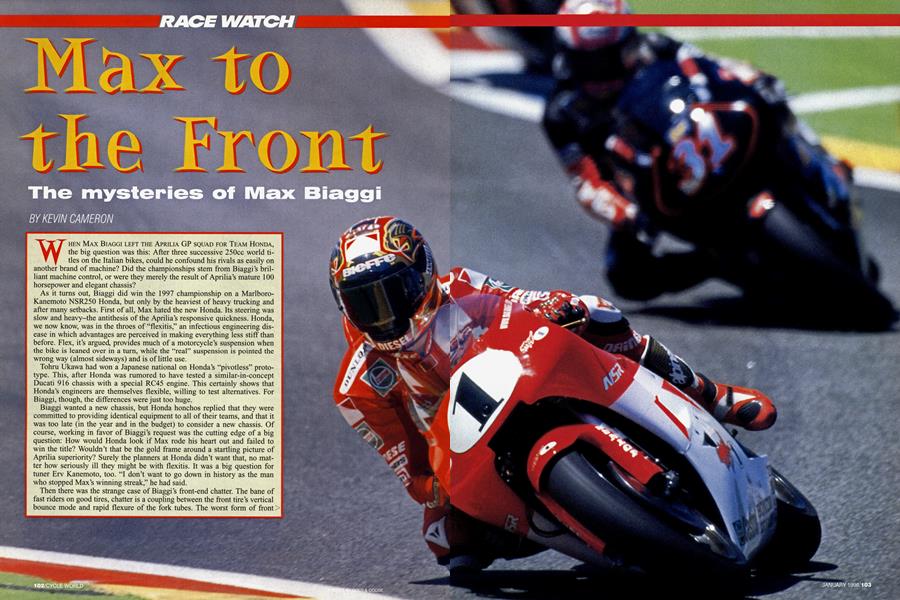
As it turns out, Biaggi did win the 1997 championship on a Marlboro Kanemoto NSR25O Honda, but only by the heaviest of heavy trucking and after many setbacks. First of all, Max hated the new Honda. Its steering was slow and heavy-the antithesis of the Aprilia's responsive quickness. Honda, we now know, was in the throes of "flexitis," an infectious engineering dis ease in which advantages are perceived in making everything less stiff than before. Flex, it's argued, provides much of a motorcycle's suspension when the bike is leaned over in a turn, while the "real" suspension is pointed the wrong way (almost sideways) and is of little use.
Tohru Ukawa had won a Japanese national on Honda's "pivotless" proto type. This, after Honda was rumored to have tested a similar-in-concept Ducati 916 chassis with a special RC45 engine. This certainly shows that Honda's engineers are themselves flexible, willing to test alternatives. For Biaggi, though, the differences were just too huge.
Biaggi wanted a new chassis, but Honda honchos replied that they were committed to providing identical equipment to all of their teams, and that it was too late (in the year and in the budget) to consider a new chassis. Of course, working in favor of Biaggi's request was the cutting edge of a big question: How would Honda look if Max rode his heart out and failed to win the title9 Wouldn't that be the gold frame around a startling picture of Aprilia superiority? Surely the planners at Honda didn't want that, no mat ter how seriously ill they might be with flexitis. It was a big question for tuner Erv Kanemoto, too. "I don't want to go down in history as the man who stopped Max's winning streak," he had said.
Then there was the strange case of Biaggi's front-end chatter. The bane of fast riders on good tires, chatter is a coupling between the front tire's vertical bounce mode and rapid flexure of the fork tubes The worst form of front> chatter is a speed-limiter. The harder the rider tries to gas it out of turns, the faster the front end hammers toward the outside. Trouble was, the on-board computer reported no such chatter. Be cause the computer's sensor records suspension movement rather than ver tical acceleration, this could mean ei ther a) there was no chatter, or b) the front suspension was locking. In human terms, it could also mean that Biaggi wasn't happy, and this was his chosen mode of complaint.
Meanwhile, Marlboro teammate Raif Waldmann went his chatterless way on his identical NSR25O. The Hondas were developed on Michelin tires; Biaggi was contracted to Dun lop, Waldmann to Michelin. Tires? Rider? Flexitis?
Aprilia hasn't bought into the cali brated-flex concept, preferring to cap italize on the traditional 250 virtues of instant maneuverability and high cor ner speed. This was the wellspring of Biaggi's riding style. Now, he would have to remake it while Kanemoto tried to remake the Honda.
Kanemoto began to alter chassis and component stiffness, item by
item, attempting to tease out cause and effect. One chassis assembly was delivered to associates in California, for reinforcement with carbon-fiber jacketing. This chassis was pho tographed later in the season. Was this a real experiment? Or was it a pointed question to Honda: Which is more im portant-this championship, or your policy of equal equipment for all?
Although Biaggi had raced a Kanemoto-prepared Honda NSR25O in 1993, the two men were not close collaborators. Italian GP teams have the reputation of capricious favoritism and Byzantine intrigue. Biaggi has learned to play a very close game, dis closing no information unless ab solutely necessary. Accordingly, when Biaggi goes out to test rim widths or damper settings, he reveals no preference. To do so might put information into dishonest hands, from which it might leak to Waldmann or other opponents. The only way to know which wheel Max likes is to see which one his Italian mechanic rolls to the grid on the bike.
While this may be an effective way to operate in a highly political multirider team, it markedly slows smallteam development by blocking infor mation flow. Biaggi came to inter national prominence by winning the 1991 European 250cc championship, riding an Aprilia set up by a much more experienced rider. All he did was ride-fabulously. Kanemoto `s great strength is his ability to carry out simultaneous racing and develop ment. The styles of the two men were seriously at odds: The Honda needed development to make it suit Biaggi, to keep it quick enough to parry the effi cient thrusts of teammate Waldmann and Aprilia-mounted Tetsuya Harada. But Biaggi felt information was most useful when kept to himself.
How would you proceed? As with feeding a finicky cat, you set out the maximum possible number of alterna tives and see which ones are chosen. If constructive discussion with the rider is impossible, switch to rapid fire experiments and get your ques tions at least partly answered by the stopwatch, the on-board computer and veteran intuition. Presently, Wald mann began to complain that Biaggi was getting special parts. Damned if you do, damned if you don't.
It was an eventful season, and Biaggi worked hard-as he has done before. He forged ahead in points only to fall or be disqualified, as he was at Assen for in sisting on changing a wheel on the start ing grid, after being directed not to. Then, he would perform brilliantly just in time to snatch back the points lead. The stunner of the season was his hair'sbreadth win at Mugello, whose bumps make it Chatter City. Aprilia factory test rider Marcellino Luccbi was on pole, a veteran of thousands of laps at the Ital ian circuit, with Biaggi's arch-rival Loris Capirossi second on the grid.
Despite the two Aprilias and Luc chi's fluidity, Biaggi fought back with his own racecraft and the Honda's sharp carburetion. After harrowing pass and repass, Max made it stick for the first Honda win at Mugello since 1992, in the heart of Aprilia country. You could almost imagine that Biaggi was staging these severe ups and downs of fortune to showcase his own ability to climb from disaster back to triumph. Recall his countryman, Luca Cadalora, who in his 250cc career often played with his rivals until the last lap-only to humiliate them with a sensational pass.
From our utilitarian U.S. viewpoint, all this is not only unnecessary but downright harmful; better to pull out 10 seconds on a properly set-up bike and cruise to victory. A well-designed test sequence answers questions quickly and produces a usable setup in minimum time. But Kanemoto's way is not Biaggi's way-and it's Biag gi's life. Does he really date super model Naomi Campbell? Did he really drive to Paris to take the Con-; corde to New York, only to find he'd forgotten his favorite pair of gloves? Did a devoted retainer storm across Europe to personally deliver them? We do know that Max is very big on Italian TV-a latter-day Barry Sheene whose commentary is sought on everything from Bosnia to women's fashions. His nemesis is 18-year-old 125cc GP champ Valentino Rossi, who skewers and parodies Biaggi at every opportunity. Taking a post-race lap with an inflatable "Naomi" on the seatback behind him was only one of many episodes.
Sports stars live on the horns of a dilemma. One horn is the constant need to succeed, to be the best. The other is the pull of social glitter, of the star-seekers, of the perks of being the
one essential person, without whom nothing is possible. Everyone hangs on his every word. Does this make him wise? It's dangerous if he thinks so. In the language of promotion, he is huge. Or is he just the balloon into which the sponsor currently chooses to blow? Keeping a sense of proportion in this schizophrenic world isn't easy. Biaggi's real distinction, and the rea son we care about him, is that he is a remarkable motorcyclist. Biaggi races against hard men. To his credit, he has not so far confused the artificial social world away from the track with the real task that fuels the glamour.
The `97 season was a see-saw. Who would capitalize on Biaggi's latest cat astrophe? Olivier Jacque? Waldmann? Harada? Each time Biaggi faltered, he summoned new brilliance, while behind him Kanemoto patiently if des perately provided tools for its expres sion. Waldmann's bike, on Michelins and, presumably, without special help from either Honda or carbon-fiber stiffening, had no chatter. Late in the season, tension drove rider/tuner rela tions to a low point, as Biaggi publicly referred to Kanemoto's organization as "a band of gypsies."
Such strife is needless but under standable; the tuner tunes the bike, the rider tunes the tuner, the tuner knows he mustn't tune back, and if no one makes a mistake, it's a miracle. Mean while, money runs corrosively through everything, changing the sport fast. Sponsors dictate the nationality of rid ers; lighting directors and interior dec orators set up the pit areas; while all concerned pump the pink hands of execs whose jackets bear the familiar dollar-sign logos. Professionalism is no longer a direct focus on winning races. It also means the endless pursuit of endless and essential money. Who is ahead on this merry-go-round?
Despite this, the non-imaginary part of racing continues, and nothing suc ceeds like success. Biaggi crushed his rivals in Indonesia and went on to the title. Now comes talk of a multimil lion-dollar Marlboro deal to put Biag gi on a Kanemoto-prepared Honda NSR500, Dunlop-shod as Sumitomo Dunlop makes a full-scale return to GP racing. Meanwhile, Mick Doohan has yet to reveal what motorcycle he will ride next year. Will Honda keep John Kocinski in World Superbike for 1998, or will he too appear on the 500cc GP starting grids? Next season could be a glorious 500cc renaissance, with Biaggi and Kocinski added to Doohan and his train of ritual pur suers and one-race winners-Tadayuki Okada, Carlos Checa and Alex Criv ille-every man on Hondas.