750S
SPORTBIKES LAVERDA '98
Laverda turns the page
ALAN CATHCART
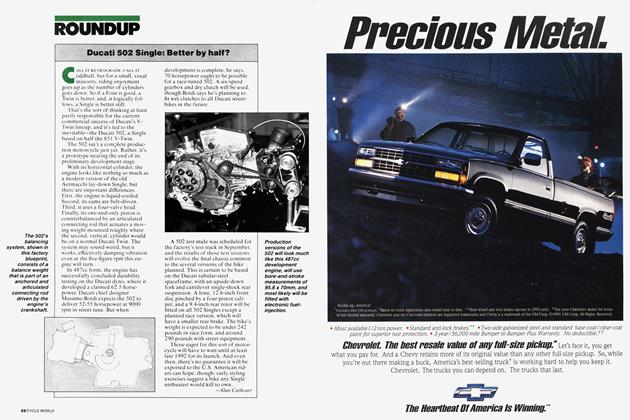
EVER SINCE ITS DEBUT FIVE YEARS AGO, THE LAVERDA 650 has been a motorcycle in search of an engine to complement its acclaimed Nico Bakker-derived aluminum twin-spar chassis.
Now at last, Laverda has that motor. The fuel-injected, liquid-cooled 750 is the first all-new (well, 90 percent new) engine to come on-line after the takeover of the company by wealthy industrialist Francesco Tognon three years ago. But as Laverda technical boss Nicola Materazzi explains, the new engine had to fulfill Tognon's brief of looking forward while keeping an eye on the past.
"It had to be a 750, and a parallel-Twin, to build on Laverda's historical links with such models," Materazzi says. "Just as a Ducati must be a 90-degree V-Twin, so a Laverda must be a parallel-Twin."
Accordingly, the new engine will form the basis of a fami ly of bikes recalling the successful twin-cylinder models from Laverda's glorious past. First of these is the 750S, which will sell for $11,800 when it reaches U.S. shores early in 1998. Compare that to $12,995 for a Ducati 748, which Laverda's engineers say provided the performance benchmark for their own eight-valve 750, and it's plain to see that the revitalized company intends to become a player in the hotly contested middleweight sportbike category.
Laverda's previous-generation, air-cooled parallel-Twin started out as a 500 in 1977, and was upsized through 600cc and 650cc to the present 668cc. But as displacement and > output increased, overheating problems led to a drop in power that was only partially cured by supplemental oilcooling. Time for a change.
A half-mile down the road on the new 750S, and you real ize that a page has been turned: This is a dramatically improved motorcycle, which for the first time bears compar ison on a level playing field with its middleweight opposi tion. For a start, the new motor is far less clattery than the old one, which always let you know there were bits inside whirring up and down and round and round. Inevitably, being liquid-cooled, the 750 is quieter as well as more sophisticated in feel-but it also doesn't seem strained at any rpm, whereas the old 650/668 always let you know when it was working hard.
Moreover, where the old engine was peaky, the new one's low-end power delivery is much cleaner and crisper, in spite of the fact that the throttle bodies on the Weber-Marelli fuel-injection system have grown from 40 to 43mm. It will pull away in top gear from as low as 3000 rpm, and will run happily as low as 2500 revs without fuss-though if you want brisk acceleration, you still need to click down a cou ple of gears.
When you do so, you'll notice that there isn't the step in the powerband around 5000 rpm that there was before, just a completely linear build-up all the way to the 9400-rpm rev limit and claimed 148-mph top speed. Even though the new 80-horsepower 747cc engine has 4.5mm-bigger bores than the old 66-horse 668, it revs even higher. The power increases progressively right up to the 8800-rpm peak, and
holds it beyond that, delivering a reward for using the gearbox to keep the engine revving high.
The gear ratios are all new, and more evenly spaced than on the old engine, reflecting the improved power characteris tics of the new motor. But even with a different selector mechanism, the gear change on each of the two bikes I test ed was stiff and balky in the bottom three gears-surprising, given that apart from a stiff clutch and hard-to-find neutral, the six-speed cluster previously swapped ratios easily. Laverda is aware of this problem, however, and plans to rec tify it with a new clutch lever mechanism when Brembo is able to deliver one.
That fixed, the Laverda should make for a fun bike. The 180-degree format (one piston up, one down) of the parallelTwin motor gives a harsh drone that rasps invigoratingly beneath you as you twist your wrist, the crisp response of the EFI butterfly throttles and all-new engine mapping delivering great midrange pickup. Vibration, while notice able, isn't really intrusive, and only comes at you through the footrests.
Apart from being smoother and more powerful, the new engine also is smaller and lighter (26 pounds lighter!) than the old one, paring the 750S's claimed dry weight to just 429 pounds. Yet it feels even less heavy, thanks to the new engine's lower center of gravity.
The effect of this on handling is dramatic. Whereas the old bike was a little lively around fast, bumpy turns, the new one shrugs off such challenges as if they didn't exist.
Really, though, it's not just the architecture but also the performance of the new engine that adds an extra dimension to a bike that was already one of the best-handling packages you could buy for the street. It just needed the engine it deserved-and now it's got it. Welcome back, Laverda.