Super X
SUPER X
Excelsior-Henderson cuts through the hype and hoopla to deliver a new American cruiser
KEVIN CAMERON
ATTEMPTS TO REVIVE CLASSIC American motorcycle names are lately met with calm skepticism. Wouldbe revivalists simultaneously send out invitations to investors and order a prototype from the usual consulting firms. An engine is milled from billet. Inside are Chevy parts or nothing at all. The chassis is equipped with catalog suspension, wheels and brakes. Prospective investors and the prototype are brought together with catered fanfare and a snowfall of press releases. Money flows. Later, another footnote to history announces complications, then silence.
Yet investors remain eager, and we know why. Harley-Davidson grosses a billion and a half dollars annually in the American Motorcycle Business. Business-minded people would like a piece of that action.
The Feds want Indian entrepreneur Philip Zanghi in prison. Wayne Baughman and his Century V-Twin Chief are God-knows-where. The Australia/Britten Indian connection failed to connect. Others seem more interested in selling Tshirts than making motorcycles. We’ve been shown everything but the essentials: a company and a factory. It’s easy to raise the money for a billet prototype, but factories are real things, not projections of active imaginations. To raise the millions they require, your business plan must withstand scrutiny by professional money managers.
When we learned of the Hanlon brothers’ new Excelsior-Henderson Motorcycle Manufacturing Company, we were skeptical. But fresh news revealed items of interest. One was the unveiling of running prototypes at this summer’s Sturgis Rally. Another was the name Allan Hurd, hired to head manufacturing. Hurd, a Brit, set up the factory that’s making the new Triumphs. We know this man. Allan Hurd in Minnesota? We’re interested. We called the travel agent.
History books tell us that Excelsiors had been big Twins, Hendersons lengthwise inline-Fours. Excelsior began operations in 1907, was bought by bicycle magnate Ignatz Schwinn in 1911, merged with Henderson in 1917 and ceased operations in 1931, victim of the Depression. Excelsior-Henderson had not existed for 65 years.
The tradition is rich. An Excelsior Twin was, in 1913, the first motorcycle officially timed at 100 mph. With Harley and Indian, the company made up the Big Three of U.S. competition, starring in the headlong board-track era. The ExcelsiorSuper X of 1925 featured unit construction, a stressed engine, gear primary drive and aluminum cases. Those were exciting times.
We found the new company in Burnsville, Minnesota, near Minneapolis. Nine people work here. CW Chief David Edwards and I were ushered into a conference room to endure an endless home video of the prototype unveiling at Sturgis. Then the Hanlon brothers, Dave and Dan, presented their views.
“We didn’t really want to do this,” Dan told us, referring to our visit to see the prototype. “We think this is backward, and we don’t want to be associated with others who have done it backward. Creating a company and a factory come first for us. The financial people want to see a company and a business plan-not a prototype. The product is, for the moment, irrelevant.”
What they wanted us to see, Dan said, was the “rich farmland” they had prepared, not just some sample corn that might be grown on it. These men like to use agricultural imagery-farming is their background-but both are successful businessmen. Both have ridden motorcycles for years. Dan, today in his “financial suit,” and Dave, sporting a Super X flamed sweatshirt, made a remarkable pair. Dave projected hot enthusiasm, buzzing around during the meeting, finishing others’ dangling sentences, making points. Dan’s was the measured voice of reason and caution.
Dan told us that financing is in place to allow construction of a factory next year in nearby Belle Plaine under a complex matching-funds agreement with the state of Minnesota. He said that management people have been “hired through to the five-year point.” The people we were about to meet, he emphasized, were not start-up people who would have to be replaced when the company outgrows their experience. What you see is what will be.
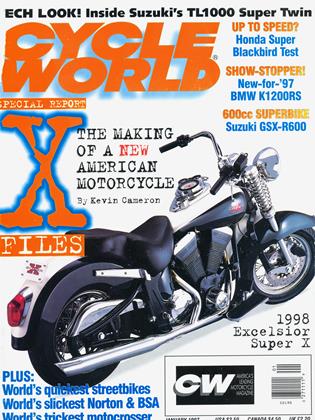
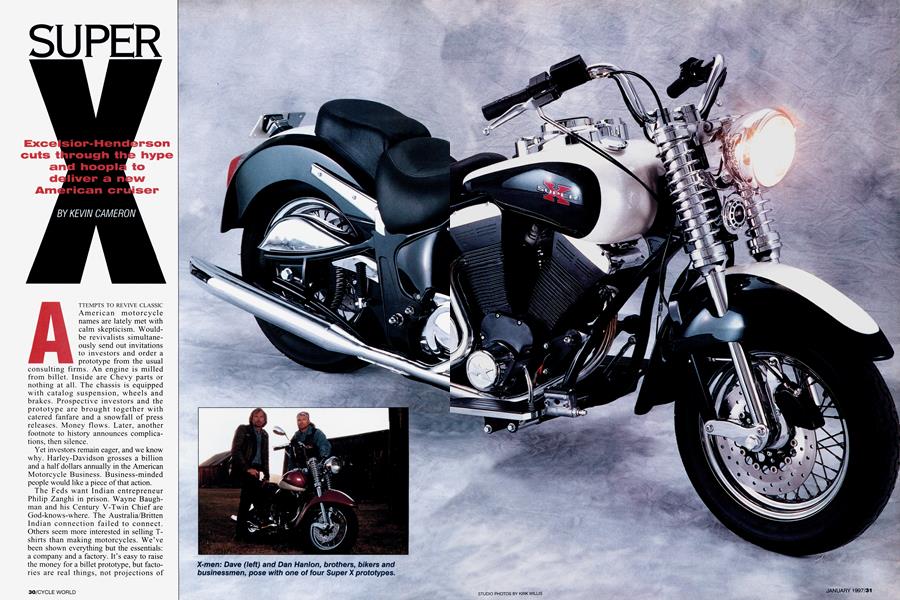
But first, we saw the machine itself. Impressive size, calm, rounded shapes and shining paint-a heavy cruiser with leading-link fork and a big, fuel-injected overhead-cam V-Twin engine. The Hanlons repeated their aim: to build a modem cruising motorcycle with the kind of traditional American styling people like.
It intentionally shares many features with the Super X of 1925. Front suspension is by short leading links, with large springs up near the headlight; all four front-end stmts pass through the front fender; there are recurved front downtubes; bulbous, saddle-style fuel tank with instmment cluster on top; left-side air cleaner; and a hard-tail-look rear frame. Finally, like Excelsior’s J.A. McNeil-designed dirttracker of 1920, it has overhead cams.
Dave Hanlon would later say, “We’re cloaking ourselves in the past, but the fact is, this is a brand-new product.” We would understand his remark better as the afternoon progressed.
The engine is an air-and-oil-cooled 50-degree V-Twin of 1386cc. The two monolithic black cylinders, closely-finned, are offset, indicating that con-rods work side-by-side on the crankpin, not in fork-and-blade fashion of Harleys and old Indians.
We asked Chief Engineer AI Benz whether the rod bearings are plain or roller. He folded his arms in classic bodylanguage that says, “I’m closed!” and just shook his head. Not for publication. The increased vee-angle (Indians had 42 degrees, the original Excelsior had 45, as do Harleys) and the engine’s crank-to-deck height suggest good-sized pistons and a near-square bore and stroke, maybe in the range of 94 x 97 to 96 x 96mm. At reasonable peak piston speed, this would redline just above 5000 rpm. Think of it as a slice from any late-model dohc auto V-Eight-say, a Cadillac Northstar. With all its advantages, it would be a surprise if this engine failed to break 80 horsepower. Dave Hanlon explained that the engine’s characteristics are aimed at peak torque in the 60-80-mph range. I asked Benz if this defined the torque curve.
He replied, “If you were beginning with a clean sheet of paper, wouldn’t you want the torque to rise steeply to a high value at low rpm, and then just stay there over the whole range?”
Yes, and four smallish valves, working through short, steep cam profiles, could deliver just that.
I then asked Benz about the use of four valves, and the engine’s big gear primary drive, which allows the unit to be very short, front to back. He first alluded to the emissions value of multiple valves, which put the sparkplug at the center of a compact, efficient combustion chamber. Then he added, “If you’re designing from scratch, don’t you use the best technology you have?”
I thought back to Dave Hanlon’s remark about a brand-new product, cloaked in the past. Benz’s “best technology” explains four valves, oil cooling, fuel injection and gear drive. This is a powerplant for a thoroughly modem cruiser, whatever traditions it may embody. Riders today want to push hard up the Rockies, two-up, in July. Tradition isn’t the first choice for that job. Use the best technology you have.
Presently, I was introduced to Allan Hurd. I asked him how a production manager goes about setting up the manufacturing process. As with Benz, his replies were economical: “You list all the components, and with them, the chosen or best available method of manufacture. You pick out the items you plan to source outside, and you find vendors. You make provision to handle the rest in-house. In this case, the absolutely critical area is paint and finish. Those, for this application, have to be very good. You therefore handle those yourself.”
Foundry and machining will be handled outside. “There are excellent sources for those things nearby, so there is no need for us to reinvent the wheel in that respect,” Hurd said.
He noted that it’s much easier to find capable vendors in the U.S. than it was with the Triumph start-up in the U.K. “In England, suppliers for things like hand controls and electrics had ceased to exist,” he said. “Fortunately, that situation is not the case here.”
Conversation with Hurd inspires confidence because he is confident. “We will do it,” was his reply to every question about the tasks ahead.
At this point, lunch arrived. Sandwiches, eaten on the job.
I spoke next with Thomas Rootness, the company’s financial officer. He said the financial community knows that this company has already made several of the scheduled steps in its business plan. The remaining steps, although large in dollar terms and still requiring much hard work (see “The XFactor,” page 36), become “almost routine” as compared with the original work of building initial credibility.
As we left the conference room, in came Ron Sackett, to whom I was introduced. He directed the marketing campaign that “repositioned Harley-Davidson as one of America’s lifestyle icons,” I was told. His firm, Case Foley Sackett, will handle Excelsior’s advertising.
We moved to the prototype shop, where another machine was being readied by Benz and Hurd. Here was the controlled chaos of design and testing-foam prototypes piled in a comer, test chassis, an engine partially disassembled. On the walls hung artist’s renderings of various styling proposals. We could see massproperties apparatus and sound analysis gear.
A bare engine revealed more. Oil pumps and chain cam drives on the right. Starter drive on the left, stacked on the crank end with the one-way starter clutch, big primary gear, toothed ignition timing wheel, fine-splined ramp-and-saddle torsional shock absorber with Belleville springs, alternator rotor.
A nice, dense package. The gearbox and diaphragmspring clutch are conventional, substantial. The primary cover carries the alternator stator and the ignition encoder. Under the projecting right-hand engine cover resides the spinon oil filter.
On the top end are shimunder-bucket tappets, operated by sharp-looking cam lobes that suggest short duration and flat torque. Each cylinder has its own intake runner, the pair cast as one piece and located in the vee. A single injector per cylinder is used, and the casting carries a throttle-position sensor and two other sensors. There is a better reason than history to put the air intake on the left side. Benz commented that it’s desirable from a noise-test standpoint to have the intake and exhaust on opposite sides of the motorcycle. The exhaust-for now a simple 2-into-l with a small muffler-is on the right. Ignition and fuel injection are computer-controlled as on all modem engines.
Spark timing is derived from an encoder, reading the unsymmetrical toothed wheel on the crank, plus another on the front cylinder’s exhaust cam, to tell the system which cycle the engine is on.
The finned crankcases are vertically split, bolted to a horizontally split, drum-shifted indirect five-speed gearbox whose sump carries oil for both. When I asked about this “semi-unit” construction, I was told, “That could change.”
This substantial combo mounts to the frame in four places, two running across the front of the crankcase, two behind the gearbox, just above the top run of the final drive-the latest in high-strength toothbelts. Rubber vibration isolators press into frame-mounted cells, giving a wide, four-point support. The company calls this the Torsion Activated Vibration Absorbing System, or TAVAS. Dave Hanlon and Benz concurred that riders like a cruiser engine to show its muscle and “shake a bit” at idle, but smooth out on the highway.
The saddle-tank geometry puts the frame backbone across the valve covers of this tall engine. How do you pull the heads with the engine in the frame? The answer is clever-and significant. Each of the four cylinder studs is actually a bolt whose head is trapped in the crankcase. The lower shank of each bolt is made hexagonal. To disassemble, these bolts are unscrewed from the heads using a special wide wrench that engages their hex shanks. Then they are pushed down into the crankcase as far as they will go, leaving clearance above them for cylinder and head removal. This feature shows that this engine is designed not as a quick prototype, but as a serviceable piece.
The chassis is a heavy weldment in steel tubing and machined plate. Front leading-links project forward from fork legs of curved rectangular bar. Front wheel load rises to steering-head level via a second pair of legs, which operate the spring-damper combo mounted there. Rear suspension is by hard-tail-styled triangular swingarm, operating a single, multi-adjustable shock in modem, direct fashion.
Front and rear wheel are each braked by a single, floating 11.4-inch disc, using a four-piston caliper at the front and a two-piston at the rear. The front caliper is carried on a floating parallelogram mount. Wheelbase is given as 65 inches, dry weight as 675 pounds.
We saw seven engines-five new and two that were obvious dyno veterans. Leaning against the workbench was a stripped test mule, its engine purposeful-looking in bare aluminum. Also in-house was another complete Super X, one of four that were shown at Sturgis, though the Hanlons reminded us often that these “finished” bikes are not necessarily definitive. Prototypes exist to be tested, evaluated and changed.
Are these people serious? Yes, although I am no financial analyst, I believe they are. Look at the prototype engines: Nothing has been done the quick-and-dirty way, and the design clearly addresses serviceability as well as function. The basic parts are all castings, appropriate for quantity production. For a few prototypes, CNC machining from solid billet is cheaper because it completely bypasses pattern-making, foundry work, heat-treating and much of the tooling for finish-machined parts. In contrast, I counted 13 unique castings in each new Excelsior engine.
Asked if this 85-cubic-incher would be the company’s only engine, Benz replied carefully, “This will probably not be the only engine we’ll ever do.” A four-cylinder Henderson tourer, perhaps?
A week after our visit, the Hanlons were closing on a large financing package, negotiated with the Minnesota state government and others. At a previous ceremony, the governor had thrown a leg over one of the Super X prototypes, the lieutenant governor had even donned a Super X sweatshirt. Other cities and other states had sought to become home to the new assembly plant, but the choice fell upon Belle Plaine.
People here are working with obvious enthusiasm, not retreating behind titles into carpeted offices, waiting for others to deliver the future. Dan Hanlon was off in his suit and tie to more financial meetings. AI Benz, Allan Hurd and Dave Hanlon were in the shop, building a motorcycle. Until the troops get here, the generals are doing all the work themselves.
We came away with a feeling that it could happen, that a new make could, within this framework of business and finance, enter the market and offer real competition to established players. And the Hanlons say that they have received nothing but encouragement from people in the business-people, for instance, at Yamaha, Triumph and even Harley-Davidson.
Companies, even those long-established, can fail. Startups are precarious. But the plan revealed by the new Excelsior-Henderson Motorcycle Manufacturing Company, in the present business climate, smells like success. □