Vol. 1 No. 1
Vol. 1 No. 1
UP FRONT
David Edwards
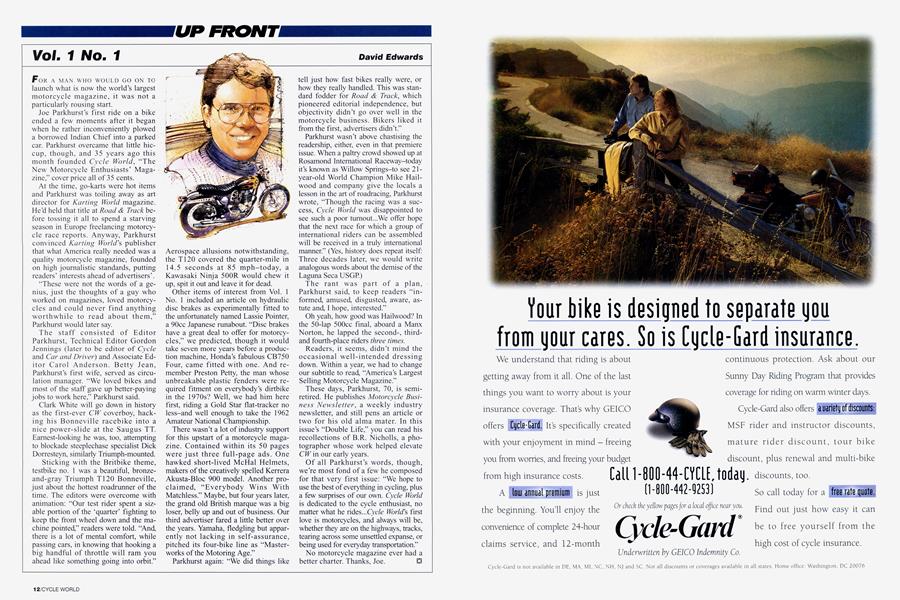
FOR A MAN WHO WOULD GO ON TO launch what is now the world’s largest motorcycle magazine, it was not a particularly rousing start.
Joe Parkhurst’s first ride on a bike ended a few moments after it began when he rather inconveniently plowed a borrowed Indian Chief into a parked car. Parkhurst overcame that little hiccup, though, and 35 years ago this month founded Cycle World, “The New Motorcycle Enthusiasts’ Magazine,” cover price all of 35 cents.
At the time, go-karts were hot items and Parkhurst was toiling away as art director for Karting World magazine. He’d held that title at Road & Track before tossing it all to spend a starving season in Europe freelancing motorcycle race reports. Anyway, Parkhurst convinced Karting World's publisher that what America really needed was a quality motorcycle magazine, founded on high journalistic standards, putting readers’ interests ahead of advertisers’.
“These were not the words of a genius, just the thoughts of a guy who worked on magazines, loved motorcycles and could never find anything worthwhile to read about them,” Parkhurst would later say.
The staff consisted of Editor Parkhurst, Technical Editor Gordon Jennings (later to be editor of Cycle and Car and Driver) and Associate Editor Carol Anderson. Betty Jean, Parkhurst’s first wife, served as circulation manager. “We loved bikes and most of the staff gave up better-paying jobs to work here,” Parkhurst said.
Clark White will go down in history as the first-ever CW coverboy, hacking his Bonneville racebike into a nice power-slide at the Saugus TT. Earnest-looking he was, too, attempting to blockade steeplechase specialist Dick Dorresteyn, similarly Triumph-mounted.
Sticking with the Britbike theme, testbike no. I was a beautiful, bronzeand-gray Triumph T120 Bonneville, just about the hottest roadrunner of the time. The editors were overcome with animation: “Our test rider spent a sizable portion of the ‘quarter’ fighting to keep the front wheel down and the machine pointed,” readers were told. “And, there is a lot of mental comfort, while passing cars, in knowing that hooking a big handful of throttle will ram you ahead like something going into orbit.” Aerospace allusions notwithstanding, the T120 covered the quarter-mile in 14.5 seconds at 85 mph-today, a Kawasaki Ninja 500R would chew it up, spit it out and leave it for dead.
Other items of interest from Vol. I No. I included an article on hydraulic disc brakes as experimentally fitted to the unfortunately named Lassie Pointer, a 90cc Japanese runabout. “Disc brakes have a great deal to offer for motorcycles,” we predicted, though it would take seven more years before a production machine, Honda’s fabulous CB750 Four, came fitted with one. And remember Preston Petty, the man whose unbreakable plastic fenders were required fitment on everybody’s dirtbike in the 1970s? Well, we had him here first, riding a Gold Star flat-tracker no less-and well enough to take the 1962 Amateur National Championship.
There wasn’t a lot of industry support for this upstart of a motorcycle magazine. Contained within its 50 pages were just three full-page ads. One hawked short-lived McHal Helmets, makers of the creatively spelled Kerrera Akusta-Bloc 900 model. Another proclaimed, “Everybody Wins With Matchless.” Maybe, but four years later, the grand old British marque was a big loser, belly up and out of business. Our third advertiser fared a little better over the years. Yamaha, fledgling but apparently not lacking in self-assurance, pitched its four-bike line as “Masterworks of the Motoring Age.”
Parkhurst again: “We did things like tell just how fast bikes really were, or how they really handled. This was standard fodder for Road & Track, which pioneered editorial independence, but objectivity didn’t go over well in the motorcycle business. Bikers liked it from the first, advertisers didn’t.” Parkhurst wasn’t above chastising the readership, either, even in that premiere issue. When a paltry crowd showed up at Rosamond International Raceway-today it’s known as Willow Springs-to see 21 -year-old World Champion Mike Hailwood and company give the locals a lesson in the art of roadracing, Parkhurst wrote, “Though the racing was a success, Cycle World was disappointed to see such a poor turnout...We offer hope that the next race for which a group of international riders can be assembled will be received in a truly international manner.” (Yes, history does repeat itself: Three decades later, we would write analogous words about the demise of the Laguna Seca USGP.)
The rant was part of a plan, Parkhurst said, to keep readers “informed, amused, disgusted, aware, astute and, I hope, interested.”
Oh yeah, how good was Hailwood? In the 50-lap 500cc final, aboard a Manx Norton, he lapped the second-, thirdand fourth-place riders three times.
Readers, it seems, didn’t mind the occasional well-intended dressing down. Within a year, we had to change our subtitle to read, “America’s Largest Selling Motorcycle Magazine.”
These days, Parkhurst, 70, is semiretired. He publishes Motorcycle Business Newsletter, a weekly industry newsletter, and still pens an article or two for his old alma mater. In this issue’s “Double Life,” you can read his recollections of B.R. Nicholls, a photographer whose work helped elevate CW in our early years.
Of all Parkhurst’s words, though, we’re most fond of a few he composed for that very first issue: “We hope to use the best of everything in cycling, plus a few surprises of our own. Cycle World is dedicated to the cycle enthusiast, no matter what he rides...Cycle World's first love is motorcycles, and always will be, whether they are on the highways, tracks, tearing across some unsettled expanse, or being used for everyday transportation.” No motorcycle magazine ever had a better charter. Thanks, Joe.