The Fine Art of Carrying Stuff
The fine art of carrying stuff
LEANINGS
Peter Egan
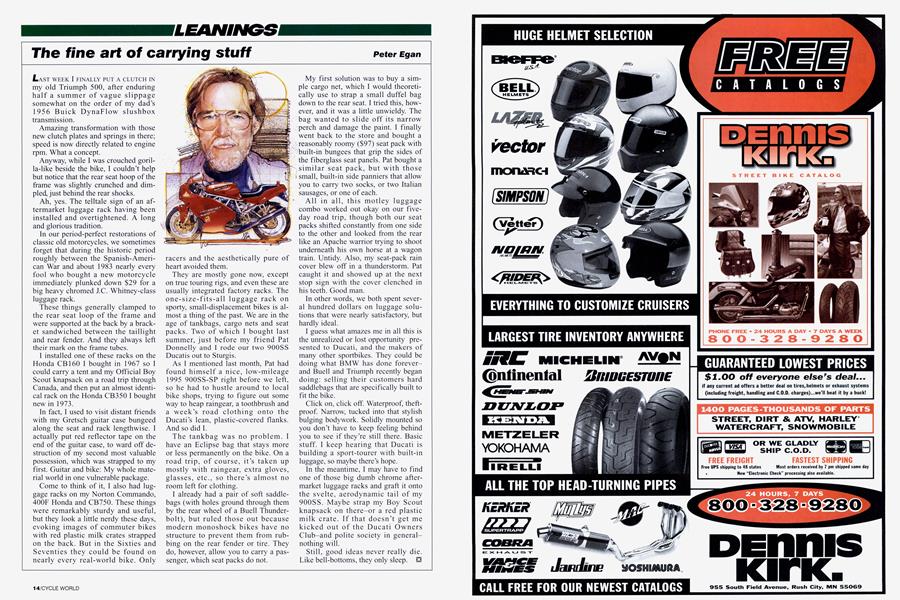
LAST WEEK I FINALLY PUT A CLUTCH IN my old Triumph 500, after enduring half a summer of vague slippage somewhat on the order of my dad’s 1956 Buick DynaFlow slushbox transmission.
Amazing transformation with those new clutch plates and springs in there; speed is now directly related to engine rpm. What a concept.
Anyway, while I was crouched gorilla-like beside the bike, I couldn’t help but notice that the rear seat hoop of the frame was slightly crunched and dimpled, just behind the rear shocks.
Ah, yes. The telltale sign of an aftermarket luggage rack having been installed and overtightened. A long and glorious tradition.
In our period-perfect restorations of classic old motorcycles, we sometimes forget that during the historic period roughly between the Spanish-American War and about 1983 nearly every fool who bought a new motorcycle immediately plunked down $29 for a big heavy chromed J.C. Whitney-class luggage rack.
These things generally clamped to the rear seat loop of the frame and were supported at the back by a bracket sandwiched between the taillight and rear fender. And they always left their mark on the frame tubes.
I installed one of these racks on the Honda CB160 I bought in 1967 so I could carry a tent and my Official Boy Scout knapsack on a road trip through Canada, and then put an almost identical rack on the Honda CB350 I bought new in 1973.
In fact, I used to visit distant friends with my Gretsch guitar case bungeed along the seat and rack lengthwise. I actually put red reflector tape on the end of the guitar case, to ward off destruction of my second most valuable possession, which was strapped to my first. Guitar and bike: My whole material world in one vulnerable package.
Come to think of it, I also had luggage racks on my Norton Commando, 400F Honda and CB750. These things were remarkably sturdy and useful, but they look a little nerdy these days, evoking images of commuter bikes with red plastic milk crates strapped on the back. But in the Sixties and Seventies they could be found on nearly every real-world bike. Only racers and the aesthetically pure of heart avoided them.
They are mostly gone now, except on true touring rigs, and even these are usually integrated factory racks. The one-size-fits-all luggage rack on sporty, small-displacement bikes is almost a thing of the past. We are in the age of tankbags, cargo nets and seat packs. Two of which I bought last summer, just before my friend Pat Donnelly and I rode our two 900SS Ducatis out to Sturgis.
As I mentioned last month, Pat had found himself a nice, low-mileage 1995 900SS-SP right before we left, so he had to hustle around to local bike shops, trying to figure out some way to heap raingear, a toothbrush and a week’s road clothing onto the Ducati’s lean, plastic-covered flanks. And so did I.
The tankbag was no problem. I have an Eclipse bag that stays more or less permanently on the bike. On a road trip, of course, it’s taken up mostly with raingear, extra gloves, glasses, etc., so there’s almost no room left for clothing.
I already had a pair of soft saddlebags (with holes ground through them by the rear wheel of a Buell Thunderbolt), but ruled those out because modern monoshock bikes have no structure to prevent them from rubbing on the rear fender or tire. They do, however, allow you to carry a passenger, which seat packs do not.
My first solution was to buy a simple cargo net, which I would theoretically use to strap a small duffel bag down to the rear seat. I tried this, however, and it was a little unwieldy. The bag wanted to slide off its narrow perch and damage the paint. I finally went back to the store and bought a reasonably roomy ($97) seat pack with built-in bungees that grip the sides of the fiberglass seat panels. Pat bought a similar seat pack, but with those 3 small, built-in side panniers that allow you to carry two socks, or two Italian sausages, or one of each.
All in all, this motley luggage combo worked out okay on our fiveday road trip, though both our seat packs shifted constantly from one side to the other and looked from the rear like an Apache warrior trying to shoot underneath his own horse at a wagon train. Untidy. Also, my seat-pack rain cover blew off in a thunderstorm. Pat caught it and showed up at the next stop sign with the cover clenched in his teeth. Good man.
In other words, we both spent several hundred dollars on luggage solutions that were nearly satisfactory, but hardly ideal.
I guess what amazes me in all this is the unrealized or lost opportunity presented to Ducati, and the makers of many other sportbikes. They could be doing what BMW has done foreverand Buell and Triumph recently began doing: selling their customers hard saddlebags that are specifically built to fit the bike.
Click on, click off. Waterproof, theftproof. Narrow, tucked into that stylish bulging bodywork. Solidly mounted so you don’t have to keep feeling behind you to see if they’re still there. Basic stuff. I keep hearing that Ducati is building a sport-tourer with built-in luggage, so maybe there’s hope.
In the meantime, I may have to find one of those big dumb chrome aftermarket luggage racks and graft it onto the svelte, aerodynamic tail of my 900SS. Maybe strap my Boy Scout knapsack on there-or a red plastic milk crate. If that doesn’t get me kicked out of the Ducati Owners Club-and polite society in generalnothing will.
Still, good ideas never really die. Like bell-bottoms, they only sleep. □