Valiant Failure
VALIANT FAILURE
BRITISH MOTORCYCLE HISTORY IS FULL OF SAD tales, poor timing and botched opportunities. For illustration, consider the all-but-forgotten AJS E90S Twin, nicknamed the Porcupine. With a littie luck, this racebike might have been remembered as one of the world's great motorcycles.
Until the years just preceding World War II, English-built Singles dominated international roadracing. But as the Thirties drew to a close, the long reign of the big Thumpers was ended by new technology. Using supercharged, multicylinder racebikes, BMW took the 500cc title in 1938, Güera in 1939.
Then Germany invaded Poland. While the world awaited Adolf Hitler’s next move, Harry Collier at AJS got on with business: designing an English reply to the BMW and Güera. He drew an inline, supercharged, overhead-cam Triple with horizontal cylinders, but the spread of war across Europe prevented its development.
As machine-tool spindles spewed chips in war production, former racebike engineers talked and doodled in spare moments. In the grim winter of 1942, Norton race chief Joe Craig, temporarily working at AMC (AJS’s multi-company parent organization) on military projects, sketched his answer to the German and Italian blower-bikes: a supercharged vertical-Twin. No draftsman, Craig left detail design to Vic Webb and Phil Irving (of Vincent fame).
When the war ended in 1945, English industries once again tackled civilian production. Initially, the bike on Webb’s drawing board was to be built under the Sunbeam brand name, so it was given a Sunbeam model number: E90S, S for supercharged.
Superchargers deliver air continuously, but engines take their air in cylinder-sized bites. Without extra volume between the cylinder and supercharger, a big cylinder’s intake stroke could easily pull manifold pressure to momentarily negative values, nullifying the benefit of supercharging. Before the war, Val Page had solved this problem on a special blown Triumph by reversing the head and putting the needed plenum volume in long intake pipes leading from the blower, which was behind the cylinders, around to the front of the head. Webb used this basic concept with the E90S, but instead of reversing the head, he ran the long pipes to intakes between the valves. Entering vertically between the cylinders, intake flow would be directed downcylinder, rather than across the cylinder, out through the exhaust valves and into the exhaust system.
KEVIN CAMERON
IT WON THE WORLD CHAMPIONSHIP IN 1949, BUT AJS's PORCUPINE 500 COULD HAVE DONE SO MUCH MORE
Despite all of its apparent benefits, Webb’s plan to build this liquid-cooled vertical-Twin was scrapped. Calculations showed that his engine would be hopelessly heavy if cast in aluminum rather than magnesium. Because coolant corrodes magnesium, the decision was made to build an a/V-cooled magnesium engine. This was odd, since AJS’s pre-war VFour racer had overheated so badly as an air-cooled design that it had to be reconfigured with liquid cooling. Strange things are done in the name of lightness.
Webb’s design was further altered to provide horizontal cylinders and conventional intake ports. Joe Craig, who left AMC to rejoin Norton in 1946, claimed that “someone else rehashed the cylinder head.” Elarry Collier had previously chosen horizontal cylinders for his drawing-board Triple, so perhaps it was he who chose this layout for the E90S.
Supercharged engines have low compression ratios because part of their compression is provided by the blower. This requires a large volume above each piston at TDC. The traditional shape for this was the hemisphere, so the engine was given two valves per cylinder, set at a wide, 90-degree included angle in a very deep chamber. With a supercharger to force air into the engine, no special attention was given to port streamlining, save for use of large valves to reduce pumping loss.
Not long after the war ended, AJS’s grand plan for the E90S ran aground. The governing body of world motorcycle competition at that time, the FICM, decided late in 1946 that the post-war world could not afford the high cost of supercharged racing. Blowers were banned. At that point, the engineers at AJS knew they needed a whole new engine. But money was short, even if ideas were plentiful. So they
hastily reshaped their design for atmospheric induction.
Conversion of the supercharged E90S into the normally aspirated E90 planted a lush garden of problems. Domed pistons were used to make up for the deliberately low compression ratio. But instead of a compact hemisphere, the combustion chamber was now more like the rind of half a grapefruit: thin and with excess surface area. It would bum slowly and inefficiently. When airflow pioneer Harry Weslake heard about the E90 from friends in the race shop, he offered his help with head and ports. But Donald Heather, the director of AMC, rejected Weslake’s offer. Why? Because Heather was an accountant, not an engineer.
Why was a numbers man leading the company? The English bike industry began based on skilled labor, which was fine so long as labor was dirt-cheap. But as Henry Ford once noted, if your employees can’t afford to buy what you make, you’ll never have a mass market. In time, English workmen earned more, putting the pinch on profits. That, combined with the Depression of the 1930s, forced many bike companies either out of business or into mergers. Big U.S. car-makers had avoided this trap by replacing expensive handwork with mass production, but England’s bikemakers were too conservative or too small to do likewise. So, whereas the original companies had been founded by practical men like Harry Collier who knew bikes, the mergers were run by accountants like Donald Heather who knew only numbers.
The E90 therefore went forward without Weslake’s help.
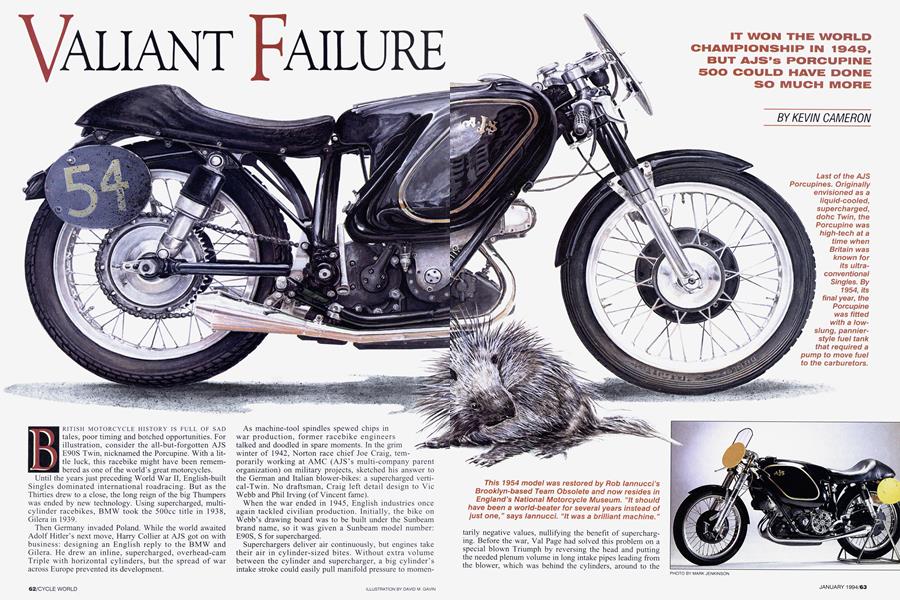
A train of spur gears from one crank end drove two overhead cams, actuating shim-under-bucket tappets in the square, 68 x 68.25mm engine. In anticipation of supercharging’s enormous heat load, the exhaust valves had been given giant, 7/i6-inch stems, sodium-filled in aircraft-engine style, with valve rotators to equalize temperature around the seats. Intake stems were 5/i6-inch. Today, valves of these same head sizes have Vs-inch stems. Forged-aluminum Hepolite pistons were used, with two commendably thin, Vi6-inch gas rings and one oil ring.
The 5.5-inch spike fins on the head were cast by a pioneering vacuum-casting technique. These spikes, as opposed to normal plate fins, allowed cooling air to move over the head in any direction. The cylinders were likewise given spike fins. It was these curious, fragile fins that gave the AJS E90 its name: Porcupine.
In a time when girder forks, squeaky friction damping and rigid-rear diamond frames were standard practice, the E90’s cycle parts were truly revolutionary. Hydraulic damping was used at both ends of the twin-loop frame; one of the new telescopic forks supported the front, and a swingarm with dual suspension units carried the rear. Cast-magnesium conical-hub brakes were fitted into 21-inch wheels.
Originally planned to withstand 20 psi of blower boost, the crankcase/gearcase was a massive one-piece, non-split casting designed for rigidity. The 360-degree crankshaft was inserted endwise, with its center main-bearing web bolted over it, into the left-hand side of the case.
To limit case diameter and weight, the crank was likewise of minimum diameter, quite unconventional in this era of big Singles with cranks like millwheels. Some think the rotating mass of the supercharger was included in original flywheel-mass planning. Rollers supported the two ends, with a plain bearing at the center. The two forged-aluminum con-rods also ran on Tony VandervelTs new plain bearings. All that was left of the blower was its profound influence on the engine design-and an empty saddle atop the gearbox.
Of course, the rest of the British motorcycle industry wasn’t watching idly while the Porcupine underwent its clumsy development. New ideas were everywhere. Irishman Rex McCandless joined the Norton team in 1948 and immediately began to pester Joe Craig for a four-cylinder racer. When it didn’t materialize, he turned his energy to chassis, designing for Norton the most-copied motorcycle frame in history: the twin-loop Featherbed. Fie pioneered 16-inch wheels, dampers with remote reservoirs, full streamlining and much more. Or, how about a monoshock, radial four-valve BSA in the 1950s? Designed by Doug Hele as a follow-on to the great Gold Star, it was built and tested-then killed.
The names of countless other men are associated with the designs they created or developed: Jack Williams, Bert Hopwood, Percy Goodman, Harold Willis and so many other experienced, capable people. These men knew each other and each others’ work, making a network of great creative power. But the same limitations that had held back the Porcupine’s design also hampered the development of their ideas.
Shortly before the Porcupine’s first racing appearance, the engine gave a weak, 37 horsepower on the low, 7:1 compression ratio made necessary by the 72-octane post-war gasoline. Peak revs, at 7600, were only a few hundred higher than a good Norton Single could reach, and the power was barely equal to the Manx’s. Weight, long wheelbase and lack of power made the Pore’s early performance less than revolutionary. Its crippled combustion chambers gave best power at an inefficient 55 degrees of spark lead. Much of the E90’s power was, as the engineers say, “rejected to coolant.” In other words, it ran hot. Mica-insulated sparkplugs, buried deep in the cylinder head, broke down and failed. At the 1947 Isle of Man TT, Porcupines finished eighth and 14th.
What had happened? The switch from supercharged to atmospheric operation was a kluge-job, like surgically converting a cat into a dog. Making matters worse was the constant changing of personnel during design and development. Collier, Craig, Webb and Irving had all had their hands in the work, and more would follow.
At this point, the question was whether AJS could develop the Porcupine’s radical features faster than Joe Craig could advance the highly refined but bone-simple Norton Manx. Had the E90 engine been able to run at Manx-like piston speed of 3800-4000 feet per minute, it would have turned something like 8800 revs. Had its ports received attention from the acknowledged masters of the day-Craig or Weslake-its combustion pressure might, with the return of high-octane fuels, have reached 185 to 200 psi. This, at 9000 rpm, would have yielded 70 horsepower, and the E90 might have achieved the performance revolution its makers envisioned.
The stream of history flowed otherwise. AJS’s racing manager, Freddie Clarke, was killed in a motor accident, and was replaced by rider Jock West. The team struggled with two-bit failures.
The magneto’s long driveshaft broke from torsional vibration. If the shaft survived, the mag threw its windings-vigorous cycle-tocycle speed variations of the light crank were the likely cause. Clutch plates deformed. The sparkplugs didn’t improve, and even prototype ceramic-insulator plugs, built by Lodge, cracked.
At the 1948 TT, all three Porcupines failed to finish. AMC chief Heather asked Matt Wright, the man who had rescued the pre-war AJS V-Four from failure, to take over the race shop. He continued the piecemeal re-make of the E90 into a true unsupercharged design. He narrowed the valve angle, creating a shallower, faster-burning combustion chamber. He tackled the failures, converting the magneto drive from shaft to chain. As a result of port design, much of the fuel was short-circuiting out the exhausts, so Wright inserted steel deflector vanes into the intake ports, to redirect fuel away from the exhaust ports. Power and mileage improved. The cylinders’ spike fins were replaced with radial finning.
Wright wanted to do more. His riders needed rear suspension units as good as the competition’s, and, in blind tests, they preferred anything to AMC’s “jam-pots,” still as primitive as door-closers. But accountants, not riders, made the choice, and the jam-pots stayed.
Even with his hands tied, Wright had the Pore at the 50horsepower level in 1949—a bit up on the Manx Nortons of the day. Failures abated, but the machine still was less reliable than the highly developed Singles. In the 1949 TT, Les Graham was leading by two minutes with two miles to run when his Porcupine cut out, letting Norton through for yet another single-cylinder win.
Development continued. To ease cold-starting, Wright converted the dry-sump engine to wet-sump. This permitted oil to be pre-heated and poured hot into the sump, to warm the engine and enhance fuel vaporization before bump-starting. The bike was fast now, and riders insisted its handling was acceptable, although to onlookers it always looked to be a handful. Then, at last, the light of success shined on the E90, if only for a brief time. With Graham riding, a first in the Swiss GP and a second at the Ulster TT gave the Porcupine the 1949 world championship-the only title it would ever win.
At the 1950 TT, Norton introduced a twin-loop, hydrodamped chassis of its own, giving its racing Singles fresh speed. Playing catch-up again, AJS switched the E90 from 21-inch wheels down to 19-inchers in 1951, which greatly reduced steering effort. The use of lighter components cut total weight to 318 pounds-comparable to a stock Norton Manx. Still, a Norton Single again won the 500 TT, with a Porcupine second.
Problems continued that had nothing to do with the bike’s hardware. As usually happens when companies founded by engineers come to be managed by accountants, conflict developed between the two points of view. The numbers men usually win. Jock West and Matt Wright transferred to sales, where life was calmer.
replaced by conventional
H.J. Hatch was appointed racing engineer, and more personnel left the shop. Hatch immediately redesigned the engine, now designated E95. Its cylinders were stood up from the original 15 degrees to 45, allowing wheelbase to be shortened to 55 inches. A 335-pound E95 came home fifth at the 1952 TT.
At the next year’s TT, two Norton Singles and a Gilera finished ahead of the Porcupine. For 1954, the machines ran with lowslung pannier fuel tanks, using pumps to lift fuel to carb level. But in yet another case of management interference, company directors forbade the use of streamlining. Nevertheless, with 55 horsepower that could push it to 145 mph, the Pore was quite fast. But results did not improve and costs were mounting, so the program was terminated. Only the 7R 350 Single continued the AJS name on the racetrack.
With the death of Charlie Collier that year, accountants fully took over. Wally Wyatt, a race-shop hand, claims the company went downhill fast after that. “AMC got what they deserved,” he would say later.
Other companies—Norton, Matchless and Velocette—had better luck than AJS, but England’s GP glory days were past. Single-cylinder bikes were yielding to the multi-cylinder Italian push-and the Porcupine couldn’t even match the Singles. The English companies withdrew their GP teams in 1954. Spirited single-cylinder British club racing continued for 15 more years, but production of the great Singles ended by 1963.
Ingenious concepts continued to flow from Britain, but without mass markets or low-cost production methods, it was like the soldier’s dream of breakfast: If we had some ham, we could have ham and eggs, if we had some eggs. All that was left was ideas, dreams. Triumph’s Edward Turner noted in the 1950s that affluent America could be the greatest bike market in the world. English engineers repeatedly proposed to build cheap, simple machines, but it would be left to Soichiro Honda to create and supply wider markets. Inoculated with the fun of $235 Honda 50cc step-throughs, millions of Americans went on to buy bigger bikes-British ones included. But without the tooling to combine advanced features with low price, the static, conservative English products lagged in price and sales appeal. Tempted by an expanding market, but poisoned by antique methods and irrelevant management, the classic manufacturers were not murdered. They committed suicide.
The final irony is the relative success of the new Triumph Corporation, whose entire line is modular—all models share basic components such as frames, pistons, rods, valves, gearboxes, etc. Bert Hopwood, one of the brightest British designers of the post-war era, had proposed this cost-cutting scheme to his various industry employers for 25 years. Not one of them was interested.
Despite pioneering advanced ideas that have since become well-accepted, the AJS Porcupine was a valiant failure. Despite winning a world championship, it did not change the direction of design in England. With the lone exception of Triumph’s T160 Triple, British roadbikes would remain vertical-Twins and pure racers would remain Singles until the doors of England’s original great motorcycle producers closed forever.