Yesterday's Superbike
Yesterday's Superbike
REVISITING AN OLD FLAME OF A MOTORCYCLE
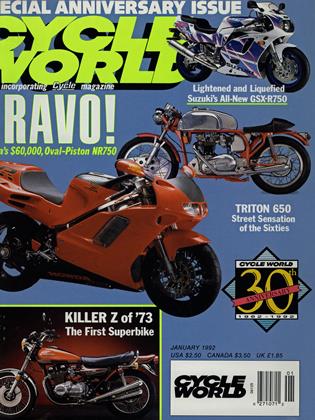
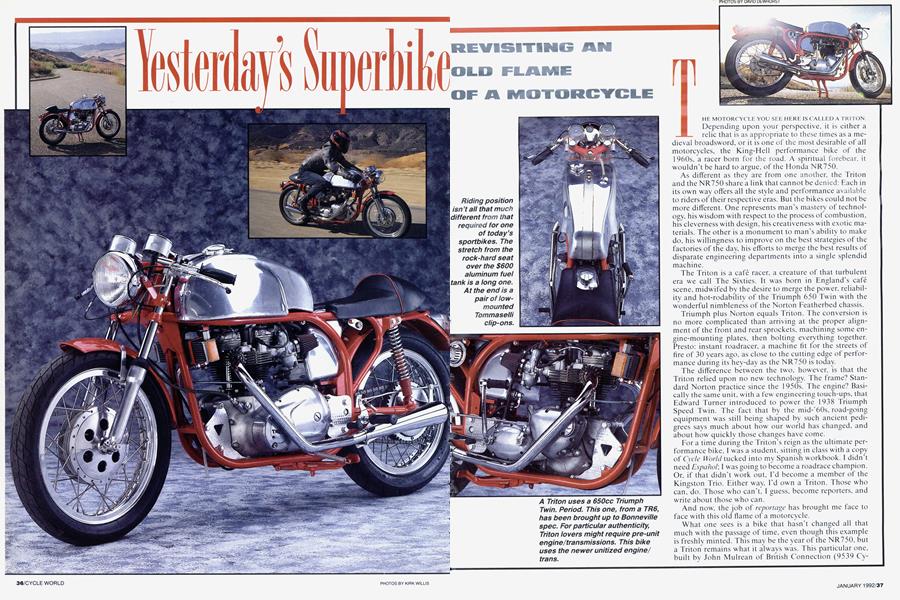
THE MOTORCYCLE YOU SEE HERE IS CALLED A TRITON. Depending upon your perspective, it is either a relic that is as appropriate to these times as a medieval broadsword, or it is one of the most desirable of all motorcycles, the King-Hell performance bike of the 1960s, a racer born for the road. A spiritual forebear, it wouldn't be hard to argue, of the Honda NR750.
As different as they are from one another, the Triton and the NR750 share a link that cannot be denied: Each in its own way offers all the style and performance available to riders of their respective eras. But the bikes could not be more different. One represents man's mastery of technol ogy, his wisdom with respect to the process of combustion, his cleverness with design. his creativeness with exotic ma terials. The other is a monument to man's ability to make do, his willingness to improve on the best strategies of the factories of the day. his efforts to merge the best results of disparate engineering departments into a single splendid machine.
The Triton is a café racer, a creature of that turbulent era we call The Sixties. It was born in England's café scene, midwifed by the desire to merge the power, reliabil ity and hot-rodability of the Triumph 650 Twin with the wonderful nimbleness of the Norton Featherbed chassis.
Triumph plus Norton equals Triton. The conversion is no more complicated than arriving at the proper align ment of the front and rear sprockets, machining some en gine-mounting plates. then bolting everything together. Presto: instant roadracer, a machine fit for the streets of fire of 30 years ago, as close to the cutting edge of perfor mance during its hey-day as the NR750 is today.
The difference between the two, however, is that the Triton relied upon no new technology. The frame? Stan dard Norton practice since the l950s. The engine? Basi cally the same unit, with a few engineering touch-ups, that Edward Turner introduced to power the 1938 Triumph Speed Twin. The fact that by the mid-'60s, road-going equipment was still being shaped by such ancient pedi grees says much about how our world has changed. and about how quickly those changes have come.
For a time during the Triton's reign as the ultimate per formance bike, I was a student, sitting in class with a copy of Ci'cle World tucked into my Spanish workbook. I didn't need EspaTiol; I was going to become a roadrace champion. Or, if that didn't work out, I'd become a member of the Kingston Trio. Either way, I'd own a Triton. Those who can, do. Those who can't, I guess, become reporters, and write about those who can.
And now, the job of reportage has brought me face to face with this old flame of a motorcycle.
What one sees is a bike that hasn't changed all that much with the passage of time, even though this example is freshly minted. This may be the year of the NR750, but a Triton remains what it always was. This particular one, built by John Mulrean of British Connection (9539 Cy press St., Lakeside, CA 92040; 619/443-9169) for cus tomer Bob Ferguson, of Santee, California, uses a 1968 Triumph TR6 engine, brought up to Bonneville spec, bolted into a 1964 Norton Atlas "slimline" Featherbed frame. The swingarm is standard Norton, with the stock rubber bushings exchanged for bronze-steel bushings. The conical rear hub is from a 1971 Triumph, the fork, triple clamps and front brake are from a 1970 Commando, and the frame and swingarm, as well as the triple-clamps and steel fenders, all are powder-coated.
The seat, and the aluminum oil and fuel tanks are from Unity Equipe, a British firm that specializes in Triton pieces. The carbs are Amal Concentrics that breathe through K&N filters, and the instruments are Smiths, from a 1972 Triumph, mounted in alloy Commando holders. Wheels are a composite of Akront alloy rims laced up with stainless-steel spokes.
The engine lilates, the alloy parts that allow the engine to be mated to the frame, were machined by Muirean. On this bike, these are engine-turned, a beauty treatment for which Muirean charges extra.
Also extra is the Fieadwork Muirean has done on this engine-hardened valve seats and stainless-steel valves, to
allow it to burn unleaded fuel, and bronze valve guides, for longevity. And for a good, hot spark, Muirean has added a Boyer-Brandsen electronic ignition system.
The bikelooks just like a Triton is supposed to look, and it works about the way you might expect it to work. Its kickstarter fouls on the right footpeg and shift rocker, but after a quick tickle to its twin Amals, it starts easily with a short bumpstart, and settles down to an immediate idle. The heel-toe shifter won't be every rider's ideal, but the bike shifts smoothly and lopes along easily, if not briskly. The Norton chassis copes with speed every bit as well as its reputation suggests it should, steering crisply, changing lines easily when you want it to, but holding a selected line with equal ease. By today's standards, the engine is not wonderful, and neither are the brakes. The engine pulls, sort of-and it vibrates, and it leaks. The brakes work well enough. but require plenty of advance planning and the use of all four fingers on the front lever.
Riding the Triton, is, in other words, like a ride on a time machine set to swoop the rider back to his youth. For me, riding it was a bittersweet experience, rather like looking forward to meeting one's high school sweetie at a reunion, and later thinking, "Good grief! What was I thinking?"
Tonight, still buzzy withthe feel of the Triton's engine and the nimbleness of its chassis, I sat on my back porch, frailed a few folk tunes on my old Vega five-string banjo, flat-picked a little bluegrass on my old Martin D-body guitar. Now, my instruments are back in their stands in the corner of my living room, as much wooden sculpture as they are instruments for the making of music.
And that's how it is with the Trit~'n. Muirean says of the bike, "It's a metal sculpture." For now, that sculpture sits in my garage, its irons and alloys ticking and pinging as they cool from the temperatures of combustion to the easy ambient temperature of this warm fall night.
In the chrome-hard terms required by value-per-dollar thinking, the Triton is a contraption that doesn't do any thing well enough to justify the $8500 price tag Muirean asks for it. But such thinking cannot account for the heart and soul required for the creation of art. It's true of music, it's true of machines. Just as my old Martins and Vega are pieces of art, so also is the Triton. And if I'd just as soon look at it as use it, well, these days, I look at my instru ments more than I use them. That doesn't make them any less valuable or important to me. It doesn't mean I desire them any less. Like the Triton, they haven't changed at all. As always, if I possess the skill and cunning for it, they'll make wonderful music.
And so it is with the Triton.
Jon F. Thompson