A Bike Called Bonneville
A Bike Called Bonneville
How a legend got its name
CHARLES E. DAVIS
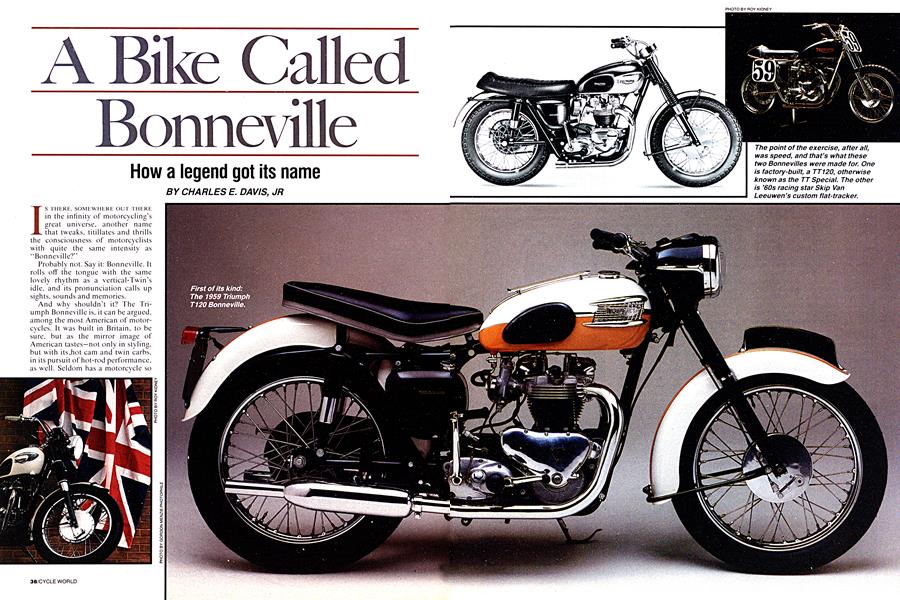
IS THERE, SOMEWHERE OUT THERE in the infinity of motorcycling's great universe, another name that tweaks, titillates and thrills the consciousness of motorcyclists with quite the same intensity as “Bonneville?”
Probably not. Say it: Bonneville. It rolls off the tongue with the same lovely rhythm as a vertical-Twin’s idle, and its pronunciation calls up sights, sounds and memories.
And why shouldn't it? The Triumph Bonneville is, it can be argued, among the most American of motorcycles. It was built in Britain, to be sure, but as the mirror image of American tastes—not only in styling, but with its.hot cam and twin carbs, in its pursuit of hot-rod performance, as well. Seldom has a motorcycle so caught the essence, the romance, of motorcycling for a generation of American riders the way the Bonneville did.
How did this wonderful amalgamation of metallurgy and charisma, hailing as it did from a small, rainsodden island, get a name associated with the vast tracts of the American desert? Was it the result of nothing more complicated than a lucky flight of fancy on the part of some doubleknit marketing type?
Jack Wilson, 64, Triumph engine builder and mechanic by trade, knows the story. Wilson has, for more than 25 years, operated Big D Cycle in—where else—Dallas, Texas. It's a shop which, for the entire span of its existence, has lured racing juggernauts like the Sirens' call lured Ulysses. If you’re going to race Triumphs, Wilson is the man to see. He has, over the years, first as a wrench and later as a rider, helped set 65 land-speed records.
The simple truth of that audacious number makes Wilson accountable for either setting or breaking more motorcycle speed records than any other person. And he did it all using Triumph motorcycle engines, mostly at that topographical oddity, not far from the Utah-Nevada state line. called the Bonneville Salt Flats. The salt flats are the venue of the Bonneville National Speed Week, held every year since 1949 during the last full week of August. Wilson’s presence on the salt has been felt most years since ’54, and the story of that presence is the story of how the Triumph T120 Bonneville got its name.
Wilson’s need for speed took a turn into the fast lane in early 1954 when he spied what looked like a I 5foot fiberglass cigar. It was, in truth, an engineless streamliner. Its builder, an airline pilot named Stormy Mangham, began talking with Wilson, and together, they dreamed that most seductive of two-wheeled dreams, the one that sees a speedo needle hovering at 200 mph.
Just one problem: Mangham’s streamliner was without power. So Wilson levered a Triumph Twin into the shell and the pair launched their effort. Mangham rode the machine, dubbed “The Texas Ceegar,’’ during Speed Week of 1954 to evaluate the shell’s aerodynamics. He found that it worked and was stable. But it was slow, so upon returning to Dallas, he had Wilson install a race motor.
Recalls Wilson, “I built a plainJane, iron-barrel Thunderbird 650cc with big carburetors running nitro and methanol. Everybody thought I had oversized pistons, but they were plain old Triumph stock size.”
Arriving on the salt with this unlikely $1000 racer in August, 1955. Wilson and Mangham, plus rider Johnny Allen, ran headlong into racing luck. As Allen began looking for speed, the 'liner’s tires—1 9-inch street rubber lifted from a Harley and used because the hull wouldn't accept 21-inch Avons built specially for the salt flats—began to chunk.
The team packed up and returned to Dallas, where its members burned up the phone lines to Triumph’s west-coast distributorship in search of proper racing rubber. Three weeks later, with the Ceegar wearing new, purpose-built, 19-inch Dunlops, Wilson and company were back on the salt fora privately organized September attempt.
Allen smoked the Ceegar to l 90 mph on his first run, but during the mandatory return run. wind blast displaced his goggles, forcing him to roll out of the throttle, which yielded a disappointing 172-mph run and a two-way average of l 8 I mph. 4 mph short of the record.
A second attempt was launched the next day. Rain had fallen that night and the salt was slick. But even worse, if the morning's overcast cleared before a run was made, the sun's heat could pull water to the surface. where it would accumulate in pools. The team went for it, and got a good two-way run at a world-record speed averaging 192.3 mph.
But there was a problem. Timing for the passes had been provided by the Southern California Timing Association, which handles all Bonneville timing. But the FIM, whose officials had returned to Europe after August's Speed Week, refused to recognize any record attempt unless an FIM observer was present. So, 192.3 miles per hour or not, the run was no record—not, at least, in the eyes of motorcycling’s international sanctioning body.
Nevertheless, the impact of the effort was considerable. Wilson, Mangham, and Allen were showered with world-wide acclaim. Allen was invited to England for a month’s exhibition. during which time he visited with Queen Elizabeth, and he and the Ceegar were displayed at the Earl’s Court motorcycle show in London. And the slow-moving machinery that would in 1959 see Triumph call its new, top-of-the-line streetbike “Bonneville” was nudged into motion.
As the winter passed and the team prepared to try again in the summer of l 956, it became clear that in addition to duplicating its feat for the FIM, it would also have to beat a renewed effort by Wilhelm Herz, the German rider sponsored by NSU. Herz had held the world record four years running in a streamlined, double-overhead-cam. 498cc Twin claiming I 10 horses. And on August 4. after l 5 days of attempts and false starts, Herz and his supercharged NSU became the first to break the 200-mph barrier, with a two-way average of 2 I l .40 mph.
When Wilson, Mangham, and Allen pulled into Bonneville, they immediately were told of Herz's record, and this. Wilson says, solidified their resolve not only to make 200. but to beat Herz. Which they did. with a run on September 6, 1956. achieving a 2l4.40-mph average on two SCTAtimed runs. But once again, their run followed the official close of Speed Week, once again the FIM was not in attendance, and once again, after six months of shilly-shallying, it declined to recognize the Texans' record speed.
With that, Wilson and Mangham turned their backs on the FIM and concentrated instead on AMA speed records. “We didn't attempt the FIM record again; the AMA record was worth as much. Besides, the FIM had screwed us around so much, we didn't want to mess with them," says Wilson. In 1958. this time with racerand-future-journalist Jess Thomas as pilot, the team set U.S. records for streamlined, normally aspirated engines running fuel —212.28 mph in the 500cc class, 214.47 mph in the 650cc class. The 500cc record still stands.
Allen would man the controls again in 1959, but suffered a horrific, 200-mph crash, luckily sustaining only minor injuries, though the Ceegar’s days on the salt were over. Restored, it is now on display in Britain’s National Motorcycle Museum.
But that wasn’t the last time a Triumph would thunder at Bonneville.
In l 962, in fact, another team did set an FIM-recognized world record, when Bill Johnson rode a T120powered ’liner to 224.57 mph. And Bob Leppan’s Gyronaut X-l, running two Triumph 650s, would streak to 245.60 mph in 1966, though at 1300cc, it was beyond the FIM’s lOOOcc limit. Jack Wilson, meanwhile, had moved on. Building dragbikes and roadracing Triumph Twins and Triples became his passion, so that’s what he did for the next two decades. These days, though, Wilson once again is thinking salt, and with rider Jon Minonno and a partially streamlined Triumph, last summer he headed for Bonneville in hopes of regaining a record.
His new machine is powered by an 860cc Trident Triple—an underdog running in a class designed for lOOOcc engines. It uses an electronic ignition system specially built from automotive components; Hilborn mechanical fuel injection; and twin turbochargers. This all came together in what Ed Mabry, who built the injection system and the bike's chassis, described, somewhat optimistically, as “the fastest motorcycle a man can throw his foot around.” The target was to exceed 232 mph, the record in the non-streamlined class. Mabry,
believing the team could find the speed it needed, said, “Unofficially, we’ve gone 210 mph, and we think 250 mph is achievable."
It was not to be, with Wilson describing his l 990 return to the salt as, “Sad. It was a bunch of little things that all added up to a big zero. We’ve got the capability. We’d be indicating over 200, and some little thing would happen" to force the team to abort the run.
But while his bikes go faster and faster in spite of niggling problems, Wilson himself is being forced to slow a bit as the result of illness and inexorable, unstoppable passage of time. He’s now looking for a buyer for Big D Cycle—someone, he hopes, who will continue the shop’s tradition of competition.
But whatever happens to his shop, Wilson’s pending retirement won’t erase his contributions to the sport. And that, in a bitter-sweet, almost poetic w’ay, seems fitting. 7'he Triumph Bonneville, after all, was “retired" years back. Yet its reality may, in fact, be superseded by its legend. It
is, after all, the bike a generation of Americans rode, or aspired to ride. Jack Wilson was an integral part of that legend, and he’ll remain a part of
it, retired or not. 0