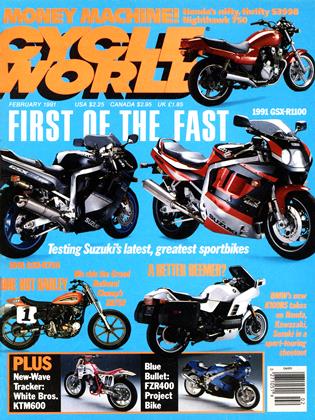
1991 Suzuki Gsx-R750 & 1100
1991 Suzuki GSX-R750 & 1100
CW DUAL TEST
The same, only different
PROGRESS ISN'T ALWAYS MEASURED IN LEAFS AND bounds. Sometimes, subtle refinements are as effective as sweeping change. Renovation, as opposed to innovation.
Not that the Suzuki GSX-R750 and 1100 needed many changes. Since 1986. when the original GSX-R ushered in a new era of sportbike design. Suzuki’s repli-racers have been among the best money can buy, winners on the sales floor as well as the racetrack. Why mess w ith success?
So for 1991. the Japanese manufacturer opted to put a leash on its design team and refine the existing GSX-Rs.
However, refinement did not come where it w'as most expected: in the engine-cooling department. That’s right, don't stock up on Prestone yet. as the dohc. inline-Four GSX-Rs are still air-and-oil-cooled. Surprising, considering the rampant rumors that hinted otherwise, and considering the drubbing Suzuki has taken in World Superbike competition, where race-team mechanics have identified heat as the GSX-R's number-one enemy. But in view of the fact that Suzuki does have a liquid-cooled sportbike—in the form of the domestic-market GSXR400—the changeover is probably inevitable.
T his does not mean, however, that the GSX-R750 and 1 100's motors have been left alone. Perish the thought. The cylinder heads of both have been refined in more ways than one.
Firstly, a new, lighter-weight valve train employing one cam lobe and one rocker arm per valve has replaced the
previous arrangement whereby one cam lobe operated two valves via a forked rocker. Valve lash is now set by a shim atop the valve-spring retainer, rather than by a threaded adjuster. The new' rockers are spring-loaded on their shafts, and can be slid out of the way to speed shim selection. Ducati Paso-style. Surprisingly, maintenance intervals are unchanged at 3500 miles.
Secondly, the 750’s intake and exhaust tracts, and the 1 100's intake tracts, are now ported by hand. The rib dividing each port has been lengthened and gradually tapered, and the area above each valve seat has been smoothly blended into the port to improve gas-flow velocity and cylinder charging and scavenging.
The valve stems and valve guides have been lengthened slightly to accommodate the new actuation system, but the diameter of each valve face remains the same. Valve timing is also mostly unchanged, with the exception being some minor juggling of the 750's intake timing. High-rpm valve control has also been improved on the 750 by the use of the 1 100’s stifler valve springs.
Suzuki doesn't claim any increase in horsepower resulting from the cylinder-head revisions, but maintains that both the 750 and 1 100 engines now make peak power longer. After riding the new bikes, that claim would seem to be a valid one.
Starting the l l 00 is easier this year, thanks to the addition of a cable-actuated choke. Not only is the choke lever’s new position on the left handlebar more convenient, its range of motion allows the operator to modulate idle speed during warm-up. This is next to impossible with the carburetor-mounted knob on the 750 (formerly used on the l 100), whose two positions leave the engine either singing or stumbling. Both bikes are extremely coldblooded. requiring the choke to be used for long minutes on cool mornings.
Once underway, both GSX-Rs feel pretty much as they did last year. The 750’s engine tingles, the l 100’s buzzes, particularly while cruising in the lower portion of the rev range or under trailing throttle. They do seem to pull longer on top. rather than peaking and dropping off suddenly as they did in the past, and the resultant impression is that the ’91 models’ motors are stronger than their predecessors.
That impression, however, is squashed by the reality of the dragstrip. The '9 l -model 750 blazed through the quarter-mile in exactly the same time as the '90 model, with a trap speed less than two-tenths of l mph faster. The ’91 l 100, meanwhile, was marginallv slower than its ’90 counterpart—attributable more to changing weather and track conditions than to any real difference in performance.
Tenths of a second aren’t as noticeable on the street, and there, both bikes feel plenty fast. The l 100, with its gobs of mid-range torque, is easier to keep on the boil than the rev-happy 750, and the fact that the l 100 has one less cog in its gearbox doesn’t hurt it in the least.
The l 100 is a tad more comfortable, too. with its slightly higher, rubber-mounted handlebars and rubbercovered footpegs providing better ergonomics and a measure of vibration damping. The 750's lower clip-ons and metal footpegs are brutally race-worthy. New, wider seats on both bikes are more supportive than before, and, as in the past, an optional solo-seat cowling is available to replace the passenger’s perch.
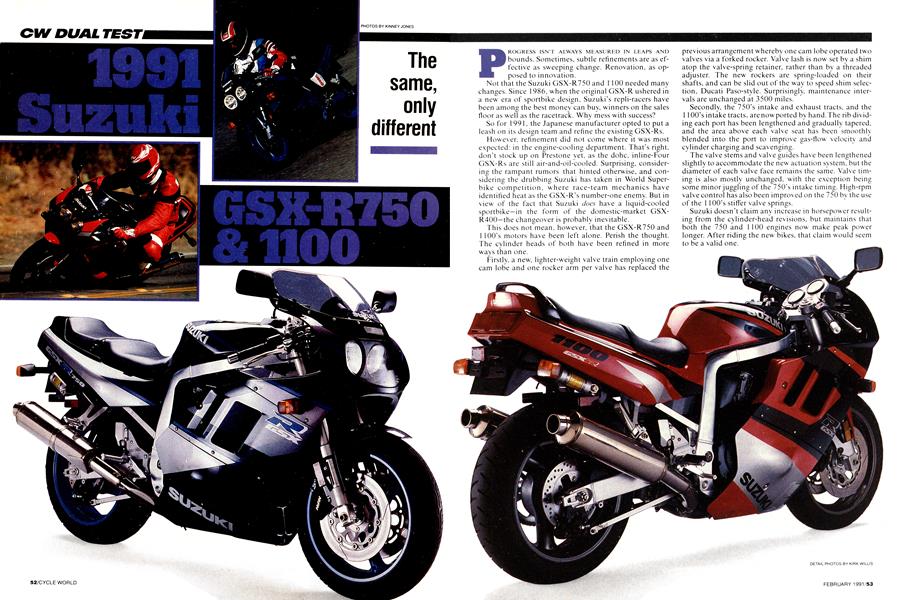
A more aerodynamic fairing design features a slanted nose and flush-mounted headlight cover for a smaller frontal area and less lift, while a slimmer tail section and attractive twin taiilights grace the rear. Suzuki claims a 2.3-percent reduction in drag on the 750 and a 3.5-percent reduction on the ll00, improvements which no doubt
aided the bikes in reaching their top speeds of l 6 l and l 54 mph, respectively, each figure 2 mph better than the speeds posted by last year's models.
One revision to this year’s GSX-Rs that was not only expected, but highly anticipated, was the move to inverted forks. Last year, GSX-Rs sold abroad were thus fitted, but U.S. models retained cost-saving traditional telescopies. This year, Suzuki decided to let us have the latest in frontsuspension technology, as well.
Once again, Suzuki is mixing suspension suppliers on
the GSX-Rs. The 750 employs Showa units front and rear, while the l 100 uses Rayaba. Both forks, with 4lmm sliders, feature externally adjustable compression and rebound damping, and spring preload, but the 750's has a wider range of damping selections.
While we didn’t notice any dramatic improvement in ride quality over last year’s forks, we did feel the additional rigidity resulting from the increased overlap of the inverted units, particularly under heavy braking. This, coupled with the excellent new Dunlop D202 Sport Radiais, allowed both bikes to register marked improvements during our brake-testing—though both keep the same Nissin four-piston calipers they used last year. Compared to the ’90 model, the ’91 750 reduced its 30-mph stopping
distance from 26 to 22 feet, and its 60-mph distance from 124 to 101 feet. The `91 1100 also improved on its `90 counterpart's numbers. cutting its 30-mph stopping dis tance from 28 to 22 feet. and its 60-mph distance from 132 to 105 feet. Okay. so braking is excellent. How about handling? Both bikes steer much as they did before, quickly and lightly, with a hit of extra confidence thanks to the feed back from the rigid inverted forks. Rapid transitions are now even quicker. as the leverage expended by the rider on the handlebars isn't wasted tweaking the fork legs. As noted, the 750 and 1100 differ in the rear-suspen sion department. Both shocks feature externally adjust able compression and rebound damping. but the 750's Showa unit features a threaded spring-preload collar, while the 11 00's Kayaba features a seven-position, ramptype adjustment. Though the 1100's shock exhibits excellent damping characteristics, its spring rate is too soft. Even at maximum preload, the rear end sags severely, which sometimes causes the front end to wag while exiting corners under power-thank goodness for the steering damper. which has been standard on the 1100 and is now included on the 750, as well. The 750's shock is just the opposite of the 1100's: Its spring rate does a good job of keeping the bike's precious parts off the pavement, but it needs a wider range of re bound-damping adjustment. Four clicks (as opposed to the 1100's 19) just aren't enough.
Given all their improvements, one would imagine that the price of these two hikes would go through the roof, but Suzuki has been able to keep the situation pretty much under control. Sticker on the GSX-R750 has risen just $300. from $6199 to $6499, while the GSX-Rl 100 has gone up an equal amount, from $6999 to $7299. Priced a set of inverted forks lately? A comparison between the two GSX-Rs is inevitable, if not entirely appropriate. On the racetrack, the 750 clearly excels, thanks to the nimbleness afforded by its more raceready riding position and lighter weight. In fact, during Suzuki's press introduction at Road Atlanta, test riders aboard 750s could usually put more distance on 1100 pi lots in the curves than the bigger bikes could make up down the long hack straight. And it was not uncommon to see a 750 tucked comfortably in the draft of an 1100, nearly equaling its speed. On the street, the GSX-R 11 00 is superior, by virtue of its less-offensive riding position and mule-train motor. In many street-riding situations, the 11 00 can be left in what ever gear it happens to be in, and its flexible powerband will let it just plug away. But between the extremes of racing and street riding lies the No Man's Land of radical sport riding, wherein the nimbleness of the GSX-R750 and the speed of the GSX R 11 00 each have a place. Which is for you? That depends on who you are, and what you expect from a motorcycle. If your concept of motorcycling includes tilting the hori zon to near-vertical angles while testing the absolute limits of rubber's adhesion to tarmac, the 750 is your mount. If you enjoy rushing past telephone poles as if they were a picket fence, while basking in one of the most torque-rich powerbands the sport has to offer, the 1100 is the bike you want. How the Suzuki GSX-Rs compare to each other is mostly academic, though. How they'll fare against their competition-notably the high-tech Kawasaki ZXR75O or inverted-fork Yamaha FZR 1000-is a question that will remain unanswered until comparison tests can be con ducted. Watch this space. What we do know is that the GSX-R750 and GSX R 1100, five years ago harbingers of a new era in sporting motorcycles, refined and renovated for 1991, continue to be pretty good marks to shoot for.
WK SUZUKI GSX-R750
SPECIFICATIONS
GENERAL
SUSPENSION/TIRES
List price
$6499
Importer American Suzuki Motor Corp. 3251 E. Imperial Hwy. Brea, CA 92621 Customer service phone 714/996-7040x380
Warranty 12 mo./unlimited mi. ENGINE & DRIVETRAIN Engine air-and-oil-cooled, four-stroke inline-Four Bore x stroke 70.0 x 48.7mm Displacement 749cc Compression ratio 10.0:1 Claimed power na Claimed torque na Valve train dohc, four valves per cylinder, shim adjustment Valve adjustment intervals 3500 mi. Carburetion (4) 38mm Mikuni Oil capacity 5.4 qt. Electrical power 300w Battery 12v, 14ah CHASSIS Weight: Tank empty Tank full 484 lb. 514 lb. Fuel capacity 5.0 gal. Wheelbase 55.6 in. Rake/trail 25.573.9 in. Seat height 31.3 in. Ground clearance 5.3 in. GVWR 900 lb. Load capacity (tank full) 386 lb.
Front suspension: Manufacturer Showa
Tube diameter 41 mm
Claimed wheel travel 4.7 in. Adjustments compression and rebound damping, _spring preload
Rear suspension:
Manufacturer Showa
Type single shock
Claimed wheel travel 5.5 in. Adjustments compression and rebound damping, spring preload
Tires:
Front
Rear
120/70 ZR 17 Dunlop D202F 170/60 ZR 17 Dunlop D202
PERFORMANCE
Time to distance:
1/4 mi. 10.92 sec.
@ 125.69 mph
Time to speed, sec. 0-30 mph 0-60 mph 0-90 mph 0-100 mph 1.2 2.8 5,7 7.1 Top gear time to speed, sec. 40-60 mph 4.2 60-80 mph 4.7 Measured top speed 154 mph Engine speed at 60 mph 4529 rpm FUEL MILEAGE High/low/avg. 39/34/36 mpg Avg. range inc. reserve 180 mi. BRAKING DISTANCE from 30 mph 22 ft. from 60 mph 101 ft. SPEEDOMETER ERROR 30 mph indicated 30 mph 60 mph indicated 60 mph
SUZUKI GSX-R1100
SPECIFICATIONS
GENERAL List price $7299 Importer American Suzuki Motor Corp. 3251 E. Imperial Hwy. Brea, CA 92621 Customer service phone 714/996-7040x380 Warranty 12 mo./unlimited mi. ENGINE & DRIVETRAIN Engine air-and-oil-cooled, four-stroke inline-Four Bore x stroke 78.0 x 59.0mm Displacement 1127cc Compression ratio 10.0:1 Claimed power na Claimed torque na Valve train dohc, four valves per cylinder, shim adjustment Valve adjustment intervals 3500 mi. Carburetion (4) 36mm Mikuni Oil capacity 5.4 qt. Electrical power 300w Battery 12v, 14ah CHASSIS Weight: Tank empty Tank full 526 lb. 555 lb. Fuel capacity 4.9 gal. Wheelbase 57.7 in. Rake/trail 25.873.6 in. Seat height 31.3 in. Ground clearance 4.9 in. GVWR 940 lb. Load capacity (tank full)385 lb.
$7299
American Suzuki Motor Corp.
SUSPENSION/TIRES
Front suspension: Manufacturer KYB
Tube diameter 41mm
Claimed wheel travel 4.7 in. Adjustments compression and rebound damping, _spring preload
Rear suspension:
Manufacturer KYB
Type single shock
Claimed wheel travel 6.2 in. Adjustments compression and rebound damping, spring preload
Tires:
Front
Rear
120/70 ZR17 Duniop D202F 180/55 ZR17 Dunlop D202
PERFORMANCE
Time to distance: 1/4 mi. 10.62 sec. @ 131.77 mph Time to speed, sec. 0-30 mph 1.2 0-60 mph 2.8 0-90 mph 5.2 0-100 mph 6.5 Top gear time to speed, sec. 40-60 mph 3.4 60-80 mph 3.1 Measured top speed 161 mph Engine speed at 60 mph 3792 rpm FUEL MILEAGE High/low/avg. 37/33/35 mpg Avg. range inc. reserve 172 mi. BRAKING DISTANCE from 30 mph 22 ft. from 60 mph 105 ft. SPEEDOMETER ERROR 30 mph indicated 30 mph 60 mph indicated 59 mph