An Improved Zx-10
AN IMPROVED ZX-10
CW PROJECT
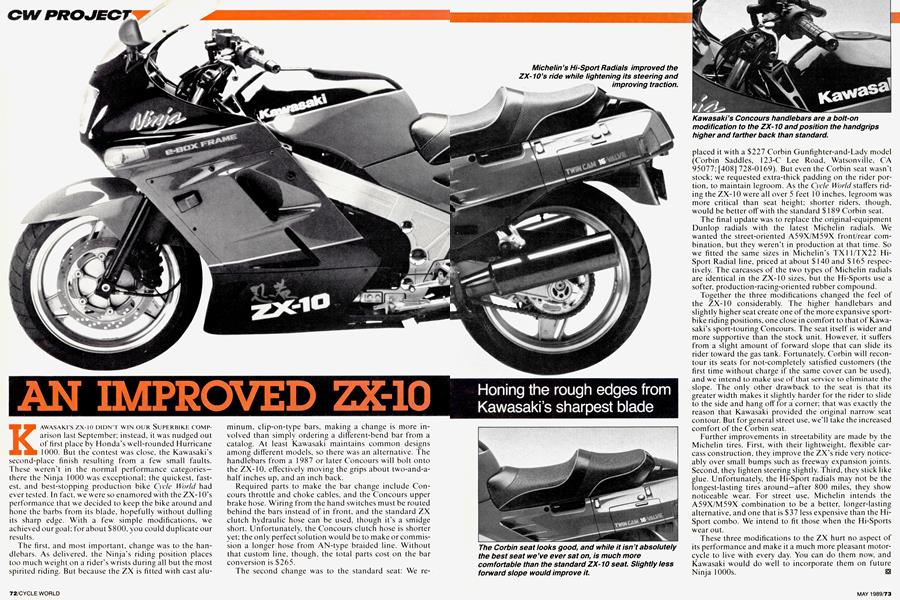
KAWASAKI’S ZX-10 DIDN’T WIN OUR SUPERBIKE COMParison last September; instead, it was nudged out of first place by Honda's well-rounded Hurricane 1000. But the contest was close, the Kawasaki's second-place finish resulting from a few small faults. These weren't in the normal performance categories— there the Ninja 1000 was exceptional; the quickest, fastest, and best-stopping production bike Cycle World had ever tested. In fact, we were so enamored with the ZX-10’s performance that we decided to keep the bike around and hone the barbs from its blade, hopefully without dulling its sharp edge. With a few simple modifications, we achieved our goal; for about $800, you could duplicate our results.
The first, and most important, change was to the handlebars. As delivered, the Ninja’s riding position places too much weight on a rider's w rists during all but the most spirited riding. But because the ZX is fitted with cast aluminum. clip-on-type bars, making a change is more involved than simply ordering a difierent-bend bar from a catalog. At least Kawasaki maintains common designs among different models, so there was an alternative. The handlebars from a 1987 or later Concours will bolt onto the ZX-10. effectively moving the grips about two-and-ahalf inches up. and an inch back.
Required parts to make the bar change include Concours throttle and choke cables, and the Concours upper brake hose. Wiring from the hand switches must be routed behind the bars instead of in front, and the standard ZX clutch hydraulic hose can be used, though it’s a smidge short. Unfortunately, the Concours clutch hose is shorter yet; the only perfect solution would be to make or commission a longer hose from AN-type braided line. Without that custom line, though, the total parts cost on the bar conversion is $265.
The second change was to the standard seat: We replaced it with a $227 Corbin Gunfighter-and-Lady model (Corbin Saddles, 123-C Lee Road, Watsonville, CA 95077; [408] 728-0169). But even the Corbin seat wasn't stock; we requested extra-thick padding on the rider portion, to maintain legroom. As the Cycle World staffers riding the ZX-IO were all over 5 feet 10 inches, legroom was more critical than seat height; shorter riders, though, would be better off with the standard $ l 89 Corbin seat.
Honing the rough edges from Kawasaki's sharpest blade
The final update was to replace the original-equipment Dunlop radiais with the latest Michelin radiais. We wanted the street-oriented A59X/M59X front/rear combination, but they weren't in production at that time. So we fitted the same sizes in Michelin’s TX11/TX22 HiSport Radial line, priced at about $ 140 and $ 165 respectively. The carcasses of the two types of Michelin radiais are identical in the ZX-IO sizes, but the Hi-Sports use a softer, production-racing-oriented rubber compound.
Together the three modifications changed the feel of the ZX-IO considerably. The higher handlebars and slightly higher seat create one of the more expansive sportbike riding positions, one close in comfort to that of Kawasaki’s sport-touring Concours. The seat itself is wider and more supportive than the stock unit. However, it suffers from a slight amount of forward slope that can slide its rider toward the gas tank. Fortunately, Corbin will recontour its seats for not-completely satisfied customers (the first time without charge if the same cover can be used), and we intend to make use of that service to eliminate the slope. The only other drawback to the seat is that its greater width makes it slightly harder for the rider to slide to the side and hang off for a corner; that was exactly the reason that Kawasaki provided the original narrow seat contour. But for general street use, we’ll take the increased comfort of the Corbin seat.
Further improvements in streetability are made by the Michelin tires. First, with their lightweight, flexible carcass construction, they improve the ZX’s ride very noticeably over small bumps such as freeway expansion joints. Second, they lighten steering slightly. Third, they stick like glue. Unfortunately, the Hi-Sport radiais may not be the longest-lasting tires around—after 800 miles, they show noticeable wear. For street use, Michelin intends the A59X/M59X combination to be a better, longer-lasting alternative, and one that is $37 less expensive than the HiSport combo. We intend to fit those when the Hi-Sports wear out.
These three modifications to the ZX hurt no aspect of its performance and make it a much more pleasant motorcycle to live with every day. You can do them now, and Kawasaki would do well to incorporate them on future Ninja 1000s.