Race Watch
RACE WATCH
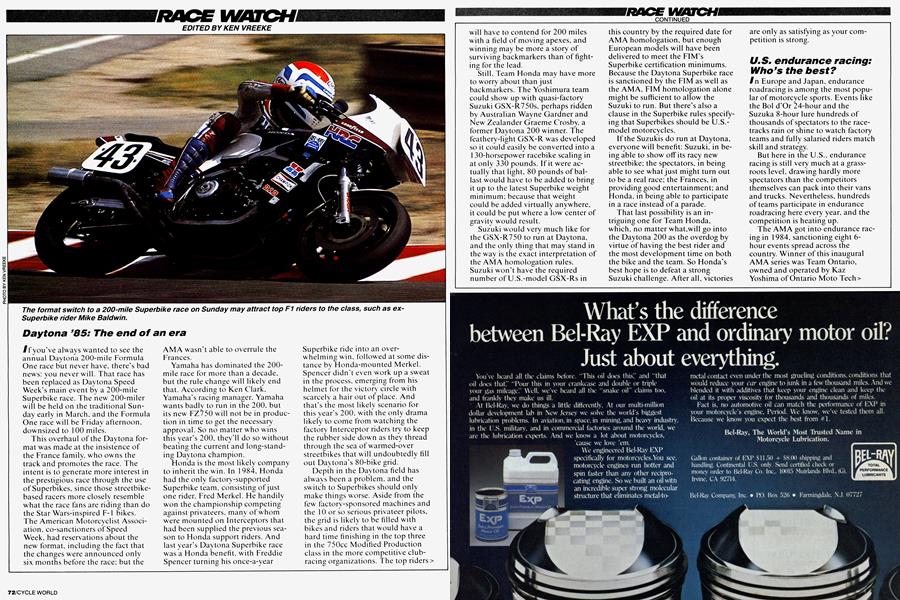
Daytona `85: The end of an era
KEN VREEKE
If you've always wanted to see the annual Daytona 200-mile Formula One race but never have, there's bad news: you never will. That race has been replaced as Daytona Speed Week's main event by a 200-mile Superbike race. The new 200-miler will be held on the traditional Sunday early in March, and the Formula One race will be Friday afternoon. downsized to 100 miles.
This overhaul of the Daytona for mat was made at the insistence of the France family, who owns the track and promotes the race. The intent is to generate more interest in the prestigious race through the use ofSuperbikes. since those streetbike based racers more closely resemble what the race fans are riding than do the Star Wars-inspired FI bikes. The American Motorcyclist Associ ation. co-sanctioners of Speed Week, had reservations about the new format, including the fact that the changes were announced only six months before the race: but the AMA wasn~t able to overrule the Frances.
Yamaha has dominated the 200mile race for more than a decade, but the rule change will likely end that. According to Ken Clark, Yamaha's racing manager. Yamaha wants badly to run in the 200, but its new FZ750 will not be in produc tion in time to get the necessary approval. So no matter who wins this year's 200, they'll do so without beating the current and long-stand ing Daytona champion.
`i-Ion~Ja is the most likely company to inherit the win. In 1984, Honda had the only factory-supported Superbike team, consisting ofjust one rider. Fred Merkel. He handily won the championship competing against privateers. many of whom were mounted on Interceptors that had been supplied the previous sea son to Honda support riders. And last year's Daytona Superbike race was a Honda benefit, with Freddie Spencer turning his once-a-year Superbike ride into an over-
wh~elming win, followed at some dis tance by Honda-mounted Merkel. Spencer didn't even work up a sweat in the process. emerging from his helmet for the victory' circle with scarcely a hair out of place. And that's the most likely scenario for this year's 200. with the only drama likely to come from watching the factory Interceptor riders try to keep the rubber side down as they thread through the sea of warmed-over streetbikes that will undoubtedly fill out Daytona's 80-bike grid.
Depth in the Dayton'~t field has always been a problem. and the switch to Superbikes should only make things worse. Aside from the few factory-sponsored machines and the 1 0 or so serious privateer pilots, the grid is likely to be filled with bikes and riders that would have a hard time finishing in the top three in the 7 50cc Modified Production class in the more competitive club racing organizations. The top riders> will have to contend for 200 miles with a field of moving apexes. and winning may be more a story of surviving backmarkers than of fight ing for the lead.
Still, Team Honda may have more to worry about than just backmarkers. The Yoshimura team could show up with quasi-factory Suzuki GSX-R750s, perhaps ridden by Australian Wayne Gardner and New Zealander Graeme Crosby, a former Daytona 200 winner. The feathery-light GSX-R was developed so it could easily be converted into a I 30-horsepower racebike scaling in at only 330 pounds. If it were ac tually that light, 80 pounds of bal last would have to be added to bring it up to the latest Superbike weight minimum: because that weight could be added virtually anywhere, it could be put where a low center of gravity would result.
Sui'uki would very much like for the GSX-R750 to run at Daytona, and the only thing that may stand in the way is the exact interpretation of the AMA homologation rules. Suzuki won't have the required number of U.S.-model GSX-Rs in this country by the required date for AMA homologation, but enough European models will have been delivered to meet the FIM's Superbike certification minimums. Because the Daytona Superbike race is sanctioned by the FIM as well as the AMA, FIM homologation alone might be sufficient to allow the Suzuki to run. But there's also a clause in the Superbike rules specify ing that Superbikes should be U.S. model motorcycles.
If the Suzukis do run at Daytona, everyone will benefit: Suzuki, in be ing able to show off its racy new streetbike: the spectators, in being able to see what just might turn out to be a real race; the Frances, in providing good entertainment; and Honda, in being able to participate in a race instead of a parade.
That last possibility is an in triguing one for Team Honda, which, no matter what,will go into the Daytona 200 as the overdog by virtue of having the best rider and the most development time on both the bike and the team. So Honda's best hope is to defeat a strong Suzuki challenge. After all, victories are only as satisfying as your com petition is strong.
U.S. endurance racing: Who's the best?
in Europe and Japan. endurance roadracing is among the most popu lar of motorcycle sports. Events like the Bol d'Or 24-hour and the Suzuka 8-hour lure hundreds of thousands of spectators to the race tracks rain or shine to watch factory teams and fully salaried riders match ski!! and strategy.
But here in the U.S., endurance racing is still very much at a grass roots level, drawing hardly more spectators than the competitors themselves can pack into their vans and trucks. Nevertheless, hundreds of teams participate in endurance roadracing here every year. and the competition is heating up.
The AMA got into endurance rac ing in 1984, sanctioning eight 6hour events spread across the country. Winner of this inaugural AMA series was Team Ontario, owned and operated by Kaz Yoshima of Ontario Moto Tech> fame. Team riders Lynn Miller and John Ashmead notched four overall wins and two point-paying finishes to beat Team Moto Guzzi for the overall title, making them this coun try's first AMA national endurance racing champions.
That title alone, however, isn't enough to lay claim to being the best endurance team in the nation. You see, there's another, non-AM Asanctioned endurance series, this one run by the Western Eastern Roadracing Association. Team Hammer, consisting mainly of Russ Paulk and John Ulrich, chose not to enter their 11 36cc Prototype-class Suzuki GP bike in the AMA series, but instead turned their attention to the more-established WERA series. They won five of the 11 races, to take the title in front of Team Quester/Sullivan.
Though we know not what 1985 will hold for U.S. endurance racing, it would be nice to see a con solida tion of the WERA and AMA series so that Teams Hammer and Ontario, unarguably the best endurance rac ing teams in this country. could race head-to-head to decide a single championship. Only twice in 1 984 did the two teams meet, with the scorecard reading Hammer I, On tario 1. Hardly conclusive evidence.
Still, with two separate series, that's about as close as we can get to answering the who's-the-best question.