All Hail the Red, White And Blue
All Hail The Red, White And Blue
KEN VREEKE
RACE WATCH
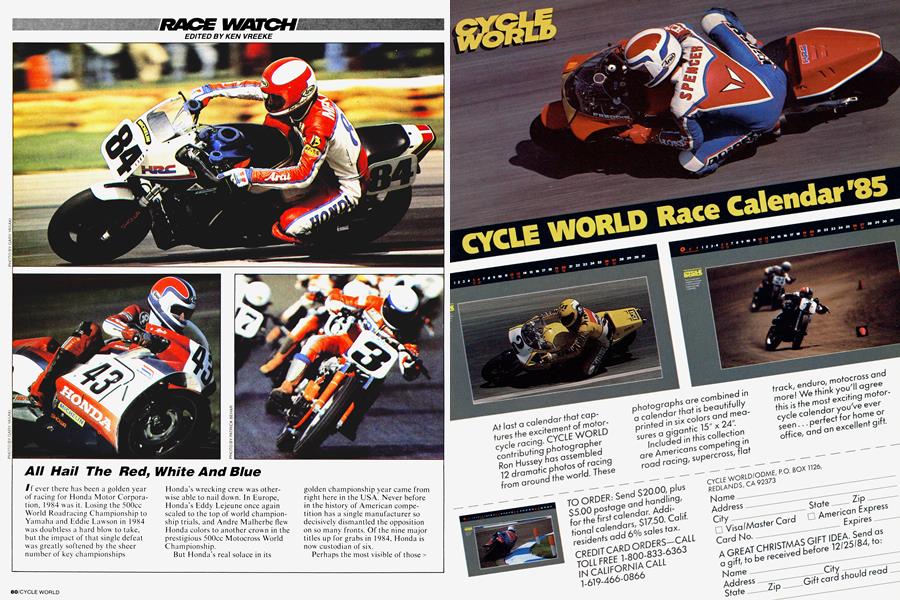
If ever there has been a golden year of racing for Honda Motor Corporation, 1984 was it. Losing the 500cc World Roadracing Championship to Yamaha and Eddie Lawson in 1984 was doubtless a hard blow to take, but the impact of that single defeat was greatly softened by the sheer number of key championships Honda’s wrecking crew was otherwise able to nail down. In Europe, Honda's Eddy Lejeune once again scaled to the top of world championship trials, and Andre Malherbe flew Honda colors to another crown in the prestigious 500cc Motocross World Championship.
But Honda’s real solace in its golden championship year came from right here in the USA. Never before in the history of American competition has a single manufacturer so decisively dismantled the opposition on so many fronts. Of the nine major titles up for grabs in 1984, Honda is now custodian of six.
Perhaps the most visible of those > titles was Insport’s crowd-pleasing Supercross championship, where Team Honda rider Johnny O'Mara double-jumped his way to the series title, leading the 1 5race championship from its inception. At season’s end, he had a 53point advantage over second-place Rick Johnson. O'Mara’s Honda teammate David Bailey was all set to wrap up the series’ second-place trophy but an uncharacteristically poor placing in the season’s last race let Yamaha’s Johnson squeak by. No one at Honda really minded, though, because weeks earlier Bailey had decimated the competition to clinch the 500cc National Motocross Championship. Bailey also added to Honda’s win total by taking the AMA’s Grand National Motocross Championship a combination of points from the outdoor nationals and the AMA’s two Supercross races.
On the asphalt circuit, it was Freddie Spencer who set the pattern of Honda domination in the opening round of the Superbike championship. At Daytona, Spencer outrode and outclassed the field before departing for the 500cc wars in Europe. Honda’s superb and durable Interceptors subsequently won an incredible 1 1 out of 12 events, with Fred Merkel, the newly crowned champ, scoring nine wins, and Honda support rider Sam McDonald taking his first Superbike win at Loudon. Honda's only real opposition came from Wes Cooley and his GS750 Suzuki. With only paltry support from Yoshimura, Cooley was relegated to putting in fast but sporadic appearances. He finished second at the Riverside National, then was disqualified after apparently winning at Laguna Seca because his machine failed to meet minimum weight requirements. Barely a month later, Cooley scored a victory at Sears Point after a pitched battle that ended with Merkel tumbling headlong toward pins and plaster.
In Formula One, Honda’s only factory entrant, two-time champ Mike Baldwin, dished out unsavory chunks of humble pie to privateer hopefuls all season. He won five of the eight F-l events and lapped the entire field at Loudon on his RS500 V-Three en route to a third consecutive title. Only The King himself, Yamaha’s Kenny Roberts, was able to sever Baldwin’s streak with wins at both Daytona and Laguna Seca, his only two U.S. appearances. At MidOhio, Baldwin was done in by a treacherous combination of rain and oil on the racetrack, but Honda still was represented in victory circle by Bubba Shobert, the first dirt-tracker to win a Grand National roadrace since Kenny Roberts did it back in 1977. The hard-charging Shobert had been locked in combat for the Grand National Championship with Honda teammate Ricky Graham, despite a mid-season, six-race suspension for belting Terry Poovey in the eye; and Shobert’s surprising MidOhio win on an Interceptor-based F1 bike brought his season victory total to six and rocketed him into contention for the GNC title.
Honda’s performance on American dirt tracks in 1984 was stunning. Of the 25 dirt-track events on the ’84 calendar, more than half were won by Honda riders. Honda’s RS750, reported to out-horsepower the mighty XR750 Harleys by as much as 10 percent, delivered a groin-shot > to Team Harley from which it will not soon recover by plundering H-D’s once-private sanctuary: the Mile. Of the 1 1 events held on mile tracks, only three were won by Harleys, and two of those were won not by the factory riders, but by privateer Hank Scott. Harley teamster Randy Goss, a title favorite until a broken leg sidelined him for the season at the San Jose Mile in the fall, inherited the win at Hagerstown when Shobert was disqualified. Still, Graham and Shobert took the lion’s share of mile wins with a total of seven (three and four, respectively) and headed into the final showdown at the Springfield Mile, each with a championship hope in his heart and a guaranteed title for Honda in his hands.
In true Grand National tradition, everything that was supposed to happen didn’t. Graham, the heavy point favorite, crashed hard and broke his hand in the closing laps at Springfield while dueling with Shobert and Ted Boody. But Graham, the consummate dirt-track hero, wasn't about to lie in the dust and watch a season’s worth of ragged-edge racing go to waste. He scrambled to his feet with two laps remaining, and in a game effort to snag a few precious series points, rode out the race in 1 3th place. As it turned out, that finishing position, coupled with the fact that Honda privateer Boody nipped past Shobert on the final straightaway to take the win, gave Graham the championship.
Graham, broken and battered but elated to his toes nonetheless, called home to tell his mom he had rounded out a near-perfect season for Honda by winning America’s most prestigious championship by a single point.
Gameplan '85: Honda's backdoor encore
Honda’s unquestionable dominance of American racing was the culmination of a great deal of effort expended and money spent. It also has been the source of tremendous controversy. Accusations of winning by default in the absence of participation by any other factory have been leveled at Honda throughout the past year. And while that may be true in the case of Superbike and Formula-One racing, it is also true that Honda is the only factory supplying privateers with competitive equipment in the form of VF750 Superbike engines and complete RS500 GP bikes.
Besides, in Camel Pro dirttracking, Honda and HarleyDavidson certainly began the season on equal footing. But Honda discovered long ago that horsepower alone does not win races on the slippery dirt-tracks of America, where all the money in the world can’t buy a winning combination. Instead, Honda’s dirt-track advantage came through the continued refinement of its machines, a progressive and, ultimately, successful search for that elusive combination of power and tractability that has long been the sole property of Harley-Davidson. Honda’s search was confounded by the fact that the company hadn’t been at the dirt-track game very long, and by the further complication of trying to strike that precarious balance with an engine designed in Japan and a chassis developed and tested exclusively on the dirt tracks of America.
But it worked. And now, in fiattracking as well as practically all other forms of American racing, Honda has to deal with the fact that its greatest competition comes from within. Motocross programs and Harley-Davidson notwithstanding, Honda has nobody to race with in the U.S. And a recent change in upper management at Honda’s central headquarters in Japan has brought the realization of the problem to a new high. Honda has now won everything it set out to win in the U.S., and to continue to race at its current level of involvement would only create more controversy and illwill. So, predictably, 1985 will bring about drastic racing cutbacks in the Honda camp.
Though specifics have not yet been announced, Honda will streamline its factory racing effort across the board. But while factory slots will decrease in number, new support programs will be started, existing ones will be expanded, contingency programs will be fattened up, and technical advisors will be dispatched to assist the support riders. In motocross, Honda plans to cut its first-string team from the current six riders to four. In roadracing, Honda will have only one factory entrant, Fred Merkel, who will defend his Superbike title, but Honda will continue to supply privateers with the $8500 VF750 engines. >
In Formula One, there should be more RS500s available at $27,500 a pop. Since there will be no factory F1 team in 1985, Mike Baldwin’s future seems uncertain though Honda is negotiating an open-door support policy with Baldwin, should he decide to continue in F-l or seek new horizons. Honda also plans to take delivery of at least ten RS250 roadracers prior to Daytona, which will be sold, for approximatly $7000 per unit, to qualified privateers.
In Camel Pro, Shobert and Graham will likely return with full factory backing, but the purse strings may tighten around the second-level team of tuner Jerry Griffiths and rider Doug Chandler. Honda’s big news to the rest of the dirt-tracking world is that the RS750 V-Twin engine will be available in greater numbers at $8500 each, and that a 500cc short-track Single will be offered at only $2295. The 500 features a special single-port intake in a sand-cast cylinder head similar to that used by Honda’s hired guns in 1984, and the engine will come complete with a spare 600cc top-end for TT racing.
If Honda’s restructured U.S.racing program was indeed initiated by upper management, it is possible that similar measures will be taken in Europe, with one notable exception. The inside word is that Fast Freddie Spencer will not only compete in the 500 world championship, but also in the 250 chase on Honda’s new RS250.
Though Honda has issued no official statement, it is likely that the company’s U.S. program reflects its worldwide racing concerns. The thrust of Honda’s recent racing programs was, in part, to expand the worldwide sportbike market; and, judging by the radical production machinery offered by all Japanese manufacturers, Honda must view that venture as a success. Cutting back on its massive racing programs while stepping up privateer support might be Honda’s first step toward restoring the balance lost when the other factories either shrunk their racing efforts or disbanded them altogether.
It is a balance that racing desperately needs, and Honda’s move is in the right direction. It has opened the door to the other factories and shifted the battle from the boardrooms of Japan back to the racetracks where it belongs. E3