Doing More With Less
DOING MORE WITH LESS
CYCLE WORLD TEST: KAWASAK1 NINJA 900
port bikes have been getting faster and bigger; 900s and 1 000s becoming 1 lOOs, 1 lOOs becom ing 11 50s; all the time gaining
length to accommodate single-shock rear suspensions and weight from the addition of fairings and tail sections and framework supports demanded by current road-racing fashion.
Into this comes the 908cc Kawasaki Ninja, a high performance street bike named for a secretive, powerful, ruthless cult of hired assassins. Japanese history tells us Ninja were deadly effective, capable of terrorizing larger forces.
Like the Ninja of old, the Kawasaki Ninja competes not with sheer numbers and size, not with brute horsepower, but with a combination of compactness, agility and power. The goal, Kawasaki engineers say, is a motorcycle with the physical size of a 750 and the performance of an 1100.
The Ninja’s numbers indicate success.
Wheelbase is 58.9 in., weight (on Cycle World’s certified scales) is 546 lb. with half a tank of gas. That’s shorter and lighter than a typical 1100. (For reference, the GPzl 100 weighs 578 lb. with a 61.6-in. wheelbase, the GSI 150 557 lb. with a 61-in. wheelbase).
Kawasaki claims 11 3 bhp at 9500 rpm for the Ninja, compared to the GS 1150’s
119 bhp at 8500 rpm and the GPzl 100’s
120 bhp at 8750 rpm. But despite that, the 900 reached 145 mph in the half mile (recorded by radar)—a new record for stock street bikes tested by Cycle World—better than the GS1150’s 141 mph and the GPzl 100’s 139 mph. (More on performance later.)
Centerpiece of the Ninja is its watercooled, dohc, plain-bearing inline Four. Kawasaki tested V-Fours and V-Sixes before deciding on this inline Four, which, according to the engineers, made as much power, weighed less and had fewer parts. Long before the Ninja engine went into production, Wes Cooley tested it, riding a special aluminum racing chassis fitted alternately with standard sized 908cc engines and big-bore F-l racing sized 1023cc versions. The racetrack test sessions, with Cooley riding at Loudon and Sears Point, and Wayne Rainey taking a few laps at Pocono, helped the factory men increase horsepower, broaden the powerband and build in reliability.
The production engine is 908cc, from a bore and stroke of 72.5 x 55mm, with cast three-ring pistons and a compression ratio of 11:1. There are four valves per cylinder; two 29mm intake valves and two 24.7mm exhaust valves, set at narrow angles (18.5° intake, 16.4° exhaust, 34.9° included) into a compact combustion chamber just big enough to accommodate the valves. As the valve angles indicate, the sets of valves are offset; the exhaust valves are also 1.6mm closer together (measured center to center) than the intake valves. Both intake and exhaust valves are opened by identical forked rockers with screw tappets, so the tappets don’t push exactly on the center of the exhaust valve stems. The offset pressure makes the exhaust valves rotate slightly in their guides. Lift for both intake and exhaust is 9.3mm, with intakes timed at 45-65° and exhausts timed at 65-45° from and to zero lift.
The camshafts are hollow to reduce weight. The two cams run directly in the cylinder head, each cam supported by five bearing blocks. Oil reaches the cylinder head by an external metal line. Two other metal lines in the cam cavity link the oil galleries for the intake and exhaust cams, feeding the bearing blocks and supplying lobe-spraying oil jets built into each rocker arm. The cams are driven by a link-plate chain on the left side of the engine, running in a cam tower outside the No. 1 cylinder.
This is a narrow engine, by design. The alternator is positioned behind the cylinders, driven by a link-plate chain through a rubber damper assembly to smooth power impulses off the right end of the crankshaft. The electric starter is behind the alternator, and turns the engine through the alternator drive system. The ignition pickups are on the left end of the crank but the system has an electric advance (and includes a rev limiter) instead of a crankshaft-mounted mechanical advance. The primary drive gear is machined out of the No. 4 cylinder’s inboard counterweight and drives the clutch basket (and the gear teeth are polished for minimal power loss and backlash). Water-cooling and the positioning of the cam chain allow the cylinder bore centers to be closer together, without the widely spaced fins, air passageways and cam chain tunnels needed between the cylinders of an air-cooled inline Four with a conventionally located, center-of-the-engine cam chain.This also makes for a shorter, stiffer and lighter crankshaft. And the Ninja’s intake and exhaust ports are straighter and shorter without the around-the-cam-chain-tunnel detours seen in other inlines.
Driving the ends of the cams increases side loading, which is why there are five bearing blocks for each camshaft. On the other hand, the Ninja’s cam chain can be replaced more easily than the GPzl 100’s cam chain, i.e., without removing the cylinder head, disassembling the engine and splitting the crankcases. And the Ninja’s cam cover uses a reusable rubber gasket and has just six large bolts holding it in place, instead of the GPzl 100’s two handfuls of bolts and paper gasket.
This is also a short engine. There’s a dynamic balancer driven by the primary gear (with its own polished gear teeth), but tucked underneath the crankshaft, not in front. The balancer rides on a slightly eccentric shaft connected to a lever outside the crankcases. The lever is used to adjust gear lash for minimum noise. The transmission has six speeds; third, fourth and fifth gears have undercut engagement dogs. This isn’t a fivespeed with an extra tall sixth added for low rpm cruising. This is a genuine closeratio six-speed, built for acceleration and speed.
The oil pump is driven off the clutch gear. There are two circuits in the oiling system, both fed by the single pump at a maximum pressure of 7 1 psi. One circuit lubricates the engine, channeling oil from the sump to the crankshaft, the transmission, the cylinder head. The other delivers oil from the sump to an aluminum cooler mounted in the front of the lower fairing, just behind the rear wheel. The cooler is protected from rocks and debris by an expanded mesh screen. Oil from the cooler is returned to the sump. The system holds 4.2 qt., and the extra capacity of the cooling loop means a lower level in the sump; that, along with baffles built around the primary and balancer gears, means the gears churn through less oil, reducing the amount of power lost in the process.
The water pump is linked to the oil pump and sends coolant through the cylinders from front to rear, up and through the cylinder head, and from there to an aluminum radiator mounted in front of the engine. The system holds 3.1 qt., the radiator carrying 0.8 qt. of the total. An electric fan bolts behind the radiator and turns on when coolant temperature reaches 206.6 degrees F.
Final drive is 530 O-ring chain with weight-reducing holes stamped in the link plates and special, long-life silicone grease packed in the bushings. A rubber cush drive is built into the rear wheel.
There’s a bank of four 34mm aluminum-body Keihin CV carburetors, but these curbs are unlike any we’ve seen before. Most CV curbs have round slides roughly the diameter of the carburetor throat. The Ninja's curb slides are round in the center with fiat extensions on each side; the round portion of each slide is roughly a third of the diameter of the carburetor throat. The new slide design is lighter, improving throttle response, and allows the carburetors to be 0.75 inches shorter than equivalent carburetors with conventional round slides.
The space saved by using shorter curbs is packed with the Ninja's large airbox, which fits between the carburetors and the rear tubes of the main frame.
The exhaust system is black chrome, 4-into-2 with a balance tube between the two collectors. Lots of attention went into tucking the mufflers up and in to keep them from dragging in corners.
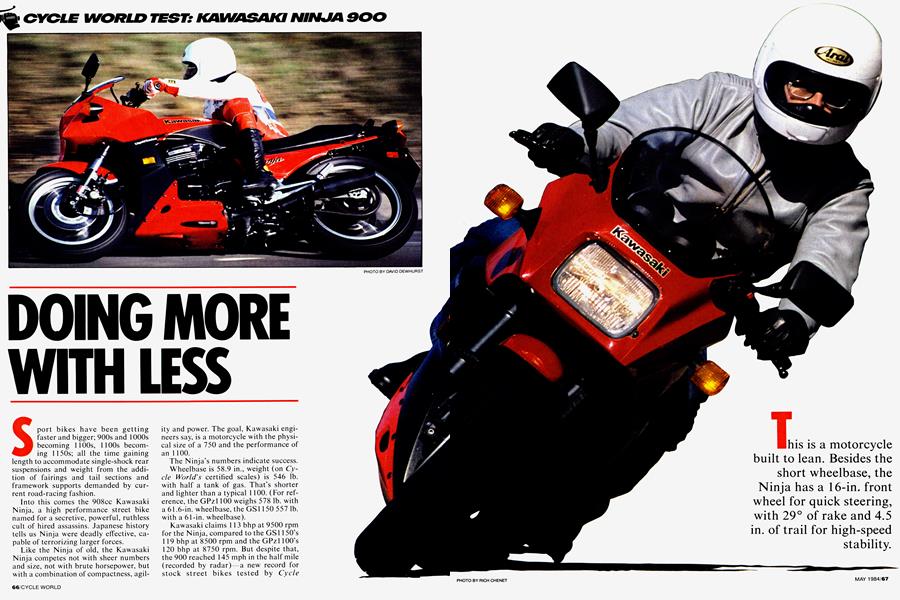
With good reason. The chassis says this is a motorcycle built to lean. Besides the short wheelbase, the Ninja has a 16in. front wheel for quick steering, with 29° of rake and 4.5 in. of trail for highspeed stability. The exhaust system can be tucked in so well because the engine is narrow and there aren't any frame tubes taking up space underneath the edges of the engine. The engine hangs from the multi-tube backbone, a stressed member of the chassis, the cylinder head bolting to two front mounts and the crankcases bolting to four rear mounts. Eliminating downtubes and engine cradle tubes not only makes room for the tucked-in exhaust but also allows the engine to be mounted lower without causing cornering clearance problems and saves, the engineers figure, about 1 1 lb. There isn't a handling penalty, and early computerized testing of prototypes built with and without downtubes showed that the extra tubes weren't needed. But for such a design to work, the engine must be very rigid. To add to the Ninja's engine rigidity, the head and base gaskets are both steel instead of the more common pape r / me t a 1 com posites.
The Ninja's main frame is constructed of round steel tubing and incorporates the steering head (with. tapered roller bearings), the inner swing arm supports, and the upper rear shock mount. The entire rear section of the frame is made of aluminum. Two cast aluminum plates, one on each side behind the engine, carry needle roller bearings to support the ends of the swing arm and also accept footpegs and muffler brackets. A rear subframe of square-section aluminum tubing bolts to the aluminum plates and the main frame backbone and carries the seat, side panels and tail section.
A steel bracket attaches to the front of the engine and supports the fairing, oil cooler and radiator.
The swing arm is an aluminum extrusion with Kawasaki's eccentric axle adjusters, carrying an MT 3.00 x 18 cast aluminum wheel shod with a Dunlop 1 30/80V-1 8 K727 tire. The swing arm is connected to the bottom of the single rear shock by an aluminum linkage system designed to make the suspension progressive; effective spring and damping rates rise as shock travel increases. The shock itself is air assisted and has adjustable rebound damping. An air fitting for changing pressure, which has about the same effect as increasing spring preload,and a knob for selecting one of four rebound damping settings are located on the frame, under the right side panel.
Like the rear shock, the Ninja's forks are air assisted, the legs linked above the lower triple clamp, with a single air fitting mounted on the right leg cap. Fork tube diameter is 38mm (the GFzl 100's tubes are 37mm) and the legs are spaced 0.4 in. farther apart than the GFzl 100's to accommodate the wide 1 20/80V-16 Dunlop FI7 front tire. (There's a little extra room left over for an even wider aftermarket tire mounted on the MT 2.50 x 16 cast wheel). There's a polished aluminum brace behind the forks, doubling as a fender mount. Forged aluminum handlebars wrap around the protruding tops of the fork tubes and bolt to the upper triple clamp.
But the biggest change to the forks is internal. The Ninja has the usual antidive system which increases compression damping when brake system pressure closes a valve and diverts fork oil through smaller damper orifices. The difference is a separate system (Kawasaki calls it AVDS, for Automatic Variable Damping System) for increasing compression damping, which works automatically and provides more damping as fork travel and the speed of fork compression increase. There's a spring-loaded valve on top of the damper rod in each fork; when about one third — depending upon the speed of compression of the 5.5 in. of fork travel is used, the main fork spring forces the valve shut. As the fork continues to compress, pressure increases inside the damper rod, underneath the valve, eventually building high enough to progressively force the valve open, allowing the fork to compress slowly. Spike loads created by big bumps in the roadway knock the spring-loaded valve off its seat and allow the forks to react.
Back to the anti-dive. As usual, there’s an adjustment knob on the bottom of each anti-dive fitting, with three positions, to select the degree of compression damping restriction produced. The Ninja's anti-dive, combined with the AVDS, has an immediate, dramatic effect when the brakes are applied. It is the most active anti-dive system we’ve seen on a street bike, and works better than even the system used on works Suzuki road racers.
There are two 10.9-in. brake discs on the front wheel and one 10.5-in. disc on the rear, with single-piston calipers and sintered metal pads all around. The discs are drilled in a new pattern to reduce the whirring noise produced by 1983 and earlier GFz models when the brakes are applied. And synthetic fibers built into the rubber hoses are designed to reduce the amount of line expansion and resultant loss of brake feel and power experienced with conventional rubber lines.
Shrouding chassis and engine is the racer-look, frame-mounted bodywork, bright red set olf by panels of dark metallic gray. There's an adaptation of a full fairing, hiding the radiator and exhaust head pipes and wrapping around the bottom of the engine but cut away to reveal the cylinder head, cylinders and crankcases. The front fender has the look of a GP bike's streamlining, without the clumsiness of many street-going interpretations of racebike lines, and the same goes for the gas tank. (The flush-top gas cap looks like the aircraft caps so popular on racers, but with a difference. The flipup T-handle of an aircraft part is there, but the cap doesn't lift off when the handle is turned. Instead, the cap is hinged with a key lock hidden by the flip-up piece.) The side panels tie in to the tank and sweep back into the flared tail section. The rear fender is an unobtrusive flat black, the pipes black chrome, the engine gloss black. The fork legs are metallic silver, the wheels gray with polished highlights. And the effect is stunning. The Ninja may well be the best looking racer-replica to date, and its hard-edged lines make the morerounded VF750F and F J 1 100 look slightly bulbous.
It isn't all show, this bodywork. The tail section, for example, hides a neat set of chromed, flip-up luggage hooks on each side of the passenger seat. The hooks are perfectly spaced for attaching bungee cords and lockup out of view when not in use. The lower fairing is lined; the inner pieces shield the rider from hot air coming off the radiator w hile ducts direct cool air toward the rider's legs. Despite the lining and ducting, our riders felt warm air reaching their legs during our testing, especially in city traffic. We tested during cool weather, and the heat was welcome. That may not be true in midsummer.
The upper fairing is also lined, and carries the Ninja’s forward-mounted mirrors and the instruments: a 13,000rpm electric tach redlined at 10,500, a slightly smaller diameter 160-mph speedometer with odometer and tripmeter. coolant temperature and gas gauges and indicator lights for turn signals, highbeam, neutral, oil pressure, sidestand use and headlight failure. There are two pushbuttons on the instrument console; one converts the tach to a voltmeter, the other resets the tripmeter.
The Ninja sends the coolant temperature gauge right to the edge of the normal range at the slightest traffic delay, and the whirring of the electric fan is a common sound riding around town and after the bike is parked and ignition shut off: This in 50° weather.
That gauge and fan behavior worried some riders, men who believe a normal gauge reading is with the needle centered. It may be, as Kawasaki representatives say, that the Ninja is just fine with the needle pegged, and that the gauge just happens to read that way: And we've seen this before, in the Yamaha Venture. But it's bad psychology at best. The smart thing would have been to design the gauge so the needle didn't approach the red zone unless the engine actually overheated.
The handlebar control pods are lightweight plastic, the right-hand pod carrying the starter button and engine kill
switch, the left-hand pod including signal selector, high-beam/low-beam switch, horn button and a ratcheting choke lever. There are hydraulic master cylinders on both bars, one for the front brakes and one for the clutch. An interesting touch is that the dogleg control levers are hollowed out at the ball ends.
Like the handlebars and hand controls, the footpegs and pedals are aluminum. The folding, spring-loaded pegs have rubber inserts. There's a replaceable acorn nut on the bottom of each peg, at the tip; the nut is positioned so it’s the first thing to drag in a corner, warning the rider that he's reaching the limits of available lean.
It takes plenty of lean to drag the indicator nuts. Next to touch is the side of the bottom fairing section as the footpegs fold up, but touching the fairing takes either a dip or bump in the middle of a peg-dragging corner or else a full-on banzai racing charge into a corner. The stands don't drag even as the fairing touches, and neither do the exhaust pipes.
The Ninja was introduced to the press at Laguna Seca, and we rode it there before our usual complete testing on the street and at the dragstrip. On hand at Laguna, besides a selection of Ninjas, were squads of Turbos and GPzl 100s for comparison. We'd ridden a Turbo and several GPzl 100s on the street and at other racetracks, and the opportunity to compare them to the Ninja made several things clear. The Ninja feels lower and lighter and is easier to turn, both in the parking lot and at speed, is more stable in turns and over bumps, and has far more cornering clearance than either the Turbo or GPzl 100, more, in fact, than anything we've tested in its class.
And there’s plenty of tire traction to match the clearance. The Japanesemade Dunlop FI 7 and K727 tires on our test bike outstuck the Michelins on the Turbo and the Dunlop Fl 1 and K1 27 on the GPzl 100, working extremely well on the racetrack at Laguna Seca and on the street.
Put two equal riders on the traek, one aboard a Turbo and one on a Ninja, and the Ninja pilot will go faster, w ith less effort. Add in a third rider of equal skill on a GPzl 100 and he’ll be left far behind.
Much of the credit for the Ninja's lack of wallow ing or pitching in even the fastest turns must go to the suspension, which is best described as sporting. The available adjustments may be useful for setting up the Ninja to suit a rider or a traek, but the range isn't wide enough to make the Ninja both a sporting rocket and a plush cruiser. Street comfort is sacrificed to the needs of speed. That isn't to say that the Ninja delivers the buckboard-ride of a 1970s Laverda; but nobody will mistake this for a Gold W ing over city-street frost heaves.
The seat isn't the most comfortable for long rides, and the bars, although nowhere as extreme as those on the 1983 GPz750, aren't exactly a touring bend. There's more effort than usual needed to turn and to hold open the Ninja's throttle, enough to make at least one rider's shoulder hurt after a 400-mile day.
The Ninja's brakes have excellent power, control and feedback. There isn't radical, instant dive when the rider puts on the brakes, the anti-dive and AVDS making a perceptible difference. (The best w ay to see just how much of a difference is to climb on a Ninja at rest, put on the rear brake and pump up and down on the handlebars. In mid-downstroke, grab the front brake and feel in amazement as the fork instantly stops moving downward.) The brakes did fade slightly after several hard laps around the fast Laguna circuit (so did the GPzl 100 and Turbo brakes) without becoming grubby or losing predictability: it just took more lever pressure to stop. The brakes never faded on the street, even during the hardest canyon runs.
Kawasaki engineers say their singlepiston calipers are as powerful as, and lighter than, the dual-piston calipers seen on competing brands. It took the Kawasaki 1 20 ft. to stop from 60 mph in our testing, not only outstopping the GS 1 1 50 ( 1 31 ft. ) and'the GPz 1 100 ( 1 24 feet ) but also requiring less distance than the VF750F Interceptor (125 ft.), the GPz750 (128 ft.) and the GS750 (134 ft.).
The Ninja is quicker at the drags than its fellow Kawasakis, turning the quarter mile in 11.18 sec. with a terminal speed of 121.65 mph. The 900 shines in midrange horsepower, making it easier to launch oil the line or to charge out of corners. Serious horsepower begins at 6000 rpm, but the Kawasaki offers very good performance for normal riding from 4000 rpm more than the GPzl 100 or 750 Turbo at that engine speed and can easily be ridden around town from 3000. The strong mid-range isn't made at the expense of high-rpm power: the Ninja explodes above 6000 and revs hard to and beyond the 10,500 rpm redline. It’s then, when the Ninja is being run hard, that the close-ratio transmission is most useful. There are no big gaps between gears, so keeping the Ninja on the power or maintaining rear wheel control while dow nshifting quickly is easy. In sixth gear at 60 mph, the engine turns 4100 rpm.
Even though the Kawasaki’s sixth gear isn't used to slow' down excessively the engine at highway speeds, that doesn't make the Ninja a gas hog. A brisk combination of city, country and freeway riding usually had the 900 traveling 170 miles before needing
reserved selected by an inconvenient lever that squeezes the rider’s fingers between it and the cam chain cover); that's about 43 mpg. Mostly highwmy riding even fast - spirited highw ay riding brought the mpg above 50. And on the Cycle World mileage loop at legal speeds, the Ninja returned 46 mpg.
The Ninja is smooth, as smooth as a bike with rubber engine mounts, the balancer eliminating vibration before it reaches the bars or pegs or mirrors. The mirrors might as well shake, though, for all the good they are in spotting suspicious four-wheelers coming up in the draft: the view is limited to the rider’s chest and sleeves and part of the adjacent lanes. To see what's directly behind, the rider must pull in his elbow and shift his body to one side.
So the Ninja has a good powerband and peak power, and a fantastic top speed. What it lacks is the effortless lunge from cruising speed seen in the GS 1 1 50 or V65. The Nin ja is, after all, a 900, not an 1 100, even if it is a fabulously fast and strong 900. Run the Kawasaki down a straight road side by side with a V65, and roll on the throttles from 60 mph with both bikes in top gear. The V65 pulls ahead and stays ahead until the Ninja reaches its best power zone at 6000 rpm, about 100 mph.
An 1100 pilot in such a situation should enjoy his advantage w hile it lasts, because once above 6000 rpm, the Kawasaki will blast past and disappear ahead, gaining more and more as the speeds increase. Add in a twist or a turn and the Ninja's advantage increases. Create any riding contest more complicated than a drag race, add in any competitive situation requiring more skill than twisting the throttle, and the Ninja is the superior piece.
$4399
Kawasaki Motors Corp.
KAWASAKI NINJA 900