The Thinking Man's Number One
The race goes to the swift, and the title to the consistent.
The race goes to the swift, and the title to the consistent.
AAfter 34 races won by 18 different riders on six makes of motorcycle using four types of engine, the Camel Pro/AMA Grand National Championship came down to math, grit and a sort of homemade luck.
Better still, the title was decided at the last race of the season and that final, also by luck and circumstance, distilled the season.
But first, the season. Although 18 different men won races during the year, there were four riders in practical contention. By order of national number, they were:
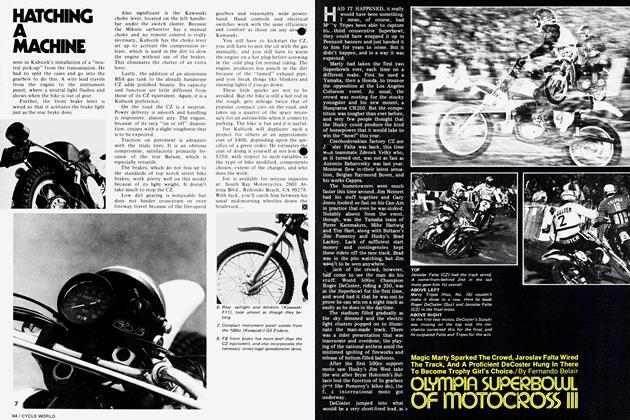
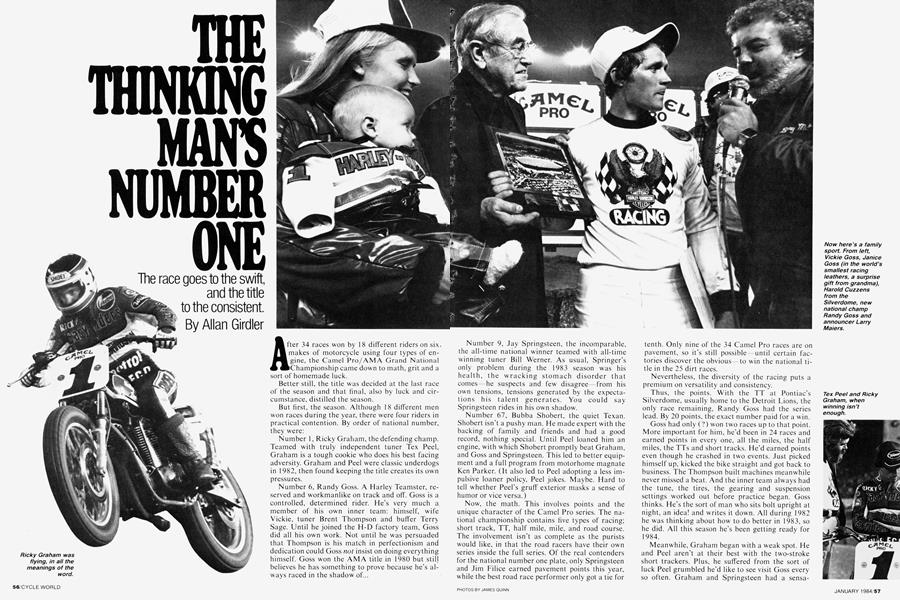
Number 1, Ricky Graham, the defending champ. Teamed with truly independent tuner Tex Peel, Graham is a tough cookie who does his best facing adversity. Graham and Peel were classic underdogs in 1982, then found keeping the title creates its own pressures.
Number 6, Randy Goss. A Harley Teamster, reserved and workmanlike on track and off. Goss is a controlled, determined rider. He’s very much a. member of his own inner team: himself, wife Vickie, tuner Brent Thompson and buffer Terry Sage. Until he joined the H-D factory team, Goss did all his own work. Not until he was persuaded that Thompson is his match in perfectionism and dedication could Goss not insist on doing everything himself. Goss won the AMA title in 1980 but still believes he has something to prove because he’s always raced in the shadow of...
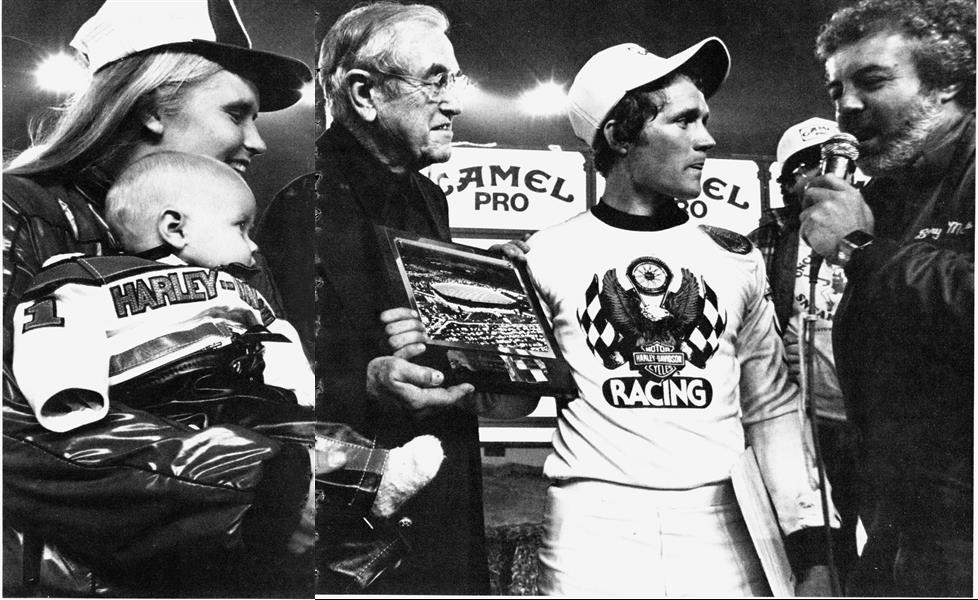 Now here’s a family sport. From left, Vickie Goss, Janice Goss (in the world’s smallest racing leathers, a surprise gift from grandma), Harold Cuzzens from the Silverdome, new national champ Randy Goss and announcer Larry Maiers.
Number 9, Jay Springsteen, the incomparable, the all-time national winner teamed with all-time winning tuner Bill Werner. As usual, Springer’s only problem during the 1983 season was his health, the wracking stomach disorder that comes he suspects and few disagree from his own tensions, tensions generated by the expectations his talent generates. You could say Springsteen rides in his own shadow.
Number 67, Bubba Shobert, the quiet Texan. Shobert isn't a pushy man. He made expert with the backing of family and friends and had a good record, nothing special. Until Peel loaned him an engine, with which Shobert promptly beat Graham, and Goss and Springsteen. This led to better equipment and a full program from motorhome magnate Ken Parker. (It also led to Peel adopting a less impulsive loaner policy, Peel jokes. Maybe. Hard to tell whether Peel’s gruff exterior masks a sense of humor or vice versa.)
Now, the math. This involves points and the unique character of the Camel Pro series. The national championship contains five types of racing; short track, TT, half mile, mile, and road course. The involvement isn’t as complete as the purists would like, in that the road racers have their own series inside the full series. Of the real contenders for the national number one plate, only Springsteen and Jim Filice earned pavement points this year, while the best road race performer only got a tie for tenth. Only nine of the 34 Camel Pro races are on pavement, so it’s still possible until certain factories discover the obvious to win the national title in the 25 dirt races.
Nevertheless, the diversity of the racing puts a premium on versatility and consistency.
Thus, the points. With the TT at Pontiac’s Silverdome, usually home to the Detroit Lions, the only race remaining, Randy Goss had the series lead. By 20 points, the exact number paid for a win.
Goss had only (?) won two races up to that point. More important for him, he’d been in 24 races and earned points in every one, all the miles, the half miles, the TTs and short tracks. He’d earned points even though he crashed in two events. Just picked himself up, kicked the bike straight and got back to business. The Thompson built machines meanwhile never missed a beat. And the inner team always had the tune, the tires, the gearing and suspension settings worked out before practice began. Goss thinks. He’s the sort of man who sits bolt upright at night, an idea! and writes it down. All during 1982 he was thinking about how to do better in 1983, so he did. All this season he’s been getting ready for 1984.

Meanwhile, Graham began with a weak spot. He and Peel aren't at their best with the two-stroke short trackers. Plus, he suffered from the sort of luck Peel grumbled he’d like to see visit Goss every so often. Graham and Springsteen had a sensational duel at the Sacramento mile, only to have Graham flagged off for leaking oil on the last lap. The bemused Springsteen lost his concentration and the canny Shobert whipped past for the win. Graham lost engines and he fell down, and he had a terrible eastern tour. Graham won four races. He was in the top three 13 times. But when he wasn’t near the top, he was nowhere. Graham, the defending national champion, came to Pontiac knowing that it wasn’t enough to win. Randy Goss had to not just lose, but be so far back he didn’t earn one point.
TOPTEN, 1983 CAMEL PRO/AMA GRAND NATIONAL CHAMPIONSHIP Rider Points Randy Goss 297 Ricky Graham 289 Jay Springsteen 272 Bubba Shobert 255 Scott Parker 209 Alex Jorgensen 161 Ted Boody 159 Jim Filice 149 Gary Scott 110 Steve Morehead/ 92 Mike Baldwin
Springer was even more of the same. He got off to a poor start, then did another “when he’s well he’s Hell” number with four straight half mile wins, and a TT, all punctuated by getting sick. And he lost two engines, something that just doesn't happen to Wernerbilts.
Shobert won three races, all miles. Shobert does his thinking during the race, so to speak, always ready to pass when it will work, hold back when it won’t. But he isn’t the best at any type of race and he doesn’t always have the fastest machine, so he didn’t gain points in the pack, and he didn’t sweep them from the top.
The Silverdome race had a few factors of its own.
First, the introduction of Harley’s 500-R. (Details in Race Watch.) Team Honda has been making steady progress. The NS750 won a mile, Hank Scott up. Mickey Fay took the Santa Fe TT with the Honda 500 Single, Terry Poovey and Doug Chandler won short tracks on the CR250-based Hondas and of course Mike Baldwin won the Formula One series. A bike for every occasion.
Harley had only the XR750 Twin for the middle ground, the Aermacchi-descended 250s for short track and the makeshift XR1000 for one road race only. Next year 500 four-strokes will be legal for short track. And indoor TTs, for which the XR750 is too big, are becoming more popular.
The Rotax-powered 500-R came just in time, literally a few days before Pontiac. The Silverdome isn’t often used for motorcycles. When the footballers are there the dirt track, well, the dirt itself, is stored outside. When they hauled it indoors, the stuff refused to pack down. More like glued gravel. The result was a tight track with ruts on the fast turns, whoops going into the tight turns and berms on the outside. The Harley riders had their choice, 750 Twin or 500 Single. It didn’t take two laps for the vote to be unanimous.
If the 500 hadn’t been ready, the last race would have been very different.
How rough was the track? Mike Kidd retires this year. Pontiac was supposed to be his last race. He crashed in practice and broke his collarbone. Just before the start the announcer asked if Kidd didn’t feel bad, sitting out his final event. Kidd laughed. The sidelines are the place to be, he said, a man could get hurt out there.
Or a man could be ready. The new Harley was an open secret. Randy Goss had already bought a CanAm trail bike, for practice.
But Tex Peel got a Rotax engine and a Knight TT frame. He got Ohlins shocks. Graham used to race motocross. He and Springsteen and Scott Parker have souped-up Yamaha YZs. For fun they race against each other in the Michigan woods. Peel tuned the engine and Graham got used to the bike. They were ready for Pontiac and Graham won his heat.
Springsteen got his 500 a week before the race. With the pressure off, Springsteen was unconcerned. He won his heat, then put on his serious face because his brother Chuck was trying to qualify for the national. He gave it a shot, but didn’t make it.
Goss made it, but not by much. Before the race it sounds so easy, earn one national point and get the title. But Camel Pro is the closest racing there is. When 18 riders can win a national and there’s room for only 15 riders in a national, just making the cut is tough.
Goss got stuck in the pack and fell and it looked hopeless. But wait, there are riders tumbling left and right, Goss zips through into third place and an automatic qualification for the national. Sure it was luck. Equally sure, he was ready when the luck went his way.
Shobert didn’t get the break. Never found his rhythm, he said later, and he didn’t qualify. Neither» did Filice or Terry Poovey.
Now, the race. Except there was no race. There was a demonstration, a rout. Graham looked cocky and his leg hurt, always two good signs. At the flag he charged to the front and began to pull away. Only Mickey Fay, best of the Honda team TT riders, and 'Scott Parker could keep Grahamin sight.
Graham is strong as a bull, his machine was ready. And he was mad, proud, determined. If he couldn’t keep the national championship by winning the race, he could at least win the race in a manner that left no doubt as to who goes fast.
This is hard to believe. This was the damndes^ Camel Pro race ever run. This was the first dirt track race that needed a lap chart.
Yeah, there are times when one man gains half a lap. There are races where the leader picks off a straggler.
But Graham began lapping the field. There were bikes breaking and riders falling. Graham kept charging, fighting the bars over the bumps, kicking through the ruts, head down, eyes blazing.
Springsteen? He got off slow, then began his run. He was going nearly as fast, passing left and right, then he dropped the bike in a hairpin. The engine stalled and the pack went by. He got going again, started passing again, dropped the bike again...and Graham passed him Jay Springsteen, lapped. As the poet says, you had to see it not to believe it.
Goss? He was doing the best he could do. It was1 obvious, he said later, that he couldn’t catch Graham, not on this track on this day. So he avoided the crashers. He was in 7th, the last man not lapped by Graham, when the checkered flag waved. He’d earned eight points and the national championship.
And then, after eight months of fierce competition, the racers thumped each other on the back and sprayed each other with champagne. Goss felt proud, Springer felt foolish and Graham felt better
One sour note. Some smart guy in the promoter’s office had scheduled a victory party. For $2, the fans could meet the stars and get autographs.
The riders had never heard of such a thing. Charge the fans? Never. When the party began, the riders were elsewhere.
Cut to Sunday afternoon and the amateur TT. Sitting in the cheap seats, cheering the kids oh minis and the old geezers on old Sportsters (True, I swear.) were Jay Springsteen and Jim Filice.
Signing autographs.
Free.